Natural Vegetation — Practice Quiz
ICSE · Class 12 · Geography
Try a 4-question quiz on Natural Vegetation for ICSE Class 12 Geography: tap an answer to check it and see why. 44 questions in the full chapter test.
Interactive on Super Tutor
Studying Natural Vegetation? Get the full interactive chapter.
Quizzes, flashcards, AI doubt-solver and a step-by-step study plan — built for practice quiz and more.
Free trial, no card needed.
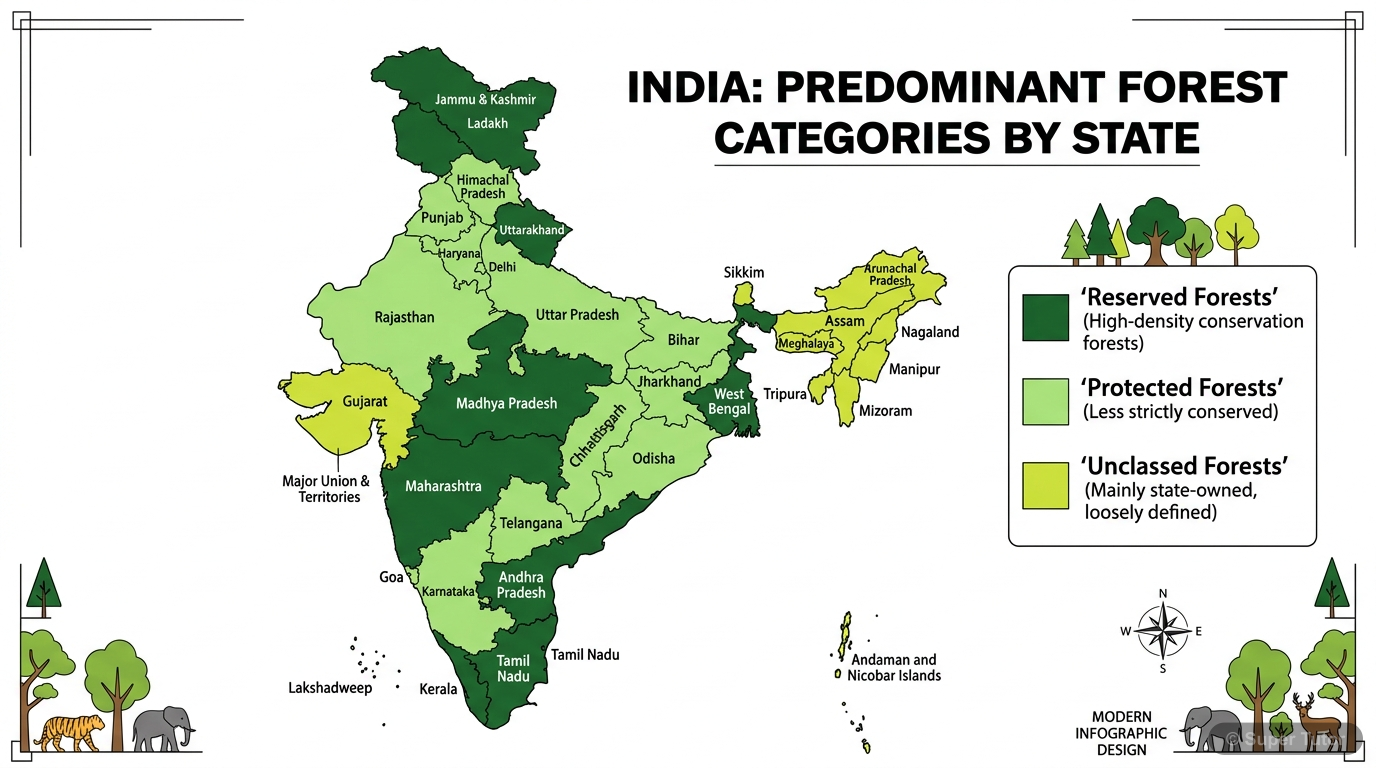
An illustration from Super Tutor's Natural Vegetation chapter — alongside flashcards, concept maps and practice questions.
Quick Quiz: Natural Vegetation
0/4Tap an answer to check it instantly. No sign-up needed for these 4.
Which type of forest is found in areas receiving annual rainfall above 200 cm with relative humidity more than 70%?
The Sundari tree, which gives the Sunderbans its name, is a characteristic species of which type of forest?
According to the chapter, what percentage of India's total geographical area is currently under forest cover?
Which state has the HIGHEST percentage of forest cover relative to its geographical area according to the data given in the chapter?
Sample Questions
The Chipko Movement was started in 1972 under the leadership of which environmental worker?
Show answer
Sunder Lal Bahuguna
Step 1: The Chipko Movement began in 1972 in the Garhwal region of Uttarakhand. Step 2: The movement was started under the leadership of Sh. Sunder Lal Bahuguna, a social and environmental worker. Step 3: Chandi Prasad Bhat is also credited along with Bahuguna for starting this movement. Step 4: The word 'Chipko' means 'to stick' — people hugged trees to prevent loggers from cutting them. Step 5: Medha Patkar is associated with the Narmada Bachao Andolan, not Chipko. Hence, Sunder Lal Bahuguna is correct.
Tropical Deciduous or Monsoon forests are found in areas receiving annual rainfall of:
Show answer
100 cm to 200 cm
Step 1: The chapter clearly describes the rainfall requirements for each forest type. Step 2: Tropical Evergreen = above 200 cm; Tropical Deciduous = 100-200 cm; Tropical Dry = 50-100 cm; Arid = less than 50 cm. Step 3: Deciduous forests are called so because they shed their leaves at the beginning of summer due to water shortage. Step 4: Important trees of deciduous forests include Sal, Teak, Shisham, Sandalwood, and Khair. Step 5: These are the most economically important forests in India and cover about 20% of India's forest area.
The term 'Social Forestry' was first used by which body in India?
Show answer
National Commission on Agriculture, 1976
Step 1: Social Forestry is a very important concept in forest conservation. Step 2: The term was first used by the National Commission on Agriculture in 1976. Step 3: It was introduced to describe tree-raising programmes that supply firewood, small timber, and minor forest produce to rural populations. Step 4: Social forestry is described as 'forestry of the people, by the people, and for the people.' Step 5: Its main aim is to reduce pressure on traditional forest areas by developing plantations of fuelwood, fodder, and grasses on barren and community lands.
Which of the following trees is characteristic of Arid forests found in Rajasthan and adjoining areas?
Show answer
Kikar, Babul and thorny bushes
Step 1: Arid forests are found in areas receiving less than 50 cm annual rainfall, mainly in Rajasthan, southwest Punjab, southwest Haryana, and parts of Gujarat. Step 2: The vegetation here is specially adapted to dry conditions — small size kikar, babul, and thorny bushes/shrubs are characteristic. Step 3: These plants have small leaves to reduce water loss, thick bark, and long thick roots to access underground water. Step 4: Deodar and Silver Fir belong to Himalayan mountainous forests; Mahogany and Ebony are tropical evergreen trees; Sal and Teak are deciduous forest trees. Step 5: The wo
+40 more questions on Natural Vegetation (ICSE Class 12 Geography)
Practise AllFrequently Asked Questions
What are the important topics in Natural Vegetation for ICSE Class 12 Geography?
How many practice questions are there for Natural Vegetation?
Sources & Official References
Content is aligned to the official syllabus. Refer to the board website for the latest curriculum.
More resources for Natural Vegetation
Important Questions
Exam-style questions with answers
Revision Notes
Key points for last-minute revision
Chapter Summary
Understand the chapter at a glance
Concept Maps
See how topics connect
Study Plan
Step-by-step plan for this chapter
Flashcards
Quick-fire cards for active recall
Syllabus
What topics to cover
For serious students
Get the full Natural Vegetation chapter — start free.
Quizzes, flashcards, an AI doubt solver and a study plan for ICSE Class 12 Geography. Free to start, no card needed.