DC Circuits and Measurements — Concept Maps
ICSE · Class 12 · Physics
4 concept maps of DC Circuits and Measurements for ICSE Class 12 Physics, each also written out as a text outline.
Interactive on Super Tutor
Studying DC Circuits and Measurements? Get the full interactive chapter.
Quizzes, flashcards, AI doubt-solver and a step-by-step study plan — built for concept maps and more.
Free trial, no card needed.
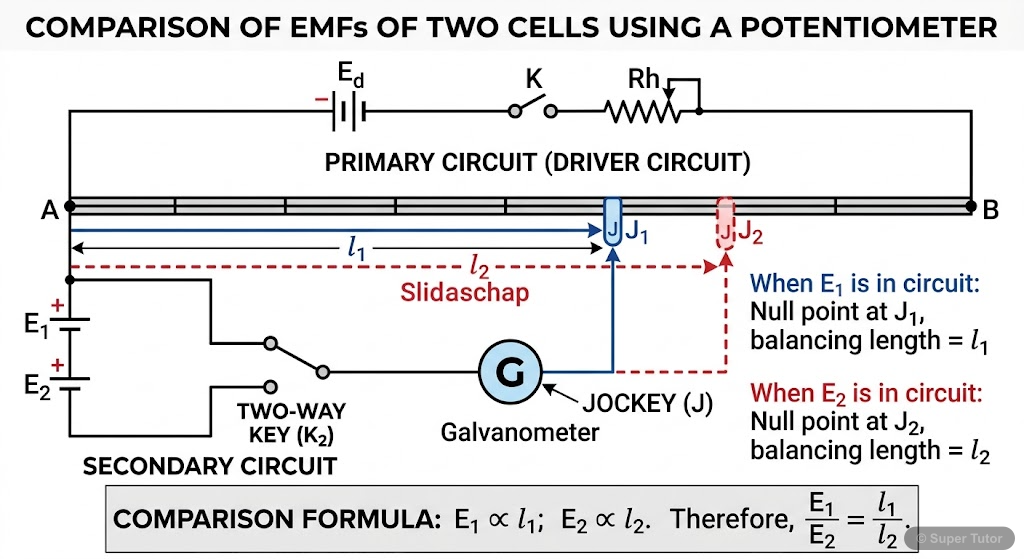
Learn better with visuals Super Tutor pairs illustrations like this with notes and quizzes for DC Circuits and Measurements.
DC Circuits and Measurements - Concept Overview
The map in words
- DC Circuits and Measurements
- Electric Cell
- EMF Definition
- Internal Resistance
- Terminal Voltage
- Cell Combinations
- Series Connection
- Parallel Connection
- Mixed Grouping
- Circuit Laws
- Kirchhoff First Law
- Kirchhoff Second Law
- Application Examples
- Measuring Devices
- Wheatstone Bridge
- Balance Condition
- Unknown Resistance
- Metre Bridge
- Null Point Method
- Slide Wire
- Potentiometer
- EMF Measurement
- Internal Resistance
- Comparison of EMFs
- Wheatstone Bridge
- Power and Energy
- Maximum Power Theorem
- Power Dissipation
- Efficiency
- Electric Cell
Flow diagram showing how chemical reactions in a cell produce electrical energy
The map in words
- Chemical Reaction
- Generates Ions: Ion Separation
- Charge Accumulation: Potential Difference
- Drives Current: Electrical Energy
- Charge Accumulation: Potential Difference
- Generates Ions: Ion Separation
Diagram showing charge movement and EMF action within a cell
The map in words
- EMF = W/q
- Defines: Inside Cell
- EMF does work: Charge Elevated to +ve Terminal
- Exits Cell: External Circuit
- Returns to -ve Terminal: Unit Positive Charge
- Exits Cell: External Circuit
- EMF does work: Charge Elevated to +ve Terminal
- Defines: Inside Cell
Electric current, emf, resistance, and measurement methods in DC circuits
The map in words
- Electric current, emf, resistance, and measurement methods in DC circuits
- Electric cell
- Electromotive force
- Terminal potential difference
- Internal resistance
- Kirchhoff's laws
- Combination of cells
- Series combination
- Parallel combination
Explore these maps interactively
Explore DiagramsFrequently Asked Questions
What are the important topics in DC Circuits and Measurements for ICSE Class 12 Physics?
What do the concept maps for DC Circuits and Measurements show?
How should I revise DC Circuits and Measurements for the ICSE Class 12 board exam?
Sources & Official References
Content is aligned to the official syllabus. Refer to the board website for the latest curriculum.
More resources for DC Circuits and Measurements
Practice Quiz
Test yourself with a quick quiz
Important Questions
Exam-style questions with answers
Revision Notes
Key points for last-minute revision
Formula Sheet
The chapter's formulas in one place
Chapter Summary
Understand the chapter at a glance
Study Plan
Step-by-step plan for this chapter
Flashcards
Quick-fire cards for active recall
Syllabus
What topics to cover
For serious students
Get the full DC Circuits and Measurements chapter — start free.
Quizzes, flashcards, an AI doubt solver and a study plan for ICSE Class 12 Physics. Free to start, no card needed.