DC Circuits and Measurements — Chapter Summary
ICSE · Class 12 · Physics
Summary of DC Circuits and Measurements for ICSE Class 12 Physics. Part of the ICSE Class 12 Physics syllabus.
Interactive on Super Tutor
Studying DC Circuits and Measurements? Get the full interactive chapter.
Quizzes, flashcards, AI doubt-solver and a step-by-step study plan — built for chapter summary and more.
Free trial, no card needed.
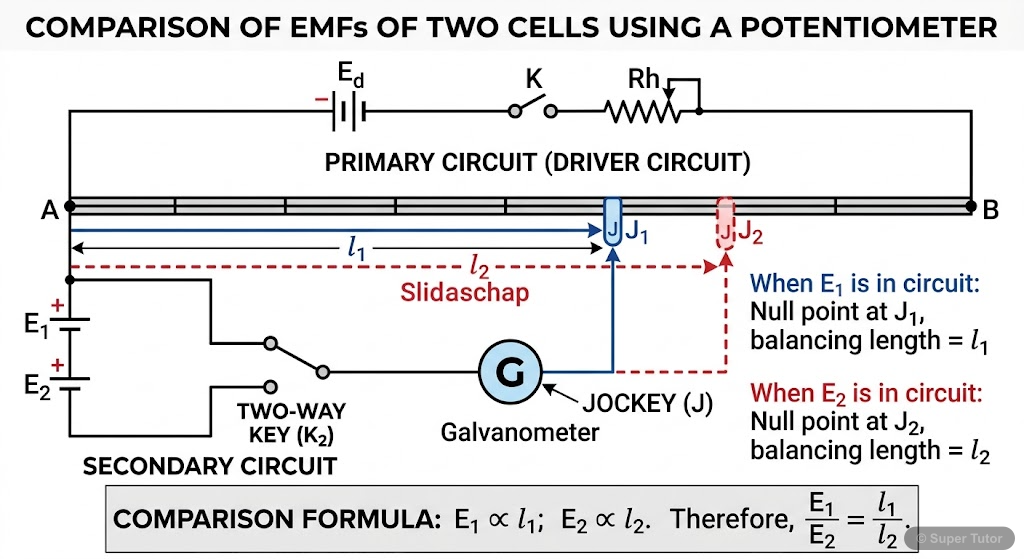
Learn better with visuals Super Tutor pairs illustrations like this with notes and quizzes for DC Circuits and Measurements.
Overview
Electric circuits use cells or batteries to maintain current flow, convert chemical energy into electrical energy, and transfer energy through resistors and measuring instruments. The central ideas of this chapter are emf, terminal potential difference, internal resistance, series and parallel combi
Key Concepts
An electric cell is a source
An electric cell is a source of electrical energy that maintains a continuous flow of charge in a circuit. It consists of two electrodes immersed in a
The emf of a cell
The emf of a cell is the work done by the cell in forcing unit positive charge round the whole circuit including the cell. Its formula is E = dW/dq an
Terminal potential difference is the work
Terminal potential difference is the work done for the flow of unit charge in the external circuit only. It is measured by a voltmeter and is given by
Internal resistance is the resistance offered
Internal resistance is the resistance offered by the electrolyte of a cell to the flow of ions. It depends on plate separation, plate area, nature of
For a discharging cell
For a discharging cell, E = V + Ir and V = E - Ir. For charging, V = E + Ir. On open circuit, V = E.
Learning Objectives
- Understand the meaning of emf, terminal potential difference, and internal resistance
- Use the relation E = V + Ir and related circuit formulas in numerical problems
- Analyze series, parallel, and mixed combinations of cells
- Apply Kirchhoff's laws to find currents in complex circuits
- Use Wheatstone bridge and metre bridge principles to determine unknown resistance
Frequently Asked Questions
What are the important topics in DC Circuits and Measurements for ICSE Class 12 Physics?
How should I revise DC Circuits and Measurements for the ICSE Class 12 board exam?
Sources & Official References
Content is aligned to the official syllabus. Refer to the board website for the latest curriculum.
More resources for DC Circuits and Measurements
Practice Quiz
Test yourself with a quick quiz
Important Questions
Exam-style questions with answers
Revision Notes
Key points for last-minute revision
Formula Sheet
The chapter's formulas in one place
Concept Maps
See how topics connect
Study Plan
Step-by-step plan for this chapter
Flashcards
Quick-fire cards for active recall
Syllabus
What topics to cover
For serious students
Get the full DC Circuits and Measurements chapter — start free.
Quizzes, flashcards, an AI doubt solver and a study plan for ICSE Class 12 Physics. Free to start, no card needed.