DC Circuits and Measurements — Practice Quiz
ICSE · Class 12 · Physics
Try a 4-question quiz on DC Circuits and Measurements for ICSE Class 12 Physics: tap an answer to check it and see why.
Interactive on Super Tutor
Studying DC Circuits and Measurements? Get the full interactive chapter.
Quizzes, flashcards, AI doubt-solver and a step-by-step study plan — built for practice quiz and more.
Free trial, no card needed.
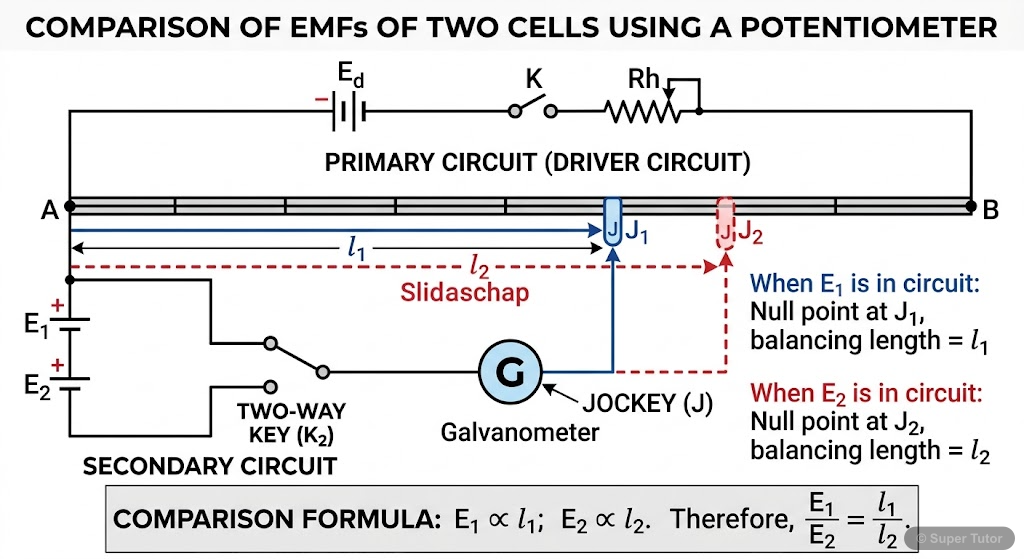
Learn better with visuals Super Tutor pairs illustrations like this with notes and quizzes for DC Circuits and Measurements.
Quick Quiz: DC Circuits and Measurements
0/4Tap an answer to check it instantly. No sign-up needed for these 4.
A cell of EMF 2 V and internal resistance 0.5 Ω is connected to a resistance R. The power delivered to R is maximum when R equals:
In a Wheatstone bridge, P = 100 Ω, Q = 10 Ω, R = 40 Ω, and the bridge is balanced. What is the value of S?
A battery of EMF 12 V and internal resistance 2 Ω is connected to two resistors of 6 Ω and 4 Ω in series. What is the terminal voltage of the battery?
In a potentiometer experiment, a standard cell of EMF 1.02 V gives a null point at 68 cm. An unknown cell gives a null point at 51 cm. What is the EMF of the unknown cell?
Sample Questions
n identical cells, each of EMF E and internal resistance r, are connected in parallel and supply current to an external resistance R. The current through R is maximum when:
Show answer
r >> R
Step 1: For n cells in parallel, I = nE/(r + nR). Step 2: If r >> R, then nR can be neglected: I ≈ nE/r. This is n times the current from a single cell — maximum benefit. Step 3: If r << R, then I ≈ nE/nR = E/R — same as a single cell, no benefit from parallel combination. Step 4: The parallel combination reduces equivalent internal resistance to r/n, which is most beneficial when this reduction matters — i.e., when r is large compared to R. Step 5: Parallel combination is useful for high internal resistance cells with small external load.
A metre bridge shows null deflection at 40 cm when an unknown resistance X is in one gap and a 6 Ω resistance in the other. If X and the 6 Ω are interchanged, the new null point is at:
Show answer
60 cm
Step 1: Original condition: X/6 = l/(100−l) = 40/60 = 2/3, so X = 4 Ω. Step 2: After interchanging, the 6 Ω is in the left gap and X (= 4 Ω) is in the right gap. Step 3: New balance condition: 6/4 = l′/(100−l′). Step 4: 6(100−l′) = 4l′ → 600 = 10l′ → l′ = 60 cm. Step 5: Note: when X and known resistance are interchanged, the new null point is at (100 − old null point) ONLY when X = known resistance. Here they differ, so we must calculate properly.
A cell is being charged by an external source. If the EMF of the cell is 6 V, internal resistance is 1 Ω, and the charging current is 2 A, what is the terminal voltage of the cell during charging?
Show answer
8 V
Step 1: During charging, current is forced into the cell against its EMF (from + to − inside the cell). Step 2: The terminal voltage during charging is V = E + Ir (not E − Ir). Step 3: V = 6 + (2)(1) = 8 V. Step 4: This is higher than the EMF because the external source must overcome both the cell's EMF and its internal resistance. Step 5: During discharging V = E − Ir (terminal voltage is less than EMF). This distinction is critical — the sign of Ir reverses depending on whether cell is charging or discharging.
In a circuit, two cells of EMF 4 V (internal resistance 1 Ω) and 2 V (internal resistance 1 Ω) are connected in series opposing each other (positive terminals facing each other) and drive current through a 4 Ω external resistance. What is the current in the circuit?
Show answer
0.33 A
Step 1: When two cells oppose each other in series, net EMF = E₁ − E₂ = 4 − 2 = 2 V. Step 2: Total internal resistance = r₁ + r₂ = 1 + 1 = 2 Ω (internal resistances always add in series regardless of cell orientation). Step 3: Total resistance = 2 + 4 = 6 Ω. Step 4: Current I = Net EMF / Total resistance = 2/6 = 1/3 ≈ 0.33 A. Step 5: Current flows in the direction of the stronger cell (4 V cell). The 2 V cell is being charged in this arrangement.
+38 more questions on DC Circuits and Measurements (ICSE Class 12 Physics)
Practise AllFrequently Asked Questions
What are the important topics in DC Circuits and Measurements for ICSE Class 12 Physics?
How many practice questions are there for DC Circuits and Measurements?
Sources & Official References
Content is aligned to the official syllabus. Refer to the board website for the latest curriculum.
More resources for DC Circuits and Measurements
Important Questions
Exam-style questions with answers
Revision Notes
Key points for last-minute revision
Formula Sheet
The chapter's formulas in one place
Chapter Summary
Understand the chapter at a glance
Concept Maps
See how topics connect
Study Plan
Step-by-step plan for this chapter
Flashcards
Quick-fire cards for active recall
Syllabus
What topics to cover
For serious students
Get the full DC Circuits and Measurements chapter — start free.
Quizzes, flashcards, an AI doubt solver and a study plan for ICSE Class 12 Physics. Free to start, no card needed.