Franchise and Representation — Practice Quiz
ICSE · Class 12 · Political Science
Try a 4-question quiz on Franchise and Representation for ICSE Class 12 Political Science: tap an answer to check it and see why.
Interactive on Super Tutor
Studying Franchise and Representation? Get the full interactive chapter.
Quizzes, flashcards, AI doubt-solver and a step-by-step study plan — built for practice quiz and more.
Free trial, no card needed.
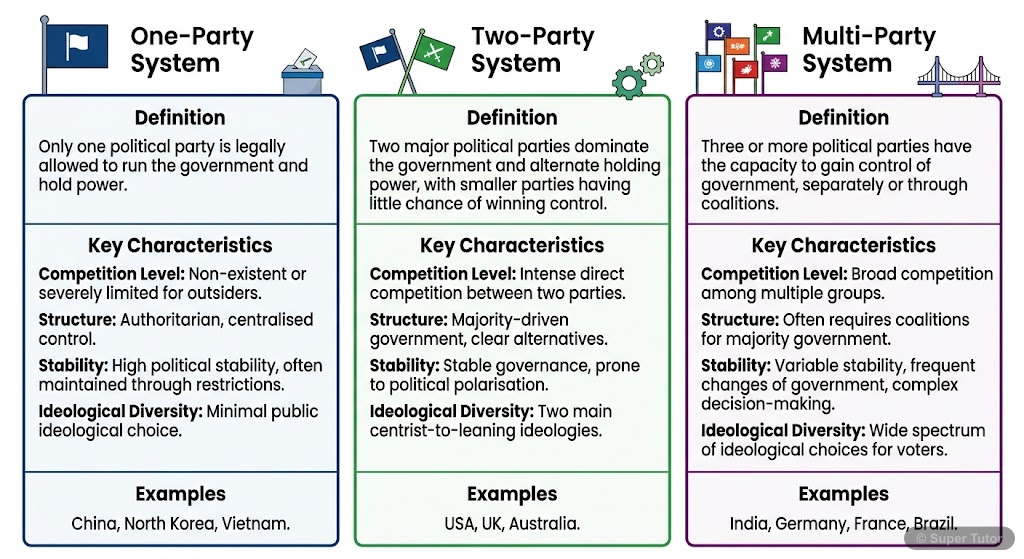
An illustration from Super Tutor's Franchise and Representation chapter — alongside flashcards, concept maps and practice questions.
Quick Quiz: Franchise and Representation
0/4Tap an answer to check it instantly. No sign-up needed for these 4.
What is the minimum voting age in India?
Which principle does Universal Adult Franchise represent?
In which country is voting compulsory by law?
Which philosopher proposed that sovereignty resides in the people?
Sample Questions
Who defined a political party as 'a body of men united for promoting the national interest on some particular principles in which they are all agreed'?
Show answer
Edmund Burke
Edmund Burke, the famous English political thinker, defined a political party as 'a body of men united for promoting the national interest on some particular principles in which they are all agreed.' Disraeli defined a political party as 'a group of men banded together to pursue certain principles.' Michael Curtis acknowledged that it is difficult to define a political party accurately. Laski praised the bi-party system. Burke's definition emphasises principles and national interest as the basis of a party.
In the First-Past-the-Post (FPTP) system, who is declared the winner?
Show answer
The candidate who gets the largest number of votes
In the First-Past-the-Post (FPTP) system, also called the plurality or majority vote system, the candidate who secures the largest number of votes is declared elected, regardless of whether they cross 50% of the total votes. For example, if A gets 450 votes, B gets 425 votes, C gets 280 votes, and D gets 120 votes out of 1275, A wins even though they don't have an absolute majority. This is the system used in India for electing members of the Lok Sabha. The main criticism is that a minority of voters can elect a winner.
Which of the following is a key feature of the Proportional Representation system?
Show answer
Multi-member constituency with quota-based election
Proportional Representation (PR) has three key features: (i) there must be a multi-member constituency, (ii) a candidate is elected not by gaining an absolute or relative majority but by obtaining a quota (total votes divided by number of seats), and (iii) it aims for mathematically exact representation of the electorate in the legislature. This system ensures that votes are 'weighed, not counted', giving fair representation to all groups. Single-member constituency is a feature of the FPTP system, not PR.
Which country is a classic example of the Bi-Party system?
Show answer
Britain
Britain is a classic example of the Bi-Party system where power alternates between two major parties — the Conservative Party and the Labour Party. India is an example of a Multi-Party system where many parties share power, often through coalition governments. France and Germany are also examples of Multi-Party systems. In the USA, the Democratic and Republican parties dominate, making it another example of the Bi-Party system. In Britain, minor parties like the Liberals and Communists exist but have little significance in the struggle for power.
+41 more questions on Franchise and Representation (ICSE Class 12 Political Science)
Practise AllFrequently Asked Questions
What are the important topics in Franchise and Representation for ICSE Class 12 Political Science?
How many practice questions are there for Franchise and Representation?
Sources & Official References
Content is aligned to the official syllabus. Refer to the board website for the latest curriculum.
More resources for Franchise and Representation
Important Questions
Exam-style questions with answers
Revision Notes
Key points for last-minute revision
Chapter Summary
Understand the chapter at a glance
Concept Maps
See how topics connect
Study Plan
Step-by-step plan for this chapter
Flashcards
Quick-fire cards for active recall
Syllabus
What topics to cover
For serious students
Get the full Franchise and Representation chapter — start free.
Quizzes, flashcards, an AI doubt solver and a study plan for ICSE Class 12 Political Science. Free to start, no card needed.