Stress and Stress Management — Chapter Summary
ICSE · Class 12 · Psychology
Summary of Stress and Stress Management for ICSE Class 12 Psychology. Part of the ICSE Class 12 Psychology syllabus.
Interactive on Super Tutor
Studying Stress and Stress Management? Get the full interactive chapter.
Quizzes, flashcards, AI doubt-solver and a step-by-step study plan — built for chapter summary and more.
Free trial, no card needed.
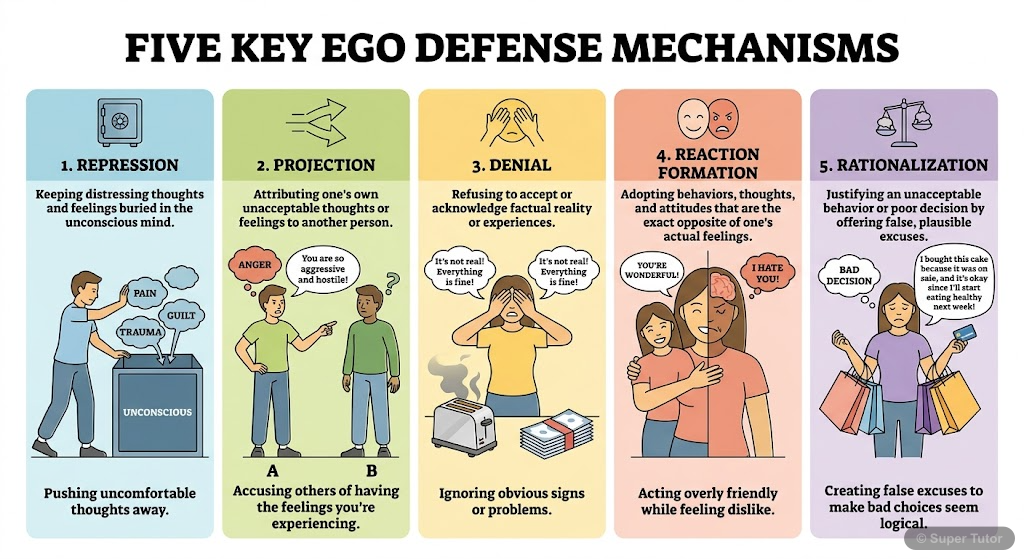
One of 8 illustrations for Stress and Stress Management in Super Tutor — alongside flashcards, concept maps and practice questions.
Overview
Stress is a mind-body reaction to a real or imagined demand. The word comes from the Latin word stringere, meaning to draw out tight. Stress becomes important in psychology because it affects health, emotions, and performance. It can be helpful at a certain level, called eustress, or harmful when it
Key Concepts
Stress is the non
Stress is the non-specific response of the body to any demand for change. It is a reaction of both mind and body when environmental demands feel great
Eustress is the optimal and beneficial
Eustress is the optimal and beneficial level of stress. It can improve energy, motivation, and performance.
Distress is harmful stress that reduces
Distress is harmful stress that reduces productivity, creativity, and well-being. It needs to be controlled.
Neustress is neutral stress that has
Neustress is neutral stress that has no effect on the individual.
Hans Selye proposed three stages
Hans Selye proposed three stages of stress response: alarm, resistance, and exhaustion. In the alarm stage, the body prepares for action. In the resis
Learning Objectives
- Understand the meaning and basic nature of stress
- Distinguish between eustress, distress, and neustress
- Learn the main models of stress: General Adaptation Syndrome and Cognitive Appraisal Model
- Identify external and internal causes of stress
- Explain how stress affects health, immunity, and performance
Frequently Asked Questions
What are the important topics in Stress and Stress Management for ICSE Class 12 Psychology?
How should I revise Stress and Stress Management for the ICSE Class 12 board exam?
Sources & Official References
Content is aligned to the official syllabus. Refer to the board website for the latest curriculum.
More resources for Stress and Stress Management
For serious students
Get the full Stress and Stress Management chapter — start free.
Quizzes, flashcards, an AI doubt solver and a study plan for ICSE Class 12 Psychology. Free to start, no card needed.