Stress and Stress Management — Syllabus
ICSE · Class 12 · Psychology
What Stress and Stress Management covers in ICSE Class 12 Psychology: 4 topics, for the 2026-27 session. Part of the ICSE Class 12 Psychology syllabus.
Interactive on Super Tutor
Studying Stress and Stress Management? Get the full interactive chapter.
Quizzes, flashcards, AI doubt-solver and a step-by-step study plan — built for syllabus and more.
Free trial, no card needed.
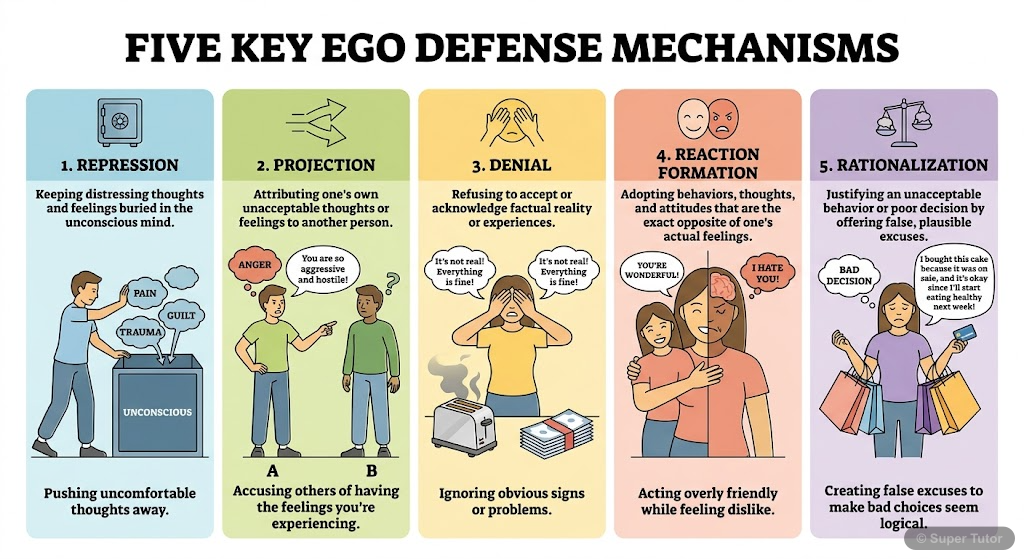
One of 8 illustrations for Stress and Stress Management in Super Tutor — alongside flashcards, concept maps and practice questions.
Topics in Stress and Stress Management
Meaning of Stress
- The word stress is derived from the Latin word stringere, meaning to draw out tight.
- Hans Selye used the term stress in 1936 and defined it as the non-specific response of the body to any demand for change.
- Stress is a process in which a person faces a demand, judges personal ability, responds physically and psychologically, and then performance may improve or decline.
Stress Models
- Hans Selye proposed the General Adaptation Syndrome, or GAS, with three stages: alarm, resistance, and exhaustion.
- In the alarm stage, the sympathetic nervous system becomes active and prepares the body for action.
- In the resistance stage, the body tries to cope with the stressor and maintain normality.
Causes of Stress
- Stressors are classified into physiological, environmental, social, and psychological groups.
- Physiological stressors include excessive exercise, lack of rest and sleep, chronic pain, physical injury, and disease.
- Environmental stressors include pollution, excessive humidity, extreme temperature, lack of proper illumination, radioactive substances, crowding, isolation, and excessive noise.
Effects of Stress on Health
- Stress disturbs homeostasis and affects both mind and body.
- During stress, sympathetic nervous system activity outpaces parasympathetic nervous system activity, so stress continues.
- Stress is estimated as one of the major reasons for almost 50-70% of life-threatening ailments like ulcers, cardiac diseases, and diabetes.
Key Concepts
Central concept: Stress and stress management as a process, its causes, effects, and coping methods
Work through every topic in Stress and Stress Management with notes and quizzes
Start This ChapterFrequently Asked Questions
What are the important topics in Stress and Stress Management for ICSE Class 12 Psychology?
How should I revise Stress and Stress Management for the ICSE Class 12 board exam?
Sources & Official References
Content is aligned to the official syllabus. Refer to the board website for the latest curriculum.
More resources for Stress and Stress Management
Practice Quiz
Test yourself with a quick quiz
Important Questions
Exam-style questions with answers
Revision Notes
Key points for last-minute revision
Chapter Summary
Understand the chapter at a glance
Concept Maps
See how topics connect
Study Plan
Step-by-step plan for this chapter
Flashcards
Quick-fire cards for active recall
For serious students
Get the full Stress and Stress Management chapter — start free.
Quizzes, flashcards, an AI doubt solver and a study plan for ICSE Class 12 Psychology. Free to start, no card needed.