Minerals — Practice Quiz
ICSE · Class 6 · Geography
Try a 4-question quiz on Minerals for ICSE Class 6 Geography: tap an answer to check it and see why. 89 questions in the full chapter test.
Interactive on Super Tutor
Studying Minerals? Get the full interactive chapter.
Quizzes, flashcards, AI doubt-solver and a step-by-step study plan — built for practice quiz and more.
Free trial, no card needed.
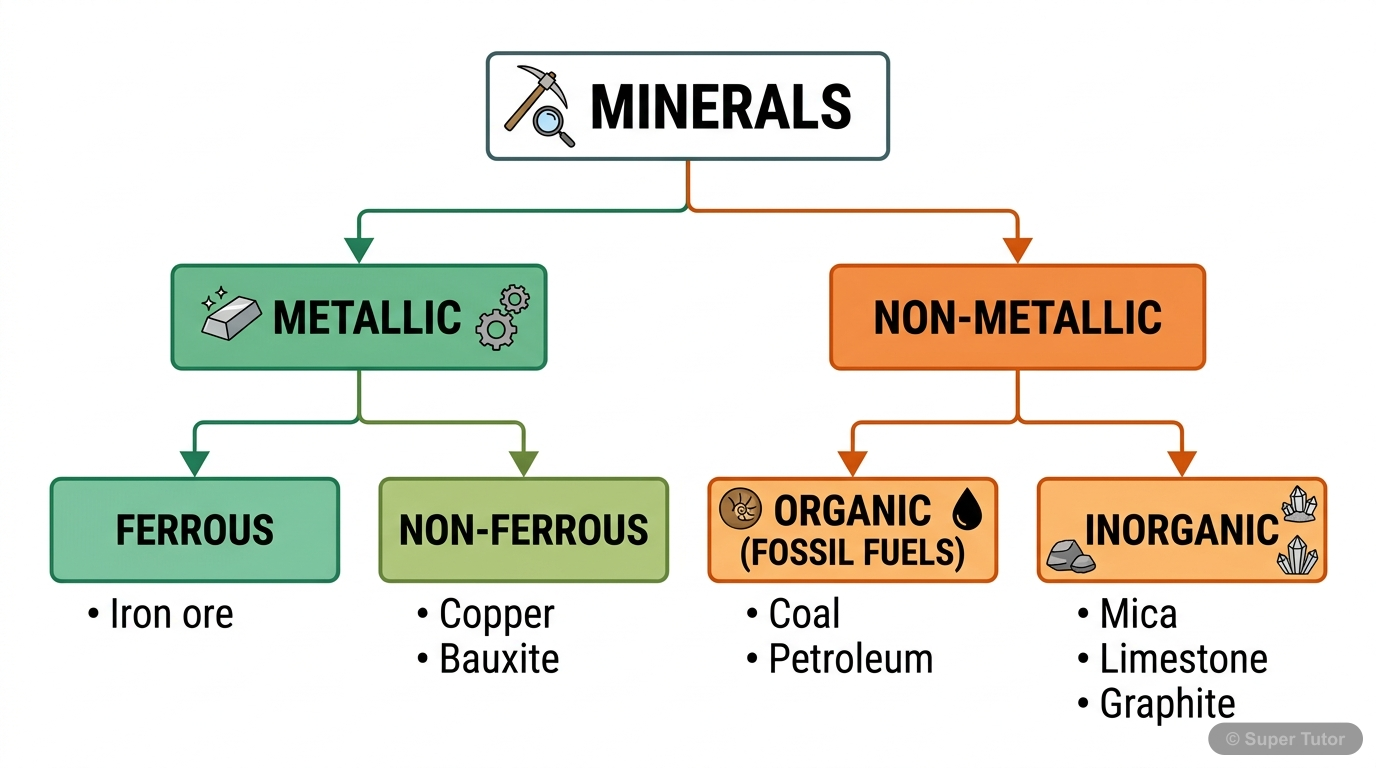
One of 10 illustrations for Minerals in Super Tutor — alongside flashcards, concept maps and practice questions.
Quick Quiz: Minerals
0/4Tap an answer to check it instantly. No sign-up needed for these 4.
Which of the following is the correct definition of a mineral?
Which variety of iron ore contains the highest percentage of pure iron?
Which state is the largest producer of iron ore in India?
Bauxite is the ore from which metal is extracted?
Sample Questions
Which of the following is a non-metallic mineral?
Show answer
Mica
Step 1: Minerals are classified into two types — metallic and non-metallic. Step 2: Metallic minerals contain metals in their composition. Copper, Gold, and Manganese are all metallic minerals because they contain metals. Step 3: Non-metallic minerals do not contain extractable metals. They are usually dull, light, and brittle. Step 4: Mica is a non-metallic mineral found in sedimentary rocks. It is brittle and used as an electrical insulator. Step 5: Therefore, Mica is the correct answer as it is a non-metallic mineral.
Which country is the largest producer of manganese in the world?
Show answer
South Africa
Step 1: Manganese is an important metallic mineral used mainly in making iron and steel. Step 2: India ranks third in the world in manganese production. Step 3: Other countries that produce manganese include China, Australia, Brazil, and Malaysia. Step 4: However, the largest producer of manganese in the world is South Africa. Step 5: USA and Germany are not among the leading producers of manganese. So South Africa is the correct answer.
Uranium is mainly used for which of the following purposes?
Show answer
Nuclear defence systems and nuclear generation of electricity
Step 1: Uranium is a radioactive metallic mineral, which means it releases energy from its atoms. Step 2: Because of its radioactive nature, uranium is used in nuclear defence systems (weapons and military). Step 3: It is also used in nuclear power plants to generate electricity — this is called nuclear energy. Step 4: It is additionally used in nuclear medicine, X-ray machines, and electronic instruments. Step 5: Making jewellery and coins is the use of gold, electrical wires use copper, and cement uses limestone — none of these are uses of uranium.
Which of the following is an example of surface mining?
Show answer
Open pit mining
Step 1: Mining is the extraction of valuable minerals from the Earth. It is broadly divided into surface mining and underground (subsurface) mining. Step 2: Surface mining extracts minerals that are near the surface of the Earth. Step 3: The three common types of surface mining are — Open pit mining, Strip mining, and Quarrying. Step 4: Open pit mining involves digging large holes or pits in the ground to extract ores and rocks near the surface. Step 5: Shaft mining and underground tunnelling are types of subsurface/underground mining. Drilling is used to access oil and natural gas. So Open pi
+85 more questions on Minerals (ICSE Class 6 Geography)
Practise AllFrequently Asked Questions
What are the important topics in Minerals for ICSE Class 6 Geography?
How many practice questions are there for Minerals?
Sources & Official References
Content is aligned to the official syllabus. Refer to the board website for the latest curriculum.
More resources for Minerals
Important Questions
Exam-style questions with answers
Revision Notes
Key points for last-minute revision
Chapter Summary
Understand the chapter at a glance
Concept Maps
See how topics connect
Study Plan
Step-by-step plan for this chapter
Flashcards
Quick-fire cards for active recall
Syllabus
What topics to cover
For serious students
Get the full Minerals chapter — start free.
Quizzes, flashcards, an AI doubt solver and a study plan for ICSE Class 6 Geography. Free to start, no card needed.