Minerals — Chapter Summary
ICSE · Class 6 · Geography
Summary of Minerals for ICSE Class 6 Geography. Key concepts: A mineral is a natural, Minerals are of two types and Different minerals are found.
Interactive on Super Tutor
Studying Minerals? Get the full interactive chapter.
Quizzes, flashcards, AI doubt-solver and a step-by-step study plan — built for chapter summary and more.
Free trial, no card needed.
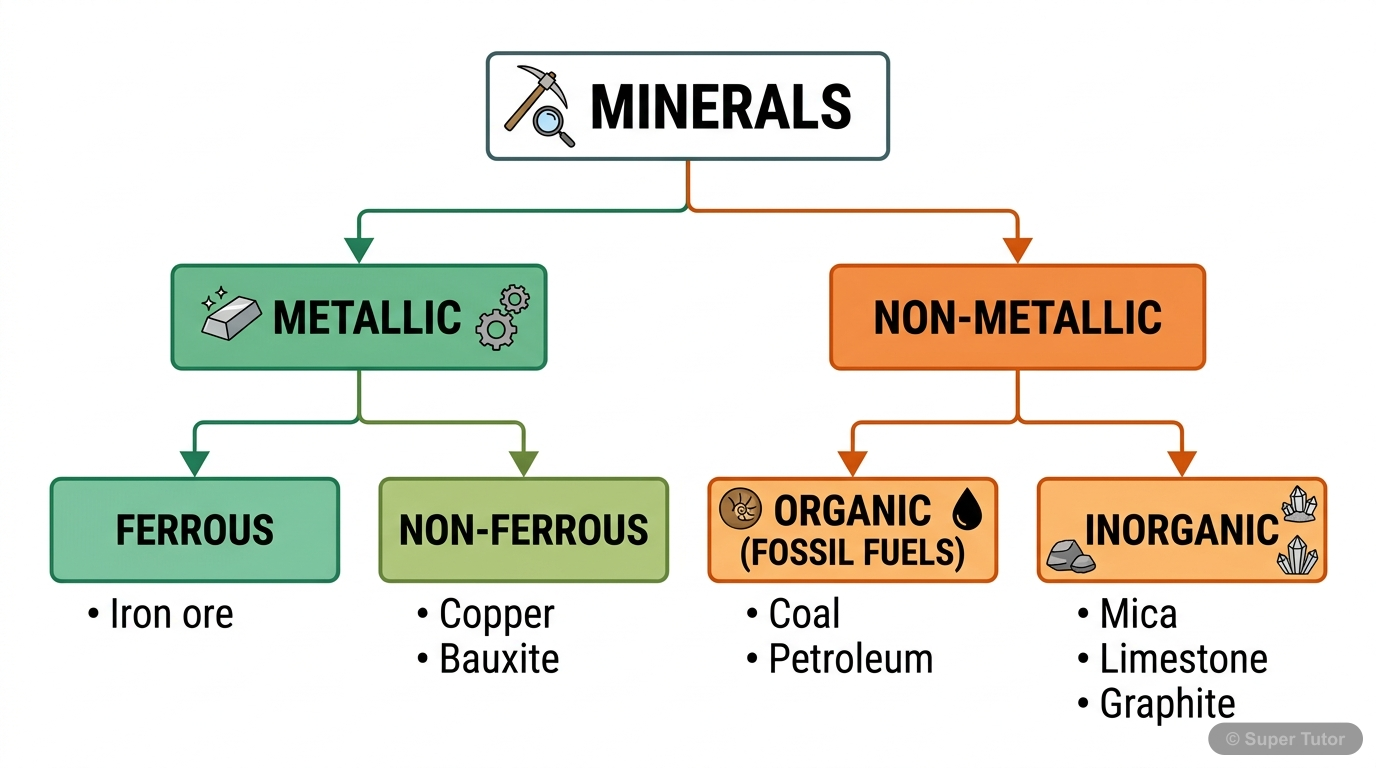
One of 10 illustrations for Minerals in Super Tutor — alongside flashcards, concept maps and practice questions.
Overview
Minerals are naturally occurring substances found in the Earth's crust. They are essential for our daily lives and are used in everything from building houses to making electronic devices. Some minerals are metals like iron and copper, while others are non-metals like coal and limestone. These resou
Key Concepts
A mineral is a natural substance
A mineral is a natural substance made of one or more elements. An ore is a mineral from which metals can be extracted profitably. For example, bauxite
Minerals are of two types
Minerals are of two types: metallic (like iron, copper, gold) and non-metallic (like limestone, mica, coal). Metallic minerals are shiny, hard, and co
Different minerals are found in different
Different minerals are found in different parts of India and the world. For example, Odisha produces the most iron ore in India, while South Africa is
Mining is the process of extracting
Mining is the process of extracting minerals from the Earth. There are two main types: surface mining (like open-pit and strip mining) and underground
Minerals take millions of years
Minerals take millions of years to form, so they are non-renewable. We must conserve them by recycling, using substitutes, and using modern technology
Learning Objectives
- Differentiate between metallic and non-metallic minerals
- Understand the uses of various minerals in daily life
- Locate major mineral-producing regions in India and the world
- Learn about different types of mining
- Appreciate the need to conserve mineral resources
Frequently Asked Questions
What are the important topics in Minerals for ICSE Class 6 Geography?
How should I revise Minerals for Class 6 exams?
Sources & Official References
Content is aligned to the official syllabus. Refer to the board website for the latest curriculum.
More resources for Minerals
For serious students
Get the full Minerals chapter — start free.
Quizzes, flashcards, an AI doubt solver and a study plan for ICSE Class 6 Geography. Free to start, no card needed.