Minerals — Flashcards
ICSE · Class 6 · Geography
30 flashcards for Minerals (ICSE Class 6 Geography) to test yourself on key terms and facts. Sample: "What are minerals?"
Interactive on Super Tutor
Studying Minerals? Get the full interactive chapter.
Quizzes, flashcards, AI doubt-solver and a step-by-step study plan — built for flashcards and more.
Free trial, no card needed.
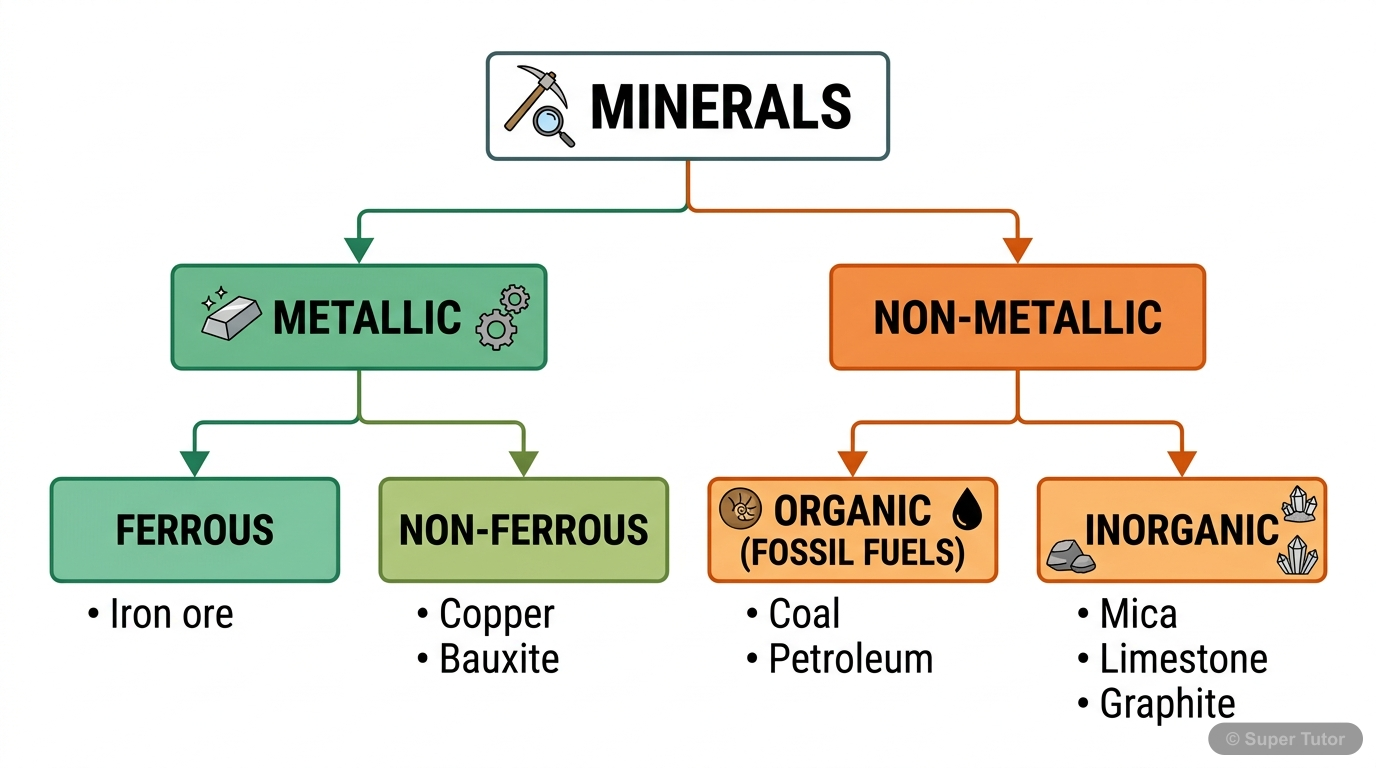
One of 10 illustrations for Minerals in Super Tutor — alongside flashcards, concept maps and practice questions.
What are minerals?
Answer
Minerals are naturally occurring substances found in the Earth's crust. They have a definite chemical composition and are formed by inorganic processes. Examples include iron ore, copper, and limeston…
What is the difference between a mineral and an ore?
Answer
A mineral is a naturally occurring substance with a definite chemical composition. An ore is a mineral from which metals can be extracted profitably. All ores are minerals, but not all minerals are or…
Name two metallic and two non-metallic minerals.
Answer
Metallic minerals: Iron ore, copper. Non-metallic minerals: Limestone, mica. Metallic minerals contain metals and are usually shiny and hard, while non-metallic minerals do not contain metals and are …
What are metallic minerals? Give examples and uses.
Answer
Metallic minerals contain metals and are usually found in igneous rocks. They are hard, shiny, and good conductors of heat and electricity. Examples: Iron ore (used in steel), copper (used in wires).
What are non-metallic minerals? Give examples and uses.
Answer
Non-metallic minerals do not contain metals and are usually found in sedimentary rocks. They are not shiny and are brittle. Examples: Limestone (used in cement), mica (used in electrical insulation).
Why is iron ore called the backbone of modern industries?
Answer
Iron ore is used to make steel and iron, which are essential for building roads, railways, machines, cars, and buildings. Almost every industry depends on iron and steel, making it the foundation of i…
Name the four types of iron ore and their iron content.
Answer
1. Magnetite – 72% iron (highest quality) 2. Haematite – 60–70% iron 3. Limonite – 40–60% iron 4. Siderite – 10–40% iron (lowest quality). Haematite and magnetite are most commonly used.
Which state is the largest producer of iron ore in India?
Answer
Odisha is the largest producer of iron ore in India. It has high-quality haematite in districts like Keonjhar, Sundargarh, and Mayurbhanj. India has about 6.6% of the world’s iron ore reserves.
+22 more flashcards
Practise AllFrequently Asked Questions
What are the important topics in Minerals for ICSE Class 6 Geography?
How many flashcards are available for Minerals?
How should I revise Minerals for Class 6 exams?
Sources & Official References
Content is aligned to the official syllabus. Refer to the board website for the latest curriculum.
More resources for Minerals
Practice Quiz
Test yourself with a quick quiz
Important Questions
Exam-style questions with answers
Revision Notes
Key points for last-minute revision
Chapter Summary
Understand the chapter at a glance
Concept Maps
See how topics connect
Study Plan
Step-by-step plan for this chapter
Syllabus
What topics to cover
For serious students
Get the full Minerals chapter — start free.
Quizzes, flashcards, an AI doubt solver and a study plan for ICSE Class 6 Geography. Free to start, no card needed.