Chapter 2 of 7
Revision Notes
Landforms — Revision Notes
ICSE · Class 6 · Geography
Landforms revision notes for ICSE Class 6 Geography: 4 topics in quick points. Part of the ICSE Class 6 Geography syllabus.
92 questions25 flashcards4 concepts
Interactive on Super Tutor
Studying Landforms? Get the full interactive chapter.
Quizzes, flashcards, AI doubt-solver and a step-by-step study plan — built for revision notes and more.
Free trial, no card needed.
Super Tutor
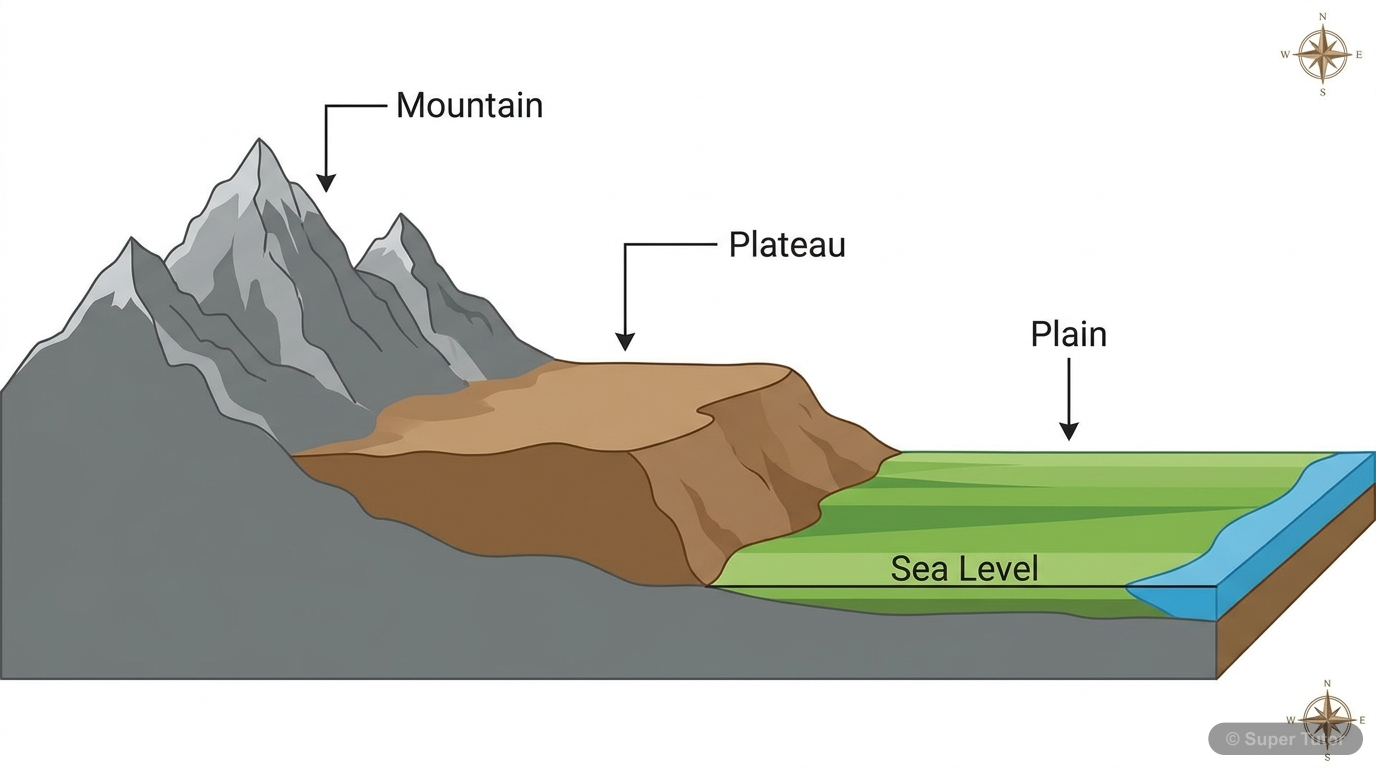
Learn better with visuals Super Tutor pairs illustrations like this with notes and quizzes for Landforms.
Key Topics to Revise
1
1. Introduction to Landforms
- Landforms are natural features of the Earth's surface like mountains, valleys, plateaus, and plains.
- Only 29% of Earth is land; the rest is water.
- Landforms are shaped by internal (inside Earth) and external (surface) forces.
2
2. Formation of Landforms
- Two main forces: Endogenic (internal) and Exogenic (external).
- Endogenic forces: Come from inside Earth — cause folding, faulting, volcanoes, earthquakes.
- Exogenic forces: Act on surface — include weathering, erosion by rivers, wind, glaciers.
3
3. Types of Mountains
- Three types: Fold, Block, and Volcanic mountains.
- Fold Mountains: Formed by tectonic plates pushing together (e.g., Himalayas, Alps).
- Young fold mountains are high and rugged; old ones are lower with rounded peaks (e.g., Aravallis, Appalachians).
4
4. Valleys and Plateaus
- Rift Valley: A long depression formed when land between two faults sinks (e.g., Narmada Valley, Rhine Valley).
- Plateaus are elevated flat lands — called tablelands.
- Types of plateaus: Intermontane (between mountains), Dissected (cut by rivers), Piedmont (border of mountains), Volcanic (lava-formed).
Get complete notes with diagrams and examples
Full NotesKey Concepts
Internal (endogenic) forces come from insideMountains are classified into three typesRift valleys form when land sinksPlains are flat
Frequently Asked Questions
What are the important topics in Landforms for ICSE Class 6 Geography?
Key topics in Landforms include Introduction to Landforms, Formation of Landforms, Types of Mountains, Valleys and Plateaus. Study these first, then practise questions on each for Class 6 exams.
How should I revise Landforms for Class 6 exams?
Learn the core ideas first, then work through the 92 practice questions on Landforms. Revise definitions regularly and use flashcards for quick recall before the exam.
Sources & Official References
Content is aligned to the official syllabus. Refer to the board website for the latest curriculum.
More resources for Landforms
For serious students
Get the full Landforms chapter — start free.
Quizzes, flashcards, an AI doubt solver and a study plan for ICSE Class 6 Geography. Free to start, no card needed.