Landforms — Chapter Summary
ICSE · Class 6 · Geography
Summary of Landforms for ICSE Class 6 Geography. Key concepts: Internal (endogenic) forces, Mountains are classified into and Rift valleys form when land.
Interactive on Super Tutor
Studying Landforms? Get the full interactive chapter.
Quizzes, flashcards, AI doubt-solver and a step-by-step study plan — built for chapter summary and more.
Free trial, no card needed.
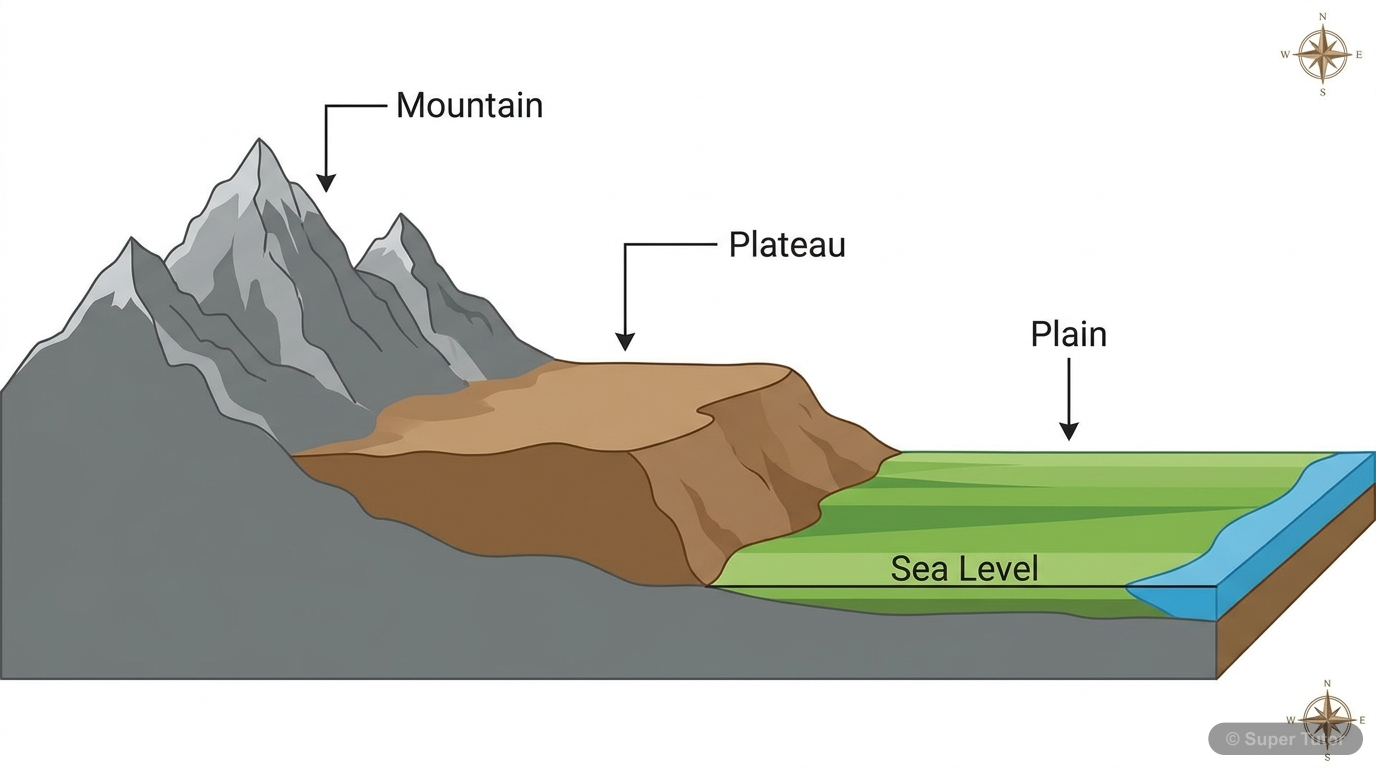
Learn better with visuals Super Tutor pairs illustrations like this with notes and quizzes for Landforms.
Overview
The Earth's surface is made up of various natural features called landforms. These include mountains, valleys, plateaus, and plains. Landforms are formed by natural forces acting over millions of years. Some forces come from inside the Earth, like volcanoes and earthquakes, while others act on the s
Key Concepts
Internal (endogenic) forces come from inside
Internal (endogenic) forces come from inside the Earth and cause events like mountain building and earthquakes. External (exogenic) forces like rivers
Mountains are classified into three types
Mountains are classified into three types: Fold Mountains (formed by bending of rock layers), Block Mountains (formed by breaking and lifting of rock
Rift valleys form when land sinks
Rift valleys form when land sinks between faults. Plateaus are flat elevated lands; they can be formed between mountains (intermontane), by erosion (d
Plains are flat
Plains are flat, low-lying areas formed by deposition of river sediments. They are fertile and support agriculture, cities, and transport.
Learning Objectives
- Identify different types of landforms such as mountains, valleys, plateaus, and plains.
- Understand how internal and external forces shape the Earth's surface.
- Differentiate between fold, block, and volcanic mountains.
- Explain the formation and importance of valleys, plateaus, and plains.
- Recognize how landforms affect human life and settlement patterns.
Frequently Asked Questions
What are the important topics in Landforms for ICSE Class 6 Geography?
How should I revise Landforms for Class 6 exams?
Sources & Official References
Content is aligned to the official syllabus. Refer to the board website for the latest curriculum.
More resources for Landforms
For serious students
Get the full Landforms chapter — start free.
Quizzes, flashcards, an AI doubt solver and a study plan for ICSE Class 6 Geography. Free to start, no card needed.