Rural Local Self-Government — Concept Maps
ICSE · Class 6 · History & Civics
4 concept maps of Rural Local Self-Government for ICSE Class 6 History & Civics, each also written out as a text outline.
Interactive on Super Tutor
Studying Rural Local Self-Government? Get the full interactive chapter.
Quizzes, flashcards, AI doubt-solver and a step-by-step study plan — built for concept maps and more.
Free trial, no card needed.
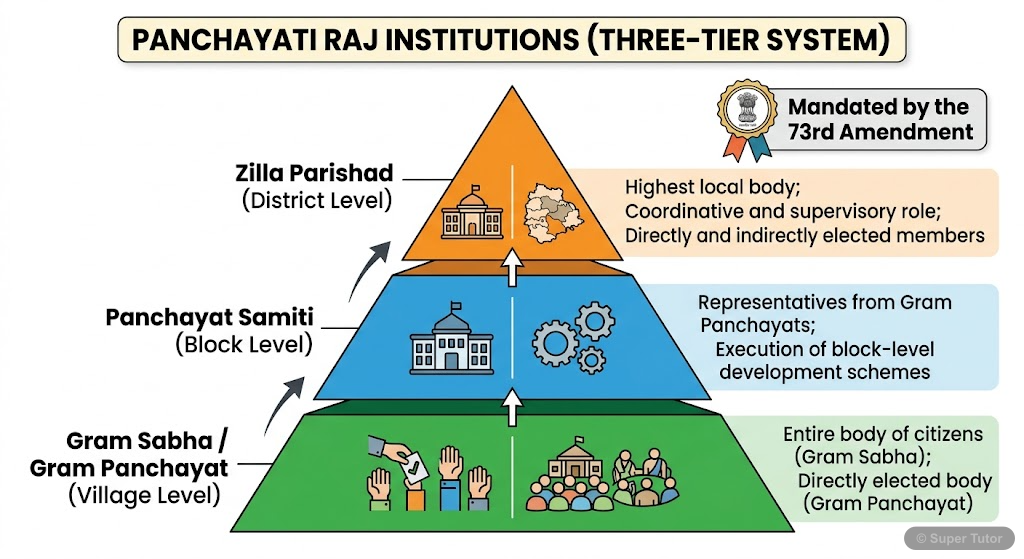
An illustration from Super Tutor's Rural Local Self-Government chapter — alongside flashcards, concept maps and practice questions.
Three-Tier Panchayati Raj System Structure
The map in words
- Zila Parishad\nDistrict Level - Highest
- Panchayat Samiti\nBlock Level - Middle
- Village Panchayat\nVillage Level - Lowest
- Gram Sabha\nAll Voters 18 and above
- Gram Panchayat\nElected Committee
- Ward Members\nPanchas
- Sarpanch\nElected Head
- Gram Panchayat\nElected Committee
- Gram Sabha\nAll Voters 18 and above
- Village Panchayat\nVillage Level - Lowest
- Panchayat Samiti\nBlock Level - Middle
Rural Local Self-Government – Complete Chapter Overview
The map in words
- Rural Local Self-Government
- Why Local Self-Govt
- 70 percent in villages
- Local people know local problems
- Faster development
- Local leadership
- Three Tier Panchayati Raj
- Village Panchayat
- Lowest tier
- Village level
- Gram Sabha
- Gram Panchayat
- Nyaya Panchayat
- Block Samiti
- Middle tier
- Block level
- Indirectly elected
- Chairperson as head
- Zila Parishad
- Highest tier
- District level
- President as head
- Village Panchayat
- Key Laws
- 73rd Amendment 1992
- 5 year term
- 33 percent for women
- SC ST OBC reservation
- First inauguration
- Nagaur Rajasthan 1959
- 73rd Amendment 1992
- After Independence Steps
- Zamindari abolished
- Five Year Plans
- Irrigation canals
- Free primary education
- Primary Health Centres
- Solar energy and biogas
- Pucca roads
- State Government Role
- State Election Commission
- Financial grants
- Collector at district level
- BDO at block level
- Why Local Self-Govt
Panchayati Raj System Structure and Functions
The map in words
- Panchayati Raj System
- Village Level
- Gram Sabha
- All adults 18 plus
- Direct democracy
- Gram Panchayat
- Sarpanch as head
- Ward Members
- Functions: water, roads, schools
- Nyaya Panchayat
- Minor disputes
- Quick justice
- Gram Sabha
- Block Level
- Block Samiti
- Indirectly elected
- Supervises villages
- Expert support
- Fund arrangement
- Block Samiti
- District Level
- Zila Parishad
- Highest tier
- Coordination
- Budget distribution
- Development planning
- Zila Parishad
- Constitutional Provisions
- 73rd Amendment 1992
- 33 percent women seats
- SC ST representation
- 5 year terms
- Income Sources
- Property taxes
- Market taxes
- Government grants
- Cattle registration fees
- Village Level
Panchayati Raj System
The map in words
- Panchayati Raj System
- Gram Sabha
- Gram Panchayat
- Panchayat Samiti (Block Samiti)
- Zila Parishad
- Functions of Village Panchayat
- Sources of Income
- Nyaya Panchayat
- Constitutional Basis
Explore these maps interactively
Explore DiagramsFrequently Asked Questions
What are the important topics in Rural Local Self-Government for ICSE Class 6 History & Civics?
What do the concept maps for Rural Local Self-Government show?
How should I revise Rural Local Self-Government for Class 6 exams?
Sources & Official References
Content is aligned to the official syllabus. Refer to the board website for the latest curriculum.
More resources for Rural Local Self-Government
Practice Quiz
Test yourself with a quick quiz
Important Questions
Exam-style questions with answers
Revision Notes
Key points for last-minute revision
Chapter Summary
Understand the chapter at a glance
Study Plan
Step-by-step plan for this chapter
Flashcards
Quick-fire cards for active recall
Syllabus
What topics to cover
For serious students
Get the full Rural Local Self-Government chapter — start free.
Quizzes, flashcards, an AI doubt solver and a study plan for ICSE Class 6 History & Civics. Free to start, no card needed.