Rural Local Self-Government — Study Plan
ICSE · Class 6 · History & Civics
A step-by-step study plan for Rural Local Self-Government, ICSE Class 6 History & Civics: what to learn first, what to practise and when to revise.
Interactive on Super Tutor
Studying Rural Local Self-Government? Get the full interactive chapter.
Quizzes, flashcards, AI doubt-solver and a step-by-step study plan — built for study plan and more.
Free trial, no card needed.
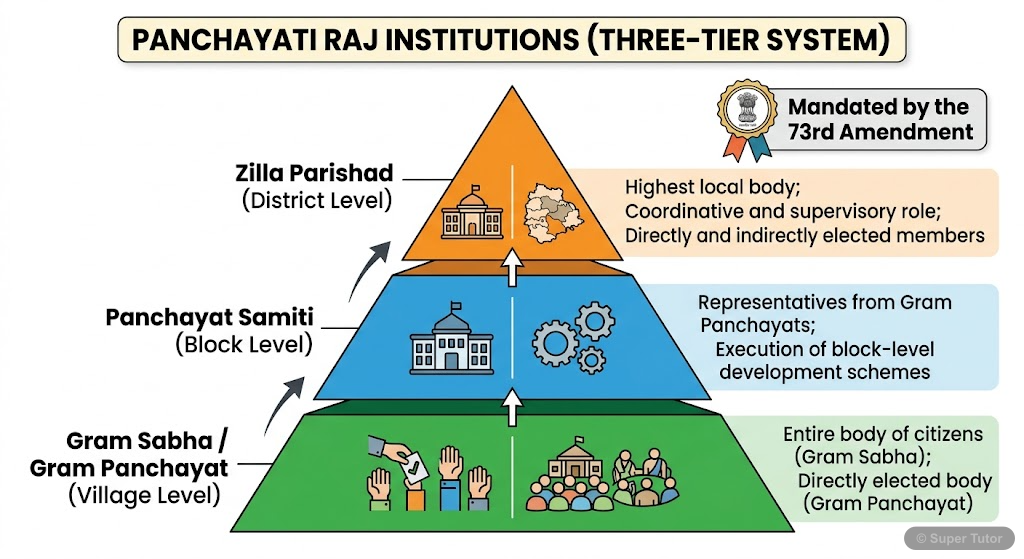
An illustration from Super Tutor's Rural Local Self-Government chapter — alongside flashcards, concept maps and practice questions.
Study Plan
Learn the Theory
Read the textbook chapter carefully. Note down definitions, formulas and key ideas. Focus on: Importance of Local Self-Government, The Panchayati Raj System – Three-Tier Structure, Gram Sabha and Gram Panchayat.
Practise
Solve the textbook exercises and extra practice questions. There are 91 questions available for this chapter.
Revise & Test
Revise key points without looking at your notes. Take a practice quiz and mark weak areas for another pass.
Spaced Revision
Come back to Rural Local Self-Government after a week. Use flashcards for quick recall and try past exam questions on this chapter.
What to Focus On
- Zamindari system was abolished to help farmers.
- Better farming tools, seeds, and fertilisers were provided.
- Irrigation facilities like canals and tubewells were developed.
- Local people understand local problems better.
- It encourages people to take part in decision-making.
- It builds leadership at the grassroots level.
- It is a three-tier system: Village, Block, and District levels.
- The 73rd Amendment Act (1992) gave constitutional status to Panchayati Raj.
- Regular elections are held every 5 years.
Common Mistakes to Avoid
The Sarpanch is elected by the Panchayat members, not directly by the people.
Gram Sabha and Gram Panchayat are the same thing.
Zila Parishad is at the block level, not district level.
Memory Tips
Three-tier system of Panchayati Raj: Village Panchayat, Block Samiti, Zila Parishad
Gram Sabha is the general body of all villagers aged 18+
Functions of Village Panchayat
Nyaya Panchayat resolves minor disputes and can fine but not jail
Want a personalised study plan?
Super Tutor builds a day-by-day plan for ICSE Class 6 History & Civics that fits your exam date and pace.
Create My Study PlanFrequently Asked Questions
What are the important topics in Rural Local Self-Government for ICSE Class 6 History & Civics?
How should I revise Rural Local Self-Government for Class 6 exams?
Sources & Official References
Content is aligned to the official syllabus. Refer to the board website for the latest curriculum.
More resources for Rural Local Self-Government
Practice Quiz
Test yourself with a quick quiz
Important Questions
Exam-style questions with answers
Revision Notes
Key points for last-minute revision
Chapter Summary
Understand the chapter at a glance
Concept Maps
See how topics connect
Flashcards
Quick-fire cards for active recall
Syllabus
What topics to cover
For serious students
Get the full Rural Local Self-Government chapter — start free.
Quizzes, flashcards, an AI doubt solver and a study plan for ICSE Class 6 History & Civics. Free to start, no card needed.