Rural Local Self-Government — Chapter Summary
ICSE · Class 6 · History & Civics
Summary of Rural Local Self-Government for ICSE Class 6 History & Civics. Part of the ICSE Class 6 History & Civics syllabus.
Interactive on Super Tutor
Studying Rural Local Self-Government? Get the full interactive chapter.
Quizzes, flashcards, AI doubt-solver and a step-by-step study plan — built for chapter summary and more.
Free trial, no card needed.
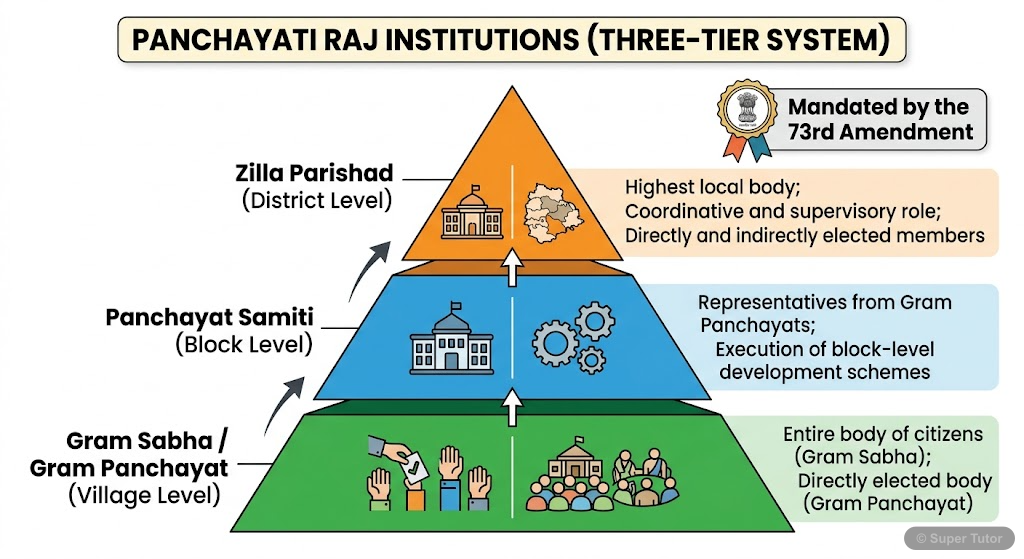
An illustration from Super Tutor's Rural Local Self-Government chapter — alongside flashcards, concept maps and practice questions.
Overview
In India, about 70% of the population lives in villages. For the development of these rural areas, it is important that local people take part in decision-making. The system of Rural Local Self-Government, known as the Panchayati Raj, allows villagers to manage their own affairs. This chapter explai
Key Concepts
It is a three
It is a three-tier system of rural local self-government in India. It includes the Gram Panchayat at the village level, Panchayat Samiti at the block
The Gram Sabha is a meeting
The Gram Sabha is a meeting of all adult villagers (18 years and above). It elects members to the Gram Panchayat and discusses important village issue
It is a small elected body
It is a small elected body responsible for a village or group of villages. It is headed by a Sarpanch and includes Ward Members. It handles basic need
It is the middle level
It is the middle level of the Panchayati Raj system, covering a block of several villages. It supervises the work of Gram Panchayats and arranges fund
It is the highest level
It is the highest level of the Panchayati Raj system at the district level. It is made up of chairpersons of Panchayat Samitis and other representativ
Learning Objectives
- Understand the meaning and importance of local self-government in rural areas.
- Learn about the three-tier structure of the Panchayati Raj system.
- Know the functions and sources of income of each level of rural self-government.
- Recognize the role of citizens in local governance and development.
- Appreciate how the 73rd Constitutional Amendment strengthened rural local bodies.
Frequently Asked Questions
What are the important topics in Rural Local Self-Government for ICSE Class 6 History & Civics?
How should I revise Rural Local Self-Government for Class 6 exams?
Sources & Official References
Content is aligned to the official syllabus. Refer to the board website for the latest curriculum.
More resources for Rural Local Self-Government
For serious students
Get the full Rural Local Self-Government chapter — start free.
Quizzes, flashcards, an AI doubt solver and a study plan for ICSE Class 6 History & Civics. Free to start, no card needed.