Physical Quantities and Measurement — Concept Maps
ICSE · Class 6 · Physics
4 concept maps of Physical Quantities and Measurement for ICSE Class 6 Physics, each also written out as a text outline.
Interactive on Super Tutor
Studying Physical Quantities and Measurement? Get the full interactive chapter.
Quizzes, flashcards, AI doubt-solver and a step-by-step study plan — built for concept maps and more.
Free trial, no card needed.
One of 5 illustrations for Physical Quantities and Measurement in Super Tutor — alongside flashcards, concept maps and practice questions.
Physical Quantities and Measurement Concept Overview
The map in words
- Physical Quantities and Measurement
- Fundamental Concepts
- Definition of Measurement
- Number and Unit Required
- Process of Comparison
- Standardized Units
- Four Basic Quantities
- Length
- SI Unit: Metre
- Sub-multiples: cm, mm
- Multiples: km
- Mass
- SI Unit: Kilogram
- Sub-multiples: g, mg
- Multiples: quintal, tonne
- Time
- SI Unit: Second
- Relationships: min, hour, day
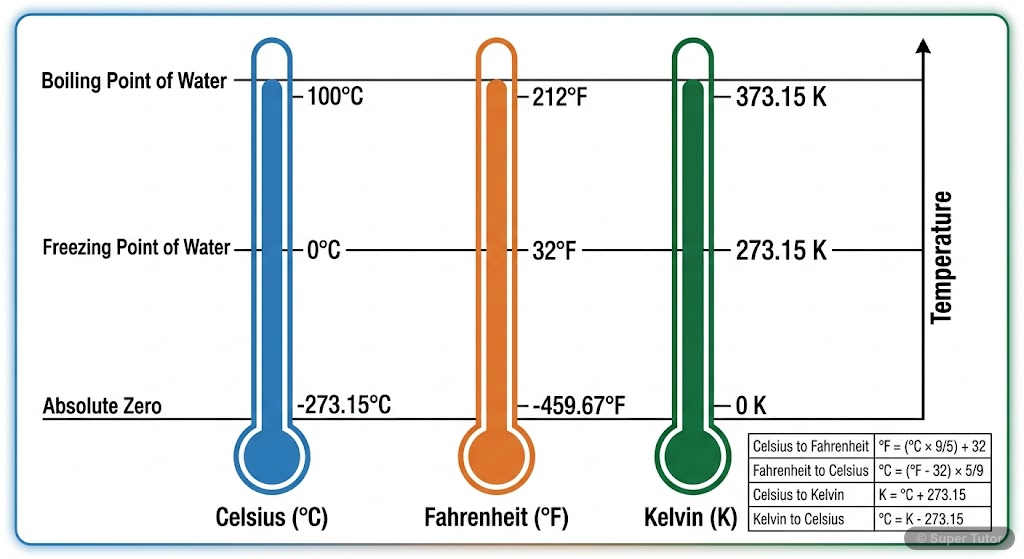
- Temperature
- SI Unit: Kelvin
- Other scales: Celsius, Fahrenheit
- Length
- Measurement Devices
- Length Measurement
- Metre Ruler
- Measuring Tape
- Mass Measurement
- Beam Balance
- Electronic Balance
- Time Measurement
- Clock and Watch
- Stop Watch
- Temperature Measurement
- Laboratory Thermometer
- Clinical Thermometer
- Length Measurement
- Derived Quantities
- Area
- Formula Applications
- Square Metre
- Volume
- Speed
- Density
- Area
- Fundamental Concepts
Step-by-step process of making a measurement
The map in words
- Measurement Problem
- Identify the Quantity
- Choose Standard Unit
- Compare with Unit
- Find Number of Units
- Write Answer = Number × Unit
- Measurement Complete
- Write Answer = Number × Unit
- Find Number of Units
- Compare with Unit
- Choose Standard Unit
- Identify the Quantity
Essential properties that a good unit for measurement must possess
The map in words
- Properties of Good Units
- Convenient Size
- Not too small
- Not too large
- Easy to use
- Universally Accepted
- Same everywhere
- Same every time
- Standardized
- No Ambiguity
- Clear meaning
- Scientific communication
- Global understanding
- Convenient Size
Measurement
The map in words
- Measurement
- Physical Quantity
- Units of Measurement
- Measuring Instruments
- Processes of Measurement
- Error and Accuracy
- Derived Quantities
- Unit Conversion
Explore these maps interactively
Explore DiagramsFrequently Asked Questions
What are the important topics in Physical Quantities and Measurement for ICSE Class 6 Physics?
What do the concept maps for Physical Quantities and Measurement show?
How should I revise Physical Quantities and Measurement for Class 6 exams?
Sources & Official References
Content is aligned to the official syllabus. Refer to the board website for the latest curriculum.
More resources for Physical Quantities and Measurement
Practice Quiz
Test yourself with a quick quiz
Important Questions
Exam-style questions with answers
Revision Notes
Key points for last-minute revision
Formula Sheet
The chapter's formulas in one place
Chapter Summary
Understand the chapter at a glance
Study Plan
Step-by-step plan for this chapter
Flashcards
Quick-fire cards for active recall
Syllabus
What topics to cover
For serious students
Get the full Physical Quantities and Measurement chapter — start free.
Quizzes, flashcards, an AI doubt solver and a study plan for ICSE Class 6 Physics. Free to start, no card needed.