Physical Quantities and Measurement — Revision Notes
ICSE · Class 6 · Physics
Physical Quantities and Measurement revision notes for ICSE Class 6 Physics: 4 topics in quick points. Part of the ICSE Class 6 Physics syllabus.
Interactive on Super Tutor
Studying Physical Quantities and Measurement? Get the full interactive chapter.
Quizzes, flashcards, AI doubt-solver and a step-by-step study plan — built for revision notes and more.
Free trial, no card needed.
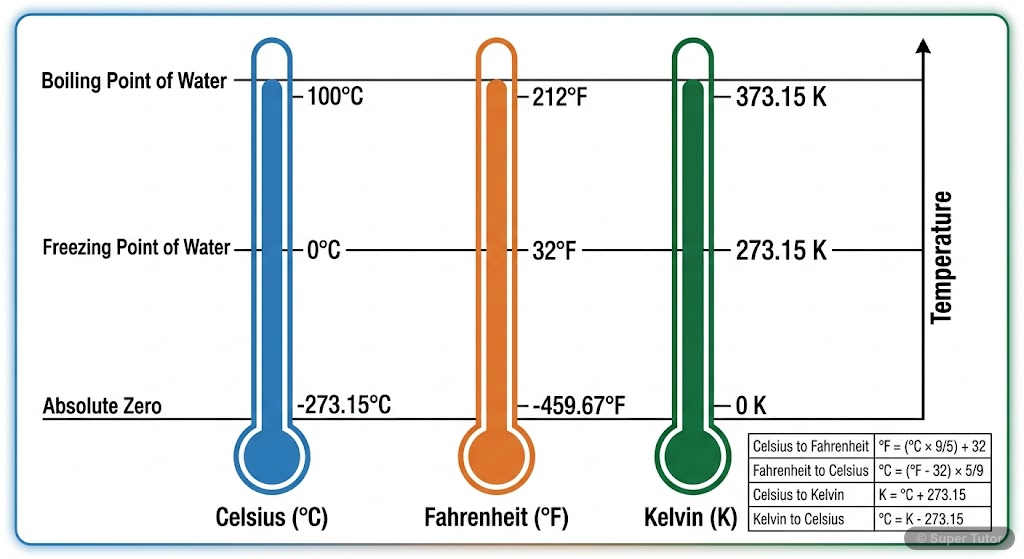
One of 5 illustrations for Physical Quantities and Measurement in Super Tutor — alongside flashcards, concept maps and practice questions.
Key Topics to Revise
1. What is Measurement?
- Measurement is the process of comparing an unknown quantity with a known standard unit.
- Every measurement has two parts: a number (n) and a unit (u). For example, 5 m means 5 times the unit 'metre'.
- Our senses like touch or sight are not reliable for exact measurement. We use instruments for accuracy.
2. Measurement of Length
- Length is the distance between two points.
- S.I. unit of length is metre (m).
- Common units: centimetre (cm), millimetre (mm), kilometre (km).
3. Measurement of Mass
- Mass is the amount of matter in an object.
- S.I. unit of mass is kilogram (kg).
- Smaller units: gram (g), milligram (mg). Larger units: quintal, metric tonne.
4. Measurement of Time
- Time is the interval between two events.
- S.I. unit of time is second (s).
- Larger units: minute (min), hour (h), day, year.
Get complete notes with diagrams and examples
Full NotesKey Concepts
Frequently Asked Questions
What are the important topics in Physical Quantities and Measurement for ICSE Class 6 Physics?
How should I revise Physical Quantities and Measurement for Class 6 exams?
Sources & Official References
Content is aligned to the official syllabus. Refer to the board website for the latest curriculum.
More resources for Physical Quantities and Measurement
Practice Quiz
Test yourself with a quick quiz
Important Questions
Exam-style questions with answers
Formula Sheet
The chapter's formulas in one place
Chapter Summary
Understand the chapter at a glance
Concept Maps
See how topics connect
Study Plan
Step-by-step plan for this chapter
Flashcards
Quick-fire cards for active recall
Syllabus
What topics to cover
For serious students
Get the full Physical Quantities and Measurement chapter — start free.
Quizzes, flashcards, an AI doubt solver and a study plan for ICSE Class 6 Physics. Free to start, no card needed.