Physical Quantities and Measurement — Study Plan
ICSE · Class 6 · Physics
A step-by-step study plan for Physical Quantities and Measurement, ICSE Class 6 Physics: what to learn first, what to practise and when to revise.
Interactive on Super Tutor
Studying Physical Quantities and Measurement? Get the full interactive chapter.
Quizzes, flashcards, AI doubt-solver and a step-by-step study plan — built for study plan and more.
Free trial, no card needed.
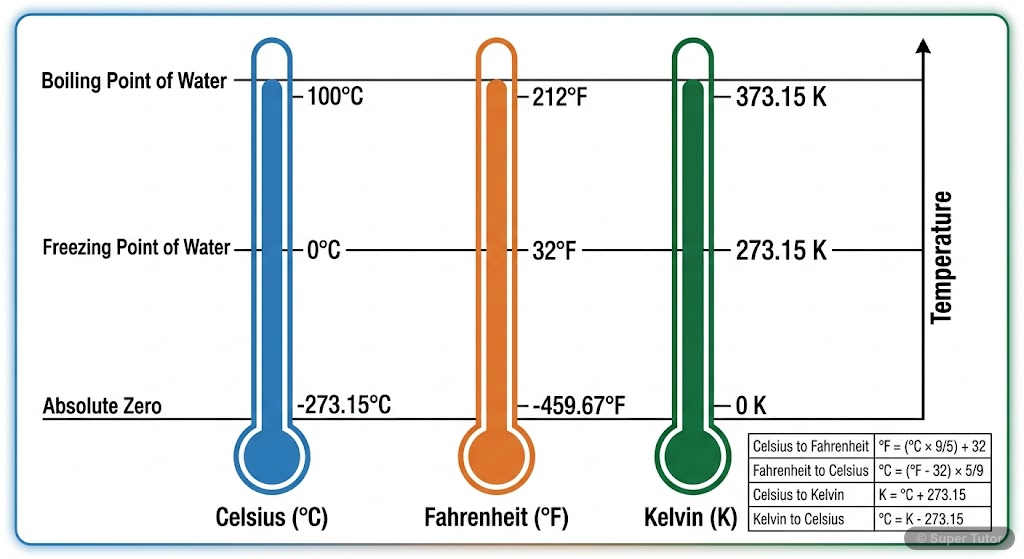
One of 5 illustrations for Physical Quantities and Measurement in Super Tutor — alongside flashcards, concept maps and practice questions.
Study Plan
Learn the Theory
Read the textbook chapter carefully. Note down definitions, formulas and key ideas. Focus on: 1. What is Measurement?, 2. Measurement of Length, 3. Measurement of Mass.
Practise
Solve the textbook exercises and extra practice questions. There are 94 questions available for this chapter.
Revise & Test
Revise key points without looking at your notes. Take a practice quiz and mark weak areas for another pass.
Spaced Revision
Come back to Physical Quantities and Measurement after a week. Use flashcards for quick recall and try past exam questions on this chapter.
What to Focus On
- Measurement = Number × Unit
- A unit must be universally accepted and of convenient size.
- S.I. units are standard units used worldwide.
- Length, mass, time, and temperature are fundamental physical quantities.
- They are independent of each other.
- Other quantities like area and volume are derived from them.
- S.I. unit of length is metre (m).
- Common units: km, m, cm, mm.
- Use ruler for straight objects, tape for curved or long lengths.
Common Mistakes to Avoid
Mass and weight are the same thing.
Zero error in a ruler doesn't matter if you start from the broken end.
Temperature measures the amount of heat in a body.
Memory Tips
The four basic physical quantities: Length, Mass, Time, Temperature
S.I. units: metre (m), kilogram (kg), second (s), kelvin (K)
Prefix meanings: milli (1/1000), centi (1/100), kilo (1000)
1 m = 100 cm, 1 cm = 10 mm
Want a personalised study plan?
Super Tutor builds a day-by-day plan for ICSE Class 6 Physics that fits your exam date and pace.
Create My Study PlanFrequently Asked Questions
What are the important topics in Physical Quantities and Measurement for ICSE Class 6 Physics?
How should I revise Physical Quantities and Measurement for Class 6 exams?
Sources & Official References
Content is aligned to the official syllabus. Refer to the board website for the latest curriculum.
More resources for Physical Quantities and Measurement
Practice Quiz
Test yourself with a quick quiz
Important Questions
Exam-style questions with answers
Revision Notes
Key points for last-minute revision
Formula Sheet
The chapter's formulas in one place
Chapter Summary
Understand the chapter at a glance
Concept Maps
See how topics connect
Flashcards
Quick-fire cards for active recall
Syllabus
What topics to cover
For serious students
Get the full Physical Quantities and Measurement chapter — start free.
Quizzes, flashcards, an AI doubt solver and a study plan for ICSE Class 6 Physics. Free to start, no card needed.