Physical Quantities and Measurement — Practice Quiz
ICSE · Class 6 · Physics
Try a 4-question quiz on Physical Quantities and Measurement for ICSE Class 6 Physics: tap an answer to check it and see why.
Interactive on Super Tutor
Studying Physical Quantities and Measurement? Get the full interactive chapter.
Quizzes, flashcards, AI doubt-solver and a step-by-step study plan — built for practice quiz and more.
Free trial, no card needed.
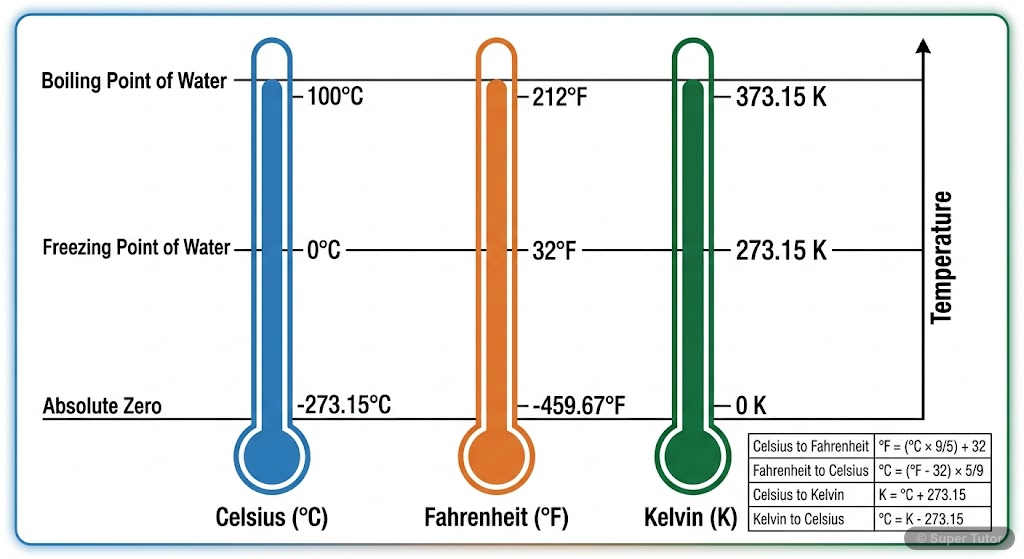
One of 5 illustrations for Physical Quantities and Measurement in Super Tutor — alongside flashcards, concept maps and practice questions.
Quick Quiz: Physical Quantities and Measurement
0/4Tap an answer to check it instantly. No sign-up needed for these 4.
What is the S.I. unit of length?
How many centimetres are there in 1 metre?
A student measures the length of her pencil using a ruler. One end of the pencil is at the 2.0 cm mark and the other end is at the 14.5 cm mark on the ruler. What is the length of the pencil?
Which device is most suitable for measuring the length of a curved line, such as the boundary of a leaf?
Sample Questions
Convert 3.5 kilometres into metres.
Show answer
3500 m
Step 1: Recall the relation: 1 km = 1000 m. Step 2: To convert km to m, multiply by 1000. Step 3: 3.5 km = 3.5 × 1000 m = 3500 m. Step 4: Option 350 m is wrong – this would be dividing instead of multiplying. Option 35000 m means multiplying by 10000, which is incorrect. Option 0.0035 m is dividing by 1000, which converts m to km, not the other way. The correct answer is 3500 m.
What is the S.I. unit of mass?
Show answer
Kilogram (kg)
Step 1: Mass is the quantity of matter contained in a body. Step 2: The S.I. system assigns standard base units to basic physical quantities. Step 3: The S.I. unit of mass is kilogram, written in short as 'kg'. Step 4: Gram (g) is a sub-multiple of kilogram (1 g = 10⁻³ kg). Milligram is an even smaller unit. Quintal is a multiple (1 quintal = 100 kg). None of these are the S.I. base unit. The correct answer is kilogram.
A shopkeeper has 2.5 kg of sugar. How many grams of sugar does he have?
Show answer
2500 g
Step 1: Recall the relation between kilogram and gram: 1 kg = 1000 g. Step 2: To convert kg to g, multiply by 1000. Step 3: 2.5 kg = 2.5 × 1000 g = 2500 g. Step 4: Option 250 g uses a multiplier of 100, not 1000, so it is wrong. Option 25 g is far too small. Option 25000 g uses a multiplier of 10000, which is incorrect. The correct answer is 2500 g.
Which balance is best suited for measuring the mass of a very small object, such as a tablet (medicine), accurately?
Show answer
Electronic balance
Step 1: A beam balance works by comparing the unknown mass with standard weights placed on the pans. It is good for general measurements but not very precise for tiny masses. Step 2: An electronic balance converts the load into an electrical signal and displays the mass digitally. It can measure masses as small as 1 mg. Step 3: Electronic balances are precise and automatic – no separate weight box is needed. Step 4: Spring balance measures force (weight), not mass directly. A measuring tape measures length. The electronic balance is the correct choice for precise, small mass measurements.
+90 more questions on Physical Quantities and Measurement (ICSE Class 6 Physics)
Practise AllFrequently Asked Questions
What are the important topics in Physical Quantities and Measurement for ICSE Class 6 Physics?
How many practice questions are there for Physical Quantities and Measurement?
Sources & Official References
Content is aligned to the official syllabus. Refer to the board website for the latest curriculum.
More resources for Physical Quantities and Measurement
Important Questions
Exam-style questions with answers
Revision Notes
Key points for last-minute revision
Formula Sheet
The chapter's formulas in one place
Chapter Summary
Understand the chapter at a glance
Concept Maps
See how topics connect
Study Plan
Step-by-step plan for this chapter
Flashcards
Quick-fire cards for active recall
Syllabus
What topics to cover
For serious students
Get the full Physical Quantities and Measurement chapter — start free.
Quizzes, flashcards, an AI doubt solver and a study plan for ICSE Class 6 Physics. Free to start, no card needed.