Physical Quantities and Measurement — Important Questions
ICSE · Class 6 · Physics
94 important questions from Physical Quantities and Measurement for ICSE Class 6 Physics, with answers. Part of the ICSE Class 6 Physics syllabus.
Interactive on Super Tutor
Studying Physical Quantities and Measurement? Get the full interactive chapter.
Quizzes, flashcards, AI doubt-solver and a step-by-step study plan — built for important questions and more.
Free trial, no card needed.
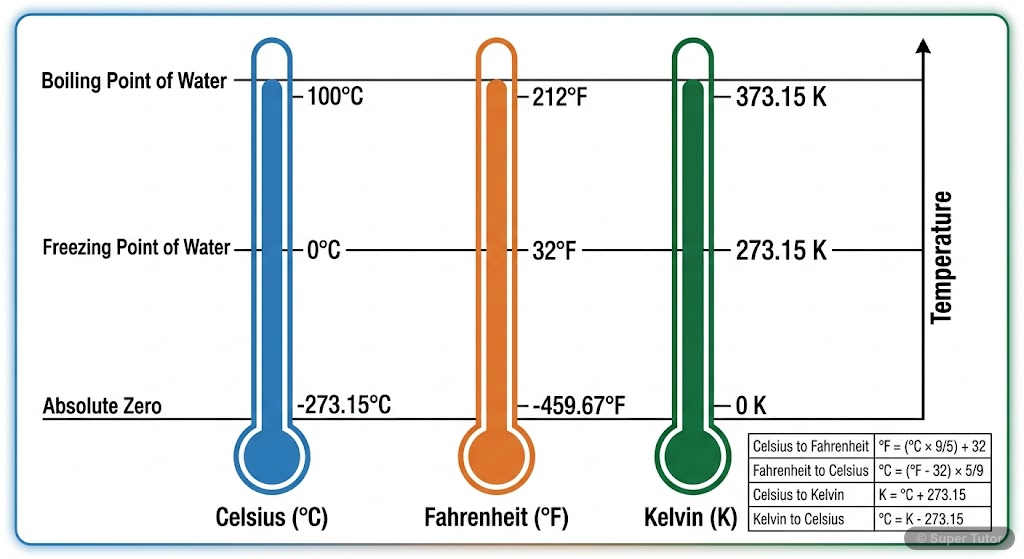
One of 5 illustrations for Physical Quantities and Measurement in Super Tutor — alongside flashcards, concept maps and practice questions.
Important Questions from Physical Quantities and Measurement
Convert 3.5 kilometres into metres.
Show answer
3500 m
Step 1: Recall the relation: 1 km = 1000 m. Step 2: To convert km to m, multiply by 1000. Step 3: 3.5 km = 3.5 × 1000 m = 3500 m. Step 4: Option 350 m is wrong – this would be dividing instead of multiplying. Option 35000 m means multiplying by 10000, which is incorrect. Option 0.0035 m is dividing by 1000, which converts m to km, not the other way. The correct answer is 3500 m.
What is the S.I. unit of mass?
Show answer
Kilogram (kg)
Step 1: Mass is the quantity of matter contained in a body. Step 2: The S.I. system assigns standard base units to basic physical quantities. Step 3: The S.I. unit of mass is kilogram, written in short as 'kg'. Step 4: Gram (g) is a sub-multiple of kilogram (1 g = 10⁻³ kg). Milligram is an even smaller unit. Quintal is a multiple (1 quintal = 100 kg). None of these are the S.I. base unit. The correct answer is kilogram.
A shopkeeper has 2.5 kg of sugar. How many grams of sugar does he have?
Show answer
2500 g
Step 1: Recall the relation between kilogram and gram: 1 kg = 1000 g. Step 2: To convert kg to g, multiply by 1000. Step 3: 2.5 kg = 2.5 × 1000 g = 2500 g. Step 4: Option 250 g uses a multiplier of 100, not 1000, so it is wrong. Option 25 g is far too small. Option 25000 g uses a multiplier of 10000, which is incorrect. The correct answer is 2500 g.
Which balance is best suited for measuring the mass of a very small object, such as a tablet (medicine), accurately?
Show answer
Electronic balance
Step 1: A beam balance works by comparing the unknown mass with standard weights placed on the pans. It is good for general measurements but not very precise for tiny masses. Step 2: An electronic balance converts the load into an electrical signal and displays the mass digitally. It can measure masses as small as 1 mg. Step 3: Electronic balances are precise and automatic – no separate weight box is needed. Step 4: Spring balance measures force (weight), not mass directly. A measuring tape measures length. The electronic balance is the correct choice for precise, small mass measurements.
+90 more questions on Physical Quantities and Measurement (ICSE Class 6 Physics)
Practise AllFrequently Asked Questions
What are the important topics in Physical Quantities and Measurement for ICSE Class 6 Physics?
How many important questions are there in Physical Quantities and Measurement?
Sources & Official References
Content is aligned to the official syllabus. Refer to the board website for the latest curriculum.
More resources for Physical Quantities and Measurement
Practice Quiz
Test yourself with a quick quiz
Revision Notes
Key points for last-minute revision
Formula Sheet
The chapter's formulas in one place
Chapter Summary
Understand the chapter at a glance
Concept Maps
See how topics connect
Study Plan
Step-by-step plan for this chapter
Flashcards
Quick-fire cards for active recall
Syllabus
What topics to cover
For serious students
Get the full Physical Quantities and Measurement chapter — start free.
Quizzes, flashcards, an AI doubt solver and a study plan for ICSE Class 6 Physics. Free to start, no card needed.