Physical Quantities and Measurement — Flashcards
ICSE · Class 6 · Physics
40 flashcards for Physical Quantities and Measurement (ICSE Class 6 Physics) to test yourself on key terms and facts.
Interactive on Super Tutor
Studying Physical Quantities and Measurement? Get the full interactive chapter.
Quizzes, flashcards, AI doubt-solver and a step-by-step study plan — built for flashcards and more.
Free trial, no card needed.
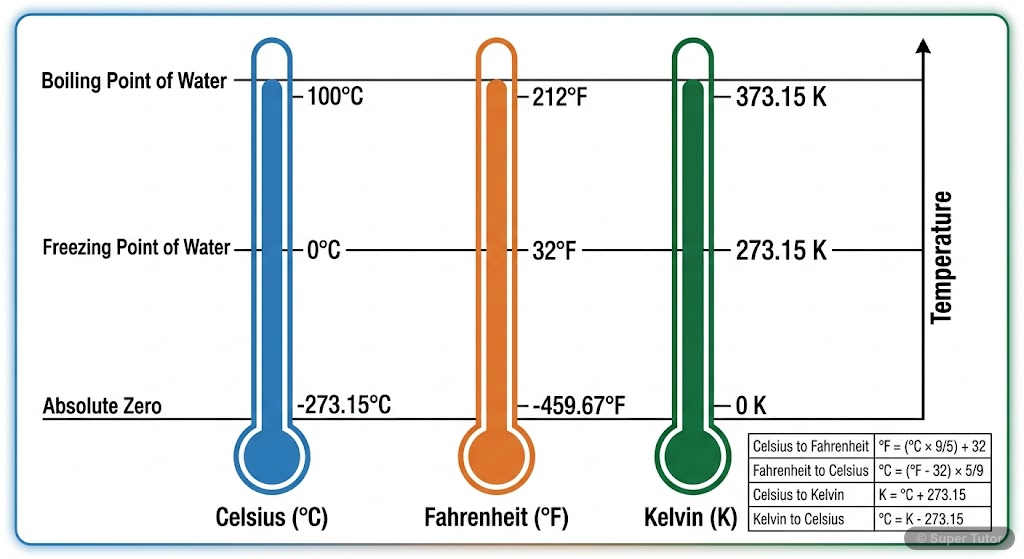
One of 5 illustrations for Physical Quantities and Measurement in Super Tutor — alongside flashcards, concept maps and practice questions.
What is a physical quantity?
Answer
A physical quantity is any quantity that can be measured. Examples include length, mass, time, and temperature. These are measured using standard units like metre, kilogram, second, and degree Celsius…
Why can't we rely only on our senses for measurement?
Answer
Our senses like touch or sight are subjective and can vary from person to person. For example, one person may feel water as warm while another feels it as hot. So, we use standard instruments like rul…
What are the two things needed for any measurement?
Answer
Every measurement requires: (1) A number (n) that tells how many times, and (2) A unit (u) which is a standard of comparison. So, Measurement = n × u. For example, 5 metres means 5 times the unit 'met…
What is the S.I. unit of length?
Answer
The S.I. unit of length is the metre (symbol: m). It is used worldwide to measure distances, heights, and lengths of objects.
Convert 2.5 km into metres.
Answer
We know: 1 km = 1000 m. So, 2.5 km = 2.5 × 1000 = 2500 m. Answer: 2500 m.
Convert 450 cm into metres.
Answer
We know: 100 cm = 1 m. So, 450 cm = 450 ÷ 100 = 4.5 m. Answer: 4.5 m.
What are the submultiples of a metre?
Answer
The submultiples of a metre are: (1) Centimetre (cm): 1 cm = 1/100 m = 0.01 m, (2) Millimetre (mm): 1 mm = 1/1000 m = 0.001 m.
How many millimetres are there in 1 centimetre?
Answer
There are 10 millimetres in 1 centimetre. So, 1 cm = 10 mm.
+32 more flashcards
Practise AllFrequently Asked Questions
What are the important topics in Physical Quantities and Measurement for ICSE Class 6 Physics?
How many flashcards are available for Physical Quantities and Measurement?
How should I revise Physical Quantities and Measurement for Class 6 exams?
Sources & Official References
Content is aligned to the official syllabus. Refer to the board website for the latest curriculum.
More resources for Physical Quantities and Measurement
Practice Quiz
Test yourself with a quick quiz
Important Questions
Exam-style questions with answers
Revision Notes
Key points for last-minute revision
Formula Sheet
The chapter's formulas in one place
Chapter Summary
Understand the chapter at a glance
Concept Maps
See how topics connect
Study Plan
Step-by-step plan for this chapter
Syllabus
What topics to cover
For serious students
Get the full Physical Quantities and Measurement chapter — start free.
Quizzes, flashcards, an AI doubt solver and a study plan for ICSE Class 6 Physics. Free to start, no card needed.