Plant and Animal Tissues — Chapter Summary
ICSE · Class 7 · Biology
Summary of Plant and Animal Tissues for ICSE Class 7 Biology. Key concepts: A tissue is a group, Meristematic tissue is made and Permanent tissue is a non.
Interactive on Super Tutor
Studying Plant and Animal Tissues? Get the full interactive chapter.
Quizzes, flashcards, AI doubt-solver and a step-by-step study plan — built for chapter summary and more.
Free trial, no card needed.
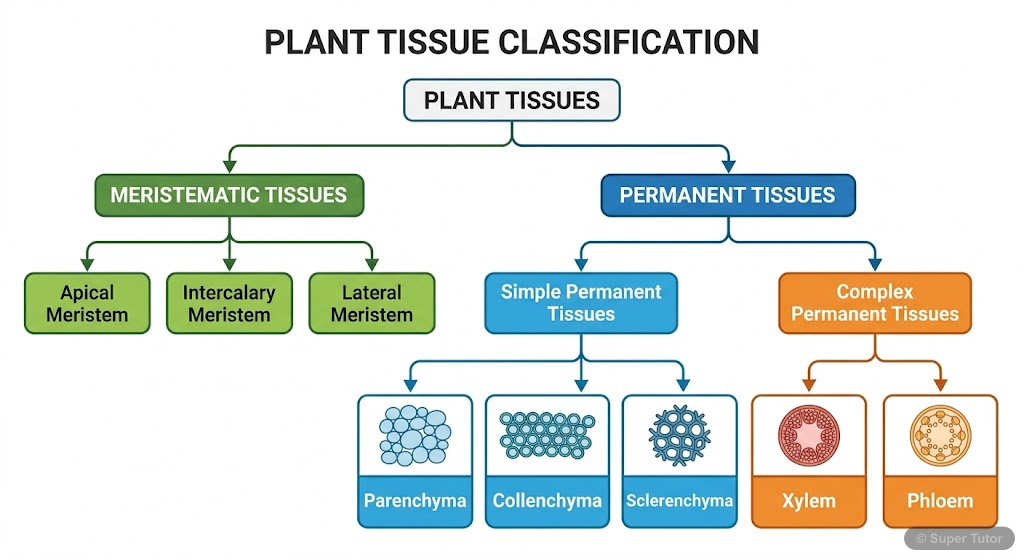
Learn better with visuals Super Tutor pairs illustrations like this with notes and quizzes for Plant and Animal Tissues.
Overview
Tissue is a group of similar cells that perform a specific function. Multicellular plants and animals are made of many kinds of tissues, and each tissue has a special job. Plant tissues are mainly of two types: meristematic tissue and permanent tissue. Animal tissues are classified into epithelial,
Key Concepts
A tissue is a group
A tissue is a group of cells that are similar in structure and perform a specific function.
Meristematic tissue is made of actively
Meristematic tissue is made of actively dividing cells. Its only function is to produce more cells for plant growth. These cells are small, thin-walle
Permanent tissue is a non
Permanent tissue is a non-dividing tissue that forms the bulk of the plant body. It is formed from meristematic cells after differentiation and is div
Parenchyma is a simple permanent supporting
Parenchyma is a simple permanent supporting tissue made of large thin-walled living cells with intercellular spaces. It stores food, and some cells co
Collenchyma is a simple permanent supporting
Collenchyma is a simple permanent supporting tissue made of living, elongated cells that are thick at the corners or edges. It is found in leaf stalks
Learning Objectives
- Define tissue and explain why tissues are important in living organisms.
- Classify plant tissues into meristematic and permanent tissues.
- Describe the characteristics, locations, and functions of parenchyma, collenchyma, sclerenchyma, xylem, and phloem.
- Classify animal tissues into epithelial, connective, muscular, and nervous tissues.
- Identify the basic structure, location, and function of major animal tissues such as bone, cartilage, blood, tendon, ligament, striated muscle, unstriated muscle, cardiac muscle, and neuron.
Frequently Asked Questions
What are the important topics in Plant and Animal Tissues for ICSE Class 7 Biology?
How should I revise Plant and Animal Tissues for Class 7 exams?
Sources & Official References
Content is aligned to the official syllabus. Refer to the board website for the latest curriculum.
More resources for Plant and Animal Tissues
For serious students
Get the full Plant and Animal Tissues chapter — start free.
Quizzes, flashcards, an AI doubt solver and a study plan for ICSE Class 7 Biology. Free to start, no card needed.