Classification of Plants — Chapter Summary
ICSE · Class 7 · Biology
Summary of Classification of Plants for ICSE Class 7 Biology. Part of the ICSE Class 7 Biology syllabus. Classification is the system of grouping living.
Interactive on Super Tutor
Studying Classification of Plants? Get the full interactive chapter.
Quizzes, flashcards, AI doubt-solver and a step-by-step study plan — built for chapter summary and more.
Free trial, no card needed.
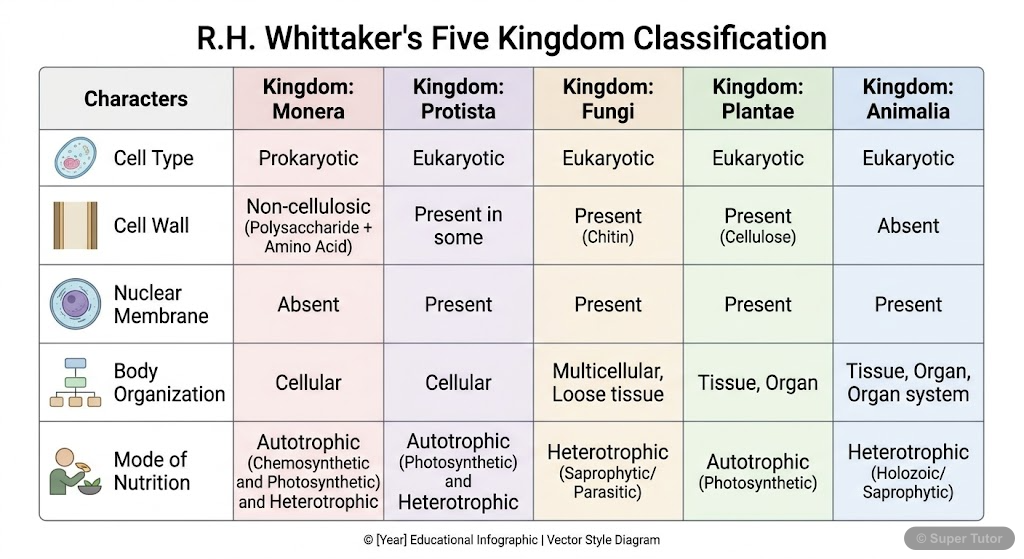
One of 9 illustrations for Classification of Plants in Super Tutor — alongside flashcards, concept maps and practice questions.
Overview
Classification is the system of grouping living organisms on the basis of common features. It makes the study of the huge variety of living things systematic and easier. In the living world, the earlier two-kingdom grouping created many anomalies, so a five kingdom classification was suggested.
Key Concepts
Classification means grouping organisms together on
Classification means grouping organisms together on the basis of similarities and differences. It helps in studying living things in an orderly way.
Robert Whittaker proposed five kingdoms
Robert Whittaker proposed five kingdoms in 1969 because the old two-kingdom system did not fit all organisms properly. The five kingdoms are Monera, P
This kingdom includes bacteria
This kingdom includes bacteria. Bacteria are unicellular, microscopic and prokaryotic because they do not have a nuclear membrane. Their genetic mater
Bacteria are commonly seen in four
Bacteria are commonly seen in four forms: coccus, bacillus, spirillum and vibrio. Coccus are spherical or ovoid, bacillus are rod-shaped, spirillum ar
Lactobacillus converts lactose into lactic acid
Lactobacillus converts lactose into lactic acid and helps in curd formation. Acetobacter converts fruit juices into vinegar. Rhizobium lives in root n
Learning Objectives
- Understand the meaning and need of classification
- Learn why the five kingdom classification was introduced
- Identify the main features of Kingdom Monera, Protista, Fungi and Plantae
- Recognise useful and harmful bacteria and fungi
- Compare mosses, ferns, gymnosperms and angiosperms
Frequently Asked Questions
What are the important topics in Classification of Plants for ICSE Class 7 Biology?
How should I revise Classification of Plants for Class 7 exams?
Sources & Official References
Content is aligned to the official syllabus. Refer to the board website for the latest curriculum.
More resources for Classification of Plants
For serious students
Get the full Classification of Plants chapter — start free.
Quizzes, flashcards, an AI doubt solver and a study plan for ICSE Class 7 Biology. Free to start, no card needed.