Plant and Animal Tissues — Important Questions
ICSE · Class 7 · Biology
45 important questions from Plant and Animal Tissues for ICSE Class 7 Biology, with answers. Includes multiple choice questions.
Interactive on Super Tutor
Studying Plant and Animal Tissues? Get the full interactive chapter.
Quizzes, flashcards, AI doubt-solver and a step-by-step study plan — built for important questions and more.
Free trial, no card needed.
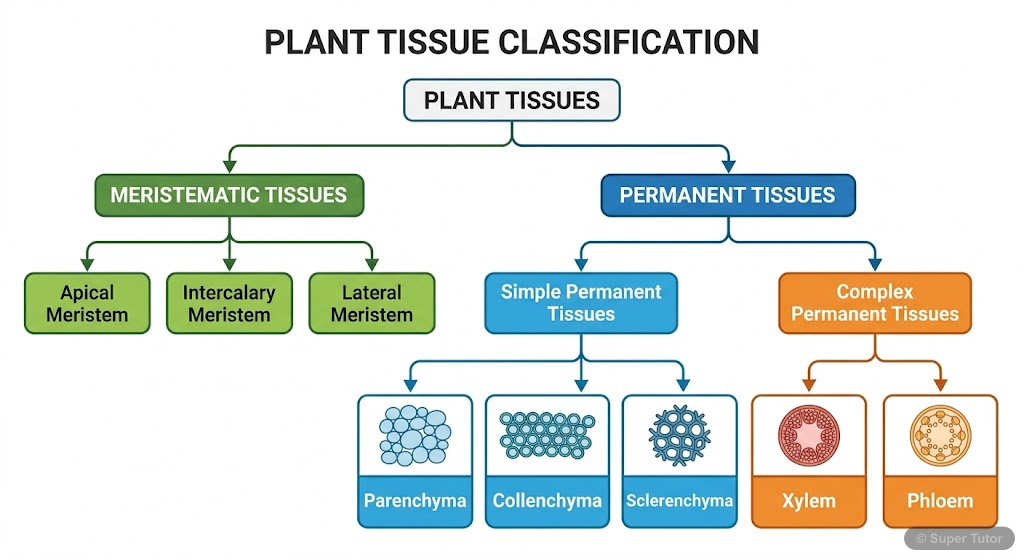
Learn better with visuals Super Tutor pairs illustrations like this with notes and quizzes for Plant and Animal Tissues.
Important Questions from Plant and Animal Tissues
Which simple permanent tissue stores food and is found in the soft parts of plants like potatoes?
Show answer
Parenchyma
Step 1: Parenchyma is a type of simple permanent supporting tissue. Step 2: It is composed of large, thin-walled living cells with intercellular spaces. Step 3: One of its main functions is to store food material – for example, potatoes are mainly made of parenchyma cells that store starch. Step 4: Collenchyma provides flexible support; sclerenchyma provides rigid support; xylem transports water. Step 5: Parenchyma is found in the soft parts of plants, including leaves, pith of stems, and roots.
Sclerenchyma cells are dead at maturity. What is the main function of sclerenchyma tissue?
Show answer
Providing rigid strength and support to the plant
Step 1: Sclerenchyma is a type of simple permanent tissue. Step 2: It is made of long, narrow, and thick-walled cells that are dead at maturity. Step 3: Because the cells are dead and thick-walled, they provide rigid (hard) mechanical and structural support to the plant. Step 4: Sclerenchyma is found in stems and veins of leaves, mostly as fibres. Step 5: Photosynthesis is done by parenchyma (with chloroplasts); transport of water is done by xylem; flexible support is the function of collenchyma.
Which complex permanent tissue transports water and minerals from roots to leaves?
Show answer
Xylem
Step 1: Complex permanent tissues are also called vascular or conducting tissues. Step 2: There are two types – xylem and phloem. Step 3: Xylem is formed of thick-walled, tubular, often dead cells placed end to end. Step 4: Xylem transports water and minerals absorbed by the roots upward to the leaves – this is unidirectional (only upward). Step 5: Phloem transports food (not water); collenchyma and parenchyma are simple permanent tissues, not conducting tissues.
Phloem transports food manufactured in the leaves. In which direction does this transport occur?
Show answer
Both upward and downward (bidirectional)
Step 1: Phloem is a complex permanent tissue that transports food. Step 2: Food is manufactured in the leaves through photosynthesis. Step 3: This food needs to reach all parts of the plant – both above and below the leaves. Step 4: Therefore, phloem conducts food in both upward and downward directions – this is called bidirectional transport. Step 5: Xylem, in contrast, transports water only upward (unidirectional). Options A and B describe only one direction, which is incomplete.
+41 more questions on Plant and Animal Tissues (ICSE Class 7 Biology)
Practise AllFrequently Asked Questions
What are the important topics in Plant and Animal Tissues for ICSE Class 7 Biology?
How many important questions are there in Plant and Animal Tissues?
Sources & Official References
Content is aligned to the official syllabus. Refer to the board website for the latest curriculum.
More resources for Plant and Animal Tissues
For serious students
Get the full Plant and Animal Tissues chapter — start free.
Quizzes, flashcards, an AI doubt solver and a study plan for ICSE Class 7 Biology. Free to start, no card needed.