Classification of Plants — Study Plan
ICSE · Class 7 · Biology
A step-by-step study plan for Classification of Plants, ICSE Class 7 Biology: what to learn first, what to practise and when to revise.
Interactive on Super Tutor
Studying Classification of Plants? Get the full interactive chapter.
Quizzes, flashcards, AI doubt-solver and a step-by-step study plan — built for study plan and more.
Free trial, no card needed.
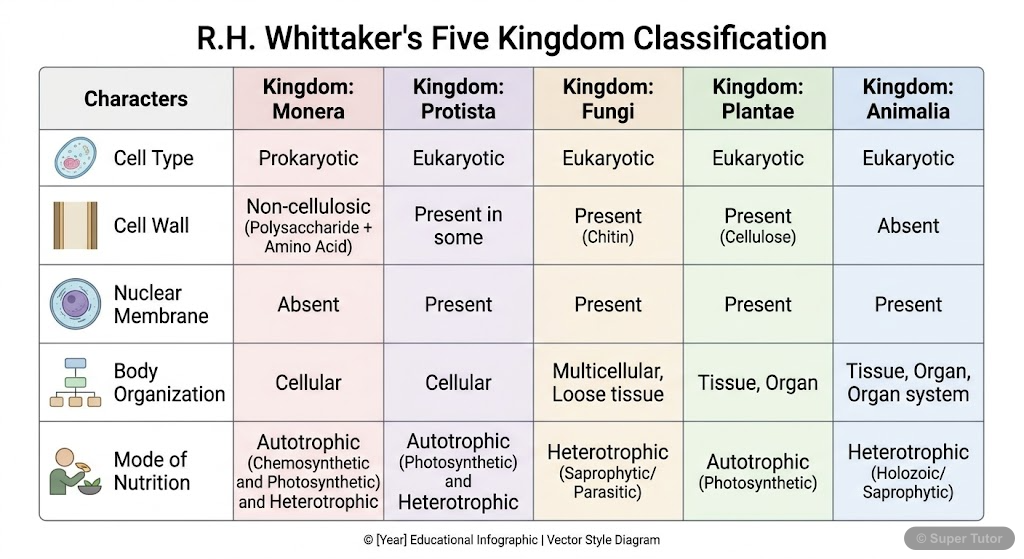
One of 9 illustrations for Classification of Plants in Super Tutor — alongside flashcards, concept maps and practice questions.
Study Plan
Learn the Theory
Read the textbook chapter carefully. Note down definitions, formulas and key ideas. Focus on: Meaning and Need of Classification, Five Kingdom Classification, Kingdom Monera and Bacteria.
Practise
Solve the textbook exercises and extra practice questions. There are 43 questions available for this chapter.
Revise & Test
Revise key points without looking at your notes. Take a practice quiz and mark weak areas for another pass.
Spaced Revision
Come back to Classification of Plants after a week. Use flashcards for quick recall and try past exam questions on this chapter.
What to Focus On
- Classification is grouping organisms with similar features.
- It makes the study of living things easier and systematic.
- It helps in identification and understanding relationships.
- Monera: unicellular, no true nucleus, prokaryotic.
- Protista: unicellular, well-developed nucleus, eukaryotic.
- Fungi: chlorophyll absent, saprophytic nutrition.
- Bacteria are unicellular and microscopic.
- They are prokaryotes because the nuclear membrane is absent.
- Their cell wall is rigid and not made of cellulose.
Common Mistakes to Avoid
All living things were always correctly placed into only two kingdoms: plants and animals.
Euglena belongs to Plantae because it has chlorophyll.
Bacteria are plants because they have a cell wall.
Memory Tips
Five kingdom classification by Robert Whittaker
Why the two-kingdom classification was not enough
Monera includes bacteria
Bacterial shapes
Want a personalised study plan?
Super Tutor builds a day-by-day plan for ICSE Class 7 Biology that fits your exam date and pace.
Create My Study PlanFrequently Asked Questions
What are the important topics in Classification of Plants for ICSE Class 7 Biology?
How should I revise Classification of Plants for Class 7 exams?
Sources & Official References
Content is aligned to the official syllabus. Refer to the board website for the latest curriculum.
More resources for Classification of Plants
Practice Quiz
Test yourself with a quick quiz
Important Questions
Exam-style questions with answers
Revision Notes
Key points for last-minute revision
Chapter Summary
Understand the chapter at a glance
Concept Maps
See how topics connect
Flashcards
Quick-fire cards for active recall
Syllabus
What topics to cover
For serious students
Get the full Classification of Plants chapter — start free.
Quizzes, flashcards, an AI doubt solver and a study plan for ICSE Class 7 Biology. Free to start, no card needed.