Classification of Plants — Important Questions
ICSE · Class 7 · Biology
43 important questions from Classification of Plants for ICSE Class 7 Biology, with answers. Includes multiple choice questions.
Interactive on Super Tutor
Studying Classification of Plants? Get the full interactive chapter.
Quizzes, flashcards, AI doubt-solver and a step-by-step study plan — built for important questions and more.
Free trial, no card needed.
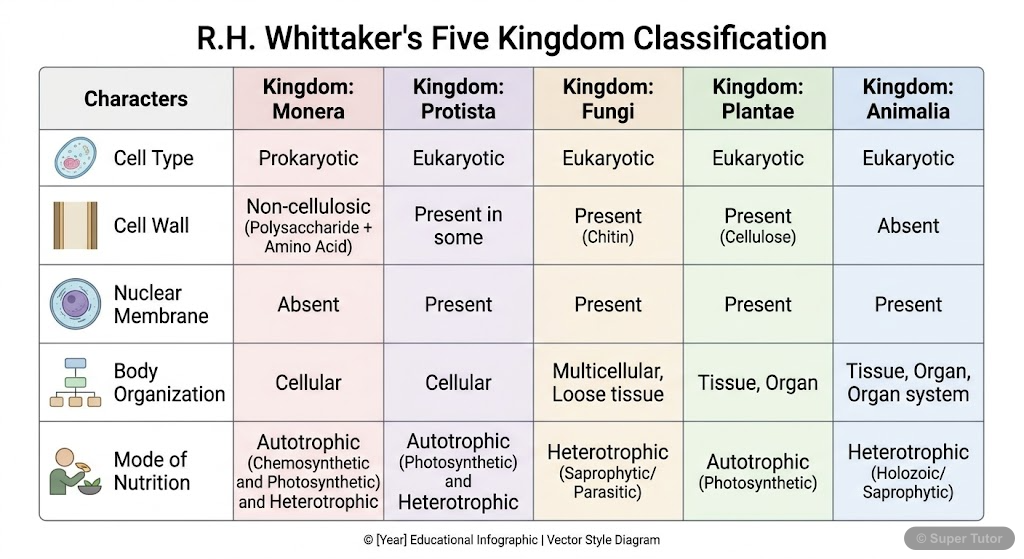
One of 9 illustrations for Classification of Plants in Super Tutor — alongside flashcards, concept maps and practice questions.
Important Questions from Classification of Plants
Bread mould (Rhizopus) grows on the top surface of bread but NOT in the inner layers. Which of the following correctly explains this observation and also describes how bread mould obtains its nutrition?
Show answer
Bread mould respires aerobically and needs oxygen; it is a saprophyte that digests food outside its body using enzymes secreted by hyphae.
Step 1: Bread mould grows on the TOP of bread because respiration in bread mould is mainly AEROBIC – it needs oxygen from the air. The inner layers of bread have less oxygen. Step 2: This explains the observation that mould is seen only on the surface. Step 3: For nutrition, bread mould is a saprophyte – it lives on dead organic matter (stale bread). Step 4: The hyphae of bread mould secrete digestive enzymes (digestive juices) INTO the bread. These enzymes break down starch into glucose outside the mould's body. Step 5: The glucose is then absorbed through the hyphae and stored as glycogen. T
Amoeba uses pseudopodia for both locomotion and feeding. Which of the following statements MOST accurately describes the structural basis of pseudopodium formation?
Show answer
Pseudopodia are temporary finger-like extensions formed by the outward flow of cytoplasm along with the cell membrane.
Step 1: The word 'pseudopodium' comes from Greek – 'pseudo' means false and 'podium' means foot. So pseudopodia are false feet. Step 2: They are NOT permanent structures. They form temporarily when needed and disappear afterward. Step 3: Structurally, pseudopodia form when the cytoplasm flows outward in a particular direction, pushing the cell membrane with it, creating a finger-like projection. Step 4: Amoeba extends one pseudopodium longer than the others in the direction of movement, and the rest of the body flows into it. Step 5: Option A is wrong because Amoeba has no cell wall and pseudo
A student observes that Amoeba excretes ammonia as its main waste product. Through which process and structure is EXCESS WATER (along with some ammonia) removed from the body of Amoeba?
Show answer
Excess water and ammonia are expelled through the contractile vacuole, which expands when full and shrinks to release the contents.
Step 1: Amoeba produces ammonia as its main nitrogenous waste product from metabolic activities. Step 2: Most of the ammonia diffuses out directly through the cell membrane (general body surface) by the process of diffusion. Step 3: However, EXCESS WATER is collected in a special structure called the contractile vacuole. Step 4: Since ammonia is soluble in water, some ammonia is also expelled along with water through the contractile vacuole. Step 5: The contractile vacuole works rhythmically – it expands as water accumulates and then contracts (shrinks) to push the water out of the cell. Optio
Which of the following CORRECTLY pairs the shape of bacteria with its specific example and associated disease?
Show answer
Vibrio shape – Vibrio cholerae – causes cholera.
Step 1: Bacteria are classified into four shapes – coccus (spherical), bacillus (rod-shaped), spirillum (spiral), and vibrio (comma-shaped). Step 2: Vibrio cholerae is a comma-shaped bacterium – it belongs to the vibrio form. Step 3: It is responsible for causing cholera, a dangerous water-borne disease. Step 4: Option A is wrong because Vibrio cholerae is NOT spiral (spirillum); it is comma-shaped (vibrio). This is a common confusion. Step 5: Option C is wrong because Streptococcus pneumoniae is a coccus (spherical) shaped bacterium, not bacillus. Option D is wrong because Salmonella typhi is
+39 more questions on Classification of Plants (ICSE Class 7 Biology)
Practise AllFrequently Asked Questions
What are the important topics in Classification of Plants for ICSE Class 7 Biology?
How many important questions are there in Classification of Plants?
Sources & Official References
Content is aligned to the official syllabus. Refer to the board website for the latest curriculum.
More resources for Classification of Plants
For serious students
Get the full Classification of Plants chapter — start free.
Quizzes, flashcards, an AI doubt solver and a study plan for ICSE Class 7 Biology. Free to start, no card needed.