Ecosystems — Chapter Summary
ICSE · Class 8 · Biology
Summary of Ecosystems for ICSE Class 8 Biology. Key concepts: An ecosystem is a self, Biotic components are living and Green plants are producers.
Interactive on Super Tutor
Studying Ecosystems? Get the full interactive chapter.
Quizzes, flashcards, AI doubt-solver and a step-by-step study plan — built for chapter summary and more.
Free trial, no card needed.
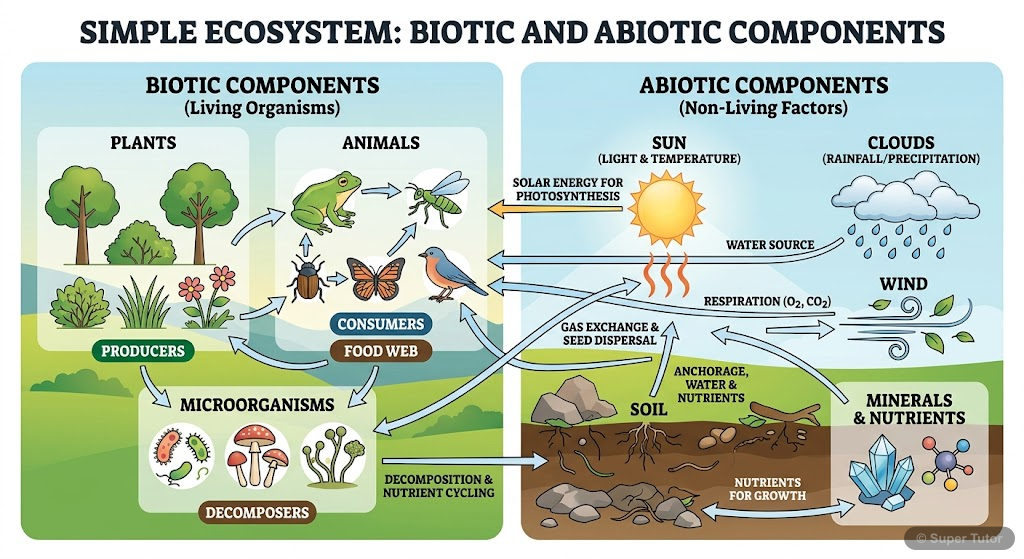
An illustration from Super Tutor's Ecosystems chapter — alongside flashcards, concept maps and practice questions.
Overview
An ecosystem is a self-contained area where living organisms and non-living conditions interact with one another. A forest ecosystem shows this clearly through plants, animals, microorganisms, sunlight, air, water, soil, and climate. Organisms depend on one another for food, shelter, pollination, se
Key Concepts
An ecosystem is a self
An ecosystem is a self-contained area made up of all the different organisms living in it and the physical conditions around them, such as sunlight, a
Biotic components are living parts
Biotic components are living parts of an ecosystem, such as plants, animals, and microorganisms. Abiotic components are non-living parts such as sunli
Green plants are producers because they
Green plants are producers because they make their own food by photosynthesis. They are also called autotrophs, meaning self-food producers.
All organisms other than autotrophs
All organisms other than autotrophs are heterotrophs, meaning differently nourished. Plant-eating animals are primary consumers, while flesh-eating an
A food chain is the linear
A food chain is the linear sequence of organisms in which each organism eats the lower member and is itself eaten by the next higher member. A chain m
Learning Objectives
- Define ecosystem and identify its biotic and abiotic components
- Explain producers, consumers, decomposers, scavengers, detritivores, and heterotrophs
- Describe food chains, food webs, and food pyramids
- Understand trophic levels in a forest ecosystem
- Recognize interdependence among organisms through symbiosis, parasitism, and predation
Frequently Asked Questions
What are the important topics in Ecosystems for ICSE Class 8 Biology?
How should I revise Ecosystems for Class 8 exams?
Sources & Official References
Content is aligned to the official syllabus. Refer to the board website for the latest curriculum.
More resources for Ecosystems
Practice Quiz
Test yourself with a quick quiz
Important Questions
Exam-style questions with answers
Revision Notes
Key points for last-minute revision
Formula Sheet
The chapter's formulas in one place
Concept Maps
See how topics connect
Study Plan
Step-by-step plan for this chapter
Flashcards
Quick-fire cards for active recall
Syllabus
What topics to cover
For serious students
Get the full Ecosystems chapter — start free.
Quizzes, flashcards, an AI doubt solver and a study plan for ICSE Class 8 Biology. Free to start, no card needed.