Chapter 2 of 9
Revision Notes
Reproduction In Plants — Revision Notes
ICSE · Class 8 · Biology
Reproduction In Plants revision notes for ICSE Class 8 Biology: 4 topics in quick points. Part of the ICSE Class 8 Biology syllabus.
45 questions40 flashcards5 concepts
Interactive on Super Tutor
Studying Reproduction In Plants? Get the full interactive chapter.
Quizzes, flashcards, AI doubt-solver and a step-by-step study plan — built for revision notes and more.
Free trial, no card needed.
Super Tutor
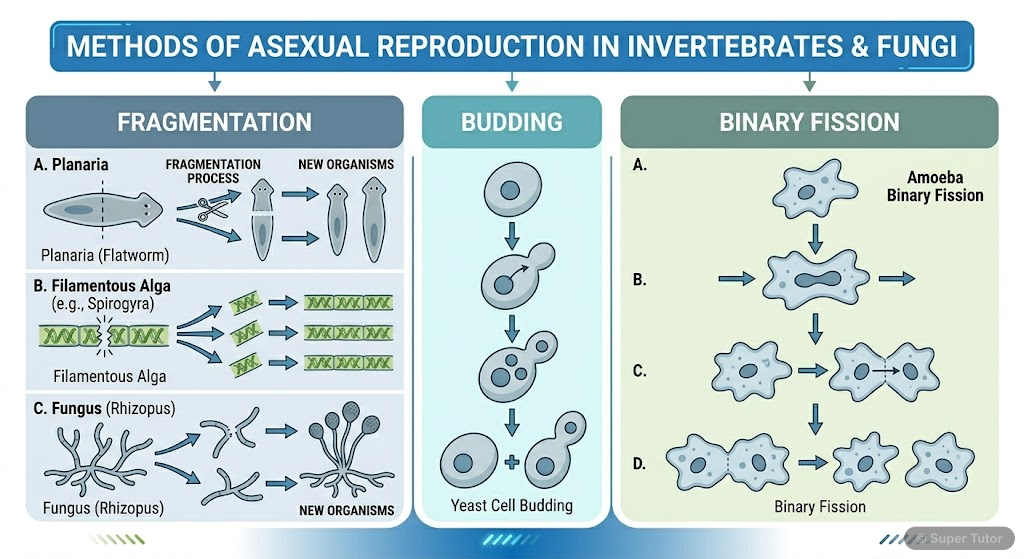
Learn better with visuals Super Tutor pairs illustrations like this with notes and quizzes for Reproduction In Plants.
Key Topics to Revise
1
1. Modes of Reproduction
- Reproduction means producing young ones of the same kind.
- Asexual reproduction involves only one parent and no fusion of gametes.
- Sexual reproduction involves two parents and fusion of male and female gametes.
2
2. Asexual Reproduction in Plants
- Binary fission occurs in bacteria.
- In binary fission, the nucleus splits into two and the cell splits into two identical daughter cells.
- Multiple fission occurs in Chlorella and Chlamydomonas, where one cell divides into four daughter cells.
3
3. Natural Vegetative Propagation
- Vegetative reproduction can occur through stem, leaf, or root.
- Ginger, potato, and onion are modified stems because they store food and help in vegetative propagation.
- Ginger has nodes, internodes, scaly leaves, and axillary buds at the nodes.
4
4. Artificial Vegetative Propagation
- Cutting, layering, grafting, and micro-propagation are artificial methods of vegetative propagation.
- In cutting, a stem piece with an axillary bud is planted in moist soil and grows into a new plant.
- In layering, a branch is bent to the ground, covered with soil, and later cut from the parent plant after roots form.
Get complete notes with diagrams and examples
Full NotesKey Concepts
Reproduction means producing young onesAsexual reproduction takes place with oneIn bacteriaIn Chlorella and ChlamydomonasIn yeast
Frequently Asked Questions
What are the important topics in Reproduction In Plants for ICSE Class 8 Biology?
Key topics in Reproduction In Plants include Modes of Reproduction, Asexual Reproduction in Plants, Natural Vegetative Propagation, Artificial Vegetative Propagation. Study these first, then practise questions on each for Class 8 exams.
How should I revise Reproduction In Plants for Class 8 exams?
Learn the core ideas first, then work through the 45 practice questions on Reproduction In Plants. Revise definitions regularly and use flashcards for quick recall before the exam.
Sources & Official References
Content is aligned to the official syllabus. Refer to the board website for the latest curriculum.
More resources for Reproduction In Plants
For serious students
Get the full Reproduction In Plants chapter — start free.
Quizzes, flashcards, an AI doubt solver and a study plan for ICSE Class 8 Biology. Free to start, no card needed.