Ecosystems
ICSE · Class 8 · Biology
Most important questions from Ecosystems for ICSE Class 8 Biology board exam 2026. MCQs, short answer, and long answer questions with marks.
Interactive on Super Tutor
Studying Ecosystems? Get the full interactive chapter.
Quizzes, flashcards, AI doubt-solver and a step-by-step study plan — built for important questions and more.
1,000+ Class 8 students started this chapter today
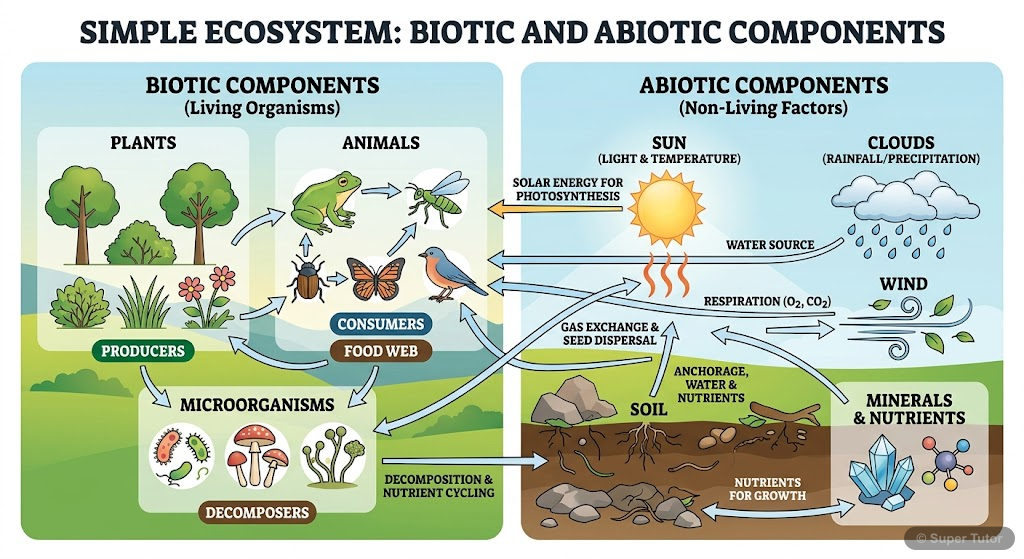
Learn better with visuals Super Tutor has hundreds of illustrations like this across every chapter — all free to try.
Get startedSample Questions
In the food chain: Grass → Grasshopper → Frog → Snake → Peacock, what is the trophic level of the snake?
Show answer
Tertiary consumer
Step 1: Let us map each organism in the food chain to its consumer level. Step 2: Grass = Producer (Trophic Level I). Step 3: Grasshopper eats grass = Primary Consumer (Trophic Level II). Step 4: Frog eats grasshopper = Secondary Consumer (Trophic Level III). Step 5: Snake eats frog = Tertiary Consumer (Trophic Level IV). The peacock that eats the snake would be the Quaternary consumer.
Which of the following organisms are classified as decomposers in an ecosystem?
Show answer
Bacteria and fungi
Step 1: After death, organisms are broken down in stages. Step 2: Scavengers like vultures and kites eat the dead flesh – they are NOT decomposers. Step 3: Detritivores like earthworms and millipedes feed on decomposing plant and animal parts (detritus) – but they ingest material directly. Step 4: Decomposers are organisms that break down dead organic matter by absorbing nutrients – they cannot ingest matter directly. Step 5: Bacteria, fungi, and protists are true decomposers because they secrete enzymes and absorb the broken-down nutrients.
Which abiotic factor is directly responsible for the production of food in green plants?
Show answer
Sunlight
Step 1: Green plants produce food through the process of photosynthesis. Step 2: Photosynthesis requires sunlight as the energy source to convert carbon dioxide and water into glucose. Step 3: Wind helps in dispersal of seeds and pollen but does not directly help in food production. Step 4: Humidity refers to water vapour in the air – it influences climate but is not the direct energy source for photosynthesis. Step 5: Soil provides minerals and support but is not the energy source for food production. Hence, sunlight is the correct answer.
What is a food web?
Show answer
A network of interconnecting food chains in a community
Step 1: A food chain is a single, straight sequence – e.g., Grass → Rabbit → Fox. Step 2: In reality, animals eat more than one type of food, so many food chains overlap and connect. Step 3: This complex network of interconnected food chains is called a food web. Step 4: Option C is wrong – a food web includes all organisms, not just producers. Step 5: Option D describes a pyramid of numbers, not a food web. Food webs provide more stability to an ecosystem than a simple food chain.
+40 more questions available
Practice AllFrequently Asked Questions
What are the important topics in Ecosystems for ICSE Class 8 Biology?
How to score full marks in Ecosystems — ICSE Class 8 Biology?
How many important questions are there in Ecosystems?
Sources & Official References
Content is aligned to the official syllabus. Refer to the board website for the latest curriculum.
More resources for Ecosystems
Practice Quiz
Test yourself with a quick quiz
Revision Notes
Key points for last-minute revision
Formula Sheet
All formulas in one place
Chapter Summary
Understand the chapter at a glance
Concept Maps
See how topics connect visually
Study Plan
Step-by-step plan to ace this chapter
Flashcards
Quick-fire cards for active recall
Syllabus
What topics to cover
NCERT Solutions
Every textbook question solved step by step
For serious students
Get the full Ecosystems chapter — for free.
Quizzes, flashcards, AI doubt-solver and a step-by-step study plan for ICSE Class 8 Biology.