Endocrine System and Adolescence — Practice Quiz
ICSE · Class 8 · Biology
Try a 4-question quiz on Endocrine System and Adolescence for ICSE Class 8 Biology: tap an answer to check it and see why.
Interactive on Super Tutor
Studying Endocrine System and Adolescence? Get the full interactive chapter.
Quizzes, flashcards, AI doubt-solver and a step-by-step study plan — built for practice quiz and more.
Free trial, no card needed.
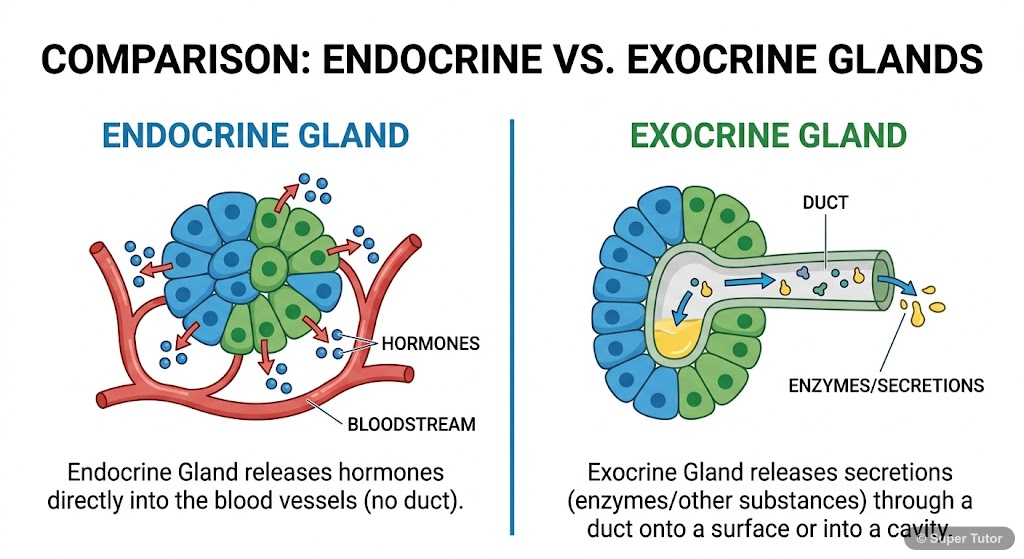
One of 7 illustrations for Endocrine System and Adolescence in Super Tutor — alongside flashcards, concept maps and practice questions.
Quick Quiz: Endocrine System and Adolescence
0/4Tap an answer to check it instantly. No sign-up needed for these 4.
Which type of glands are called 'ductless glands'?
Where is the thyroid gland located in the human body?
What is the hormone secreted by the thyroid gland?
Simple goitre is caused due to the deficiency of which mineral in our diet?
Sample Questions
Adrenaline is secreted by which part of the adrenal gland?
Show answer
Medulla of the adrenal gland
Step 1: The adrenal gland has two distinct parts — the outer cortex and the inner medulla. Step 2: The medulla (inner part) secretes adrenaline, which is also called epinephrine or the 'emergency hormone'. Step 3: The cortex (outer part) secretes hormones like cortisol, which regulate metabolism and the body's response to stress like extreme heat or cold. Step 4: Islets of Langerhans are present in the pancreas and secrete insulin and glucagon — not adrenaline. Step 5: Thyroid follicles are part of the thyroid gland. So only the medulla of the adrenal gland produces adrenaline.
Why is adrenaline called the 'fight or flight hormone'?
Show answer
It prepares the body to face or escape from an emergency situation
Step 1: Adrenaline is released when a person is under stress, fear, or anger. Step 2: This hormone quickly prepares the body for action — it increases heart beat, speeds up breathing, raises blood pressure, and releases extra glucose into the blood. Step 3: All these changes give the body extra energy and strength to either face the danger (fight) or run away from it (flight). Step 4: This is why it is called the 'fight or flight hormone' — it helps you deal with emergencies. Step 5: It does NOT control blood sugar during meals (that is insulin's job), does not help digestion, and does not sti
Which cells in the pancreas are responsible for secreting hormones?
Show answer
Islets of Langerhans
Step 1: The pancreas is mainly a digestive gland that produces digestive enzymes. Step 2: However, it also has a special cluster of cells called the Islets of Langerhans that function as endocrine tissue. Step 3: These cells secrete two important hormones — insulin and glucagon — which regulate blood sugar levels. Step 4: Alveoli are tiny air sacs in the lungs, not related to the pancreas. Step 5: Thyroid follicles are in the thyroid gland. So Islets of Langerhans is the correct answer for the hormone-secreting part of the pancreas.
Insufficient secretion of insulin leads to which disease?
Show answer
Diabetes mellitus
Step 1: Insulin is the hormone that lowers blood sugar (glucose) levels. It converts extra glucose to glycogen and helps cells use glucose for energy. Step 2: When insulin is not secreted in sufficient amounts, glucose is not properly regulated and builds up in the blood. Step 3: This condition of high blood sugar is called diabetes mellitus. Step 4: A diabetic person excretes sugar in urine, feels very thirsty, loses weight, and becomes weak. Step 5: Goitre and myxoedema are caused by thyroid problems, and cretinism is due to thyroxine deficiency in infants — none of these are related to insu
+39 more questions on Endocrine System and Adolescence (ICSE Class 8 Biology)
Practise AllFrequently Asked Questions
What are the important topics in Endocrine System and Adolescence for ICSE Class 8 Biology?
How many practice questions are there for Endocrine System and Adolescence?
Sources & Official References
Content is aligned to the official syllabus. Refer to the board website for the latest curriculum.
More resources for Endocrine System and Adolescence
Important Questions
Exam-style questions with answers
Revision Notes
Key points for last-minute revision
Chapter Summary
Understand the chapter at a glance
Concept Maps
See how topics connect
Study Plan
Step-by-step plan for this chapter
Flashcards
Quick-fire cards for active recall
Syllabus
What topics to cover
For serious students
Get the full Endocrine System and Adolescence chapter — start free.
Quizzes, flashcards, an AI doubt solver and a study plan for ICSE Class 8 Biology. Free to start, no card needed.