The Union Legislature — Chapter Summary
ICSE · Class 8 · History & Civics
Summary of The Union Legislature for ICSE Class 8 History & Civics. Part of the ICSE Class 8 History & Civics syllabus.
Interactive on Super Tutor
Studying The Union Legislature? Get the full interactive chapter.
Quizzes, flashcards, AI doubt-solver and a step-by-step study plan — built for chapter summary and more.
Free trial, no card needed.
Learn better with visuals Super Tutor pairs illustrations like this with notes and quizzes for The Union Legislature.
Overview
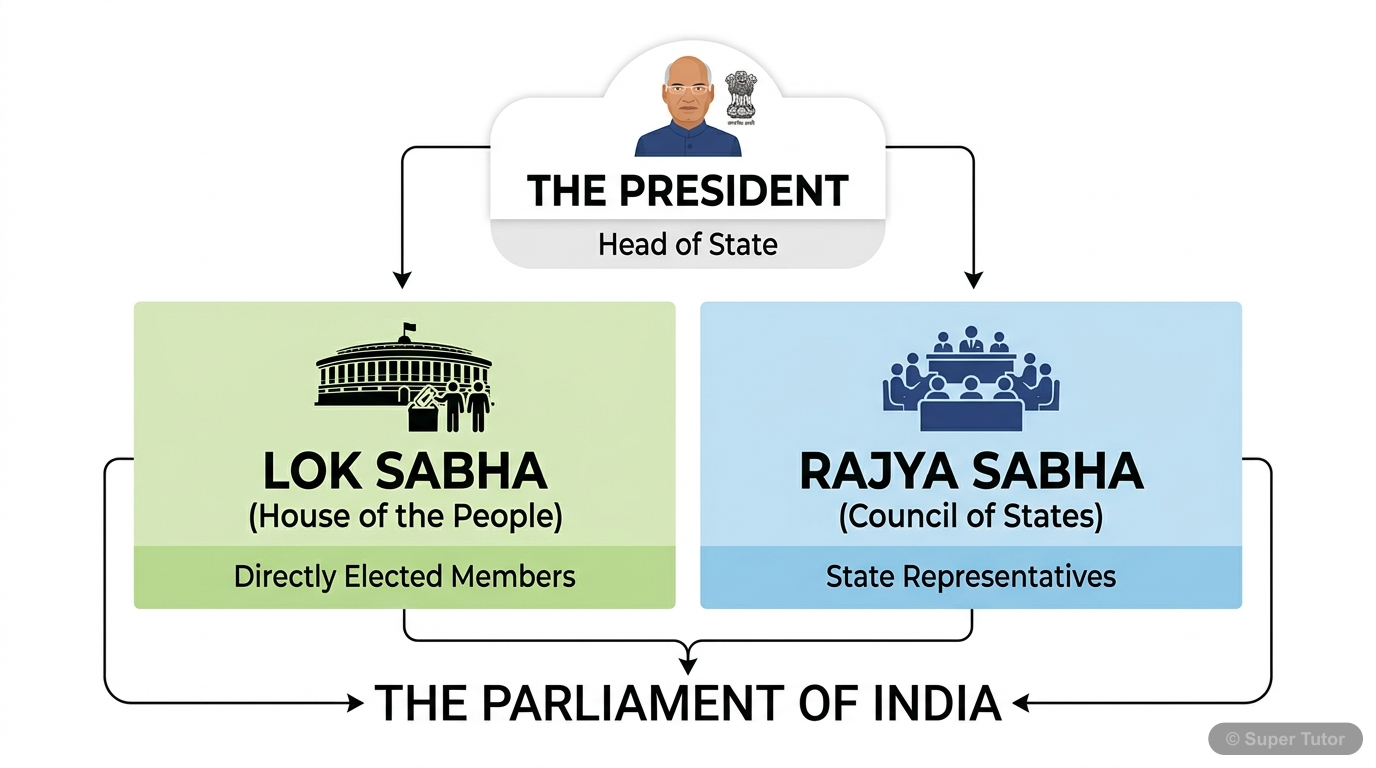
The Union Legislature of India is called Parliament, also known as Sansad. It is the highest law-making body of the country and consists of the President and two Houses: the Lok Sabha and the Rajya Sabha. Parliament makes laws, controls finance, and checks the work of the government. It also has imp
Key Concepts
Parliament is the central legislature
Parliament is the central legislature of India. It consists of the President and two Houses: the Lok Sabha and the Rajya Sabha. It is situated in New
The Lok Sabha is the Lower
The Lok Sabha is the Lower House or House of the People. Its members are directly elected by the people for five years. It can have a maximum strength
The Rajya Sabha is the Upper
The Rajya Sabha is the Upper House or Council of States. It has 245 members, of whom 233 are elected by the State Legislative Assemblies and 12 are no
The Speaker is the presiding officer
The Speaker is the presiding officer of the Lok Sabha. The Speaker maintains order, discipline, and conducts business. The Deputy Speaker presides in
The Vice President of India
The Vice President of India is the ex-officio Chairman of the Rajya Sabha. The Vice President supervises proceedings and presides over its sessions. T
Learning Objectives
- Understand the structure of the Union Legislature
- Identify the roles of the Lok Sabha, Rajya Sabha, and the President in Parliament
- Learn how members of both Houses are elected and what qualifications they need
- Explain how a bill becomes a law
- Recognize the law-making, financial, control, and judicial powers of Parliament
Frequently Asked Questions
What are the important topics in The Union Legislature for ICSE Class 8 History & Civics?
How should I revise The Union Legislature for Class 8 exams?
Sources & Official References
Content is aligned to the official syllabus. Refer to the board website for the latest curriculum.
More resources for The Union Legislature
For serious students
Get the full The Union Legislature chapter — start free.
Quizzes, flashcards, an AI doubt solver and a study plan for ICSE Class 8 History & Civics. Free to start, no card needed.