The Judiciary — Chapter Summary
ICSE · Class 8 · History & Civics
Summary of The Judiciary for ICSE Class 8 History & Civics. Part of the ICSE Class 8 History & Civics syllabus.
Interactive on Super Tutor
Studying The Judiciary? Get the full interactive chapter.
Quizzes, flashcards, AI doubt-solver and a step-by-step study plan — built for chapter summary and more.
Free trial, no card needed.
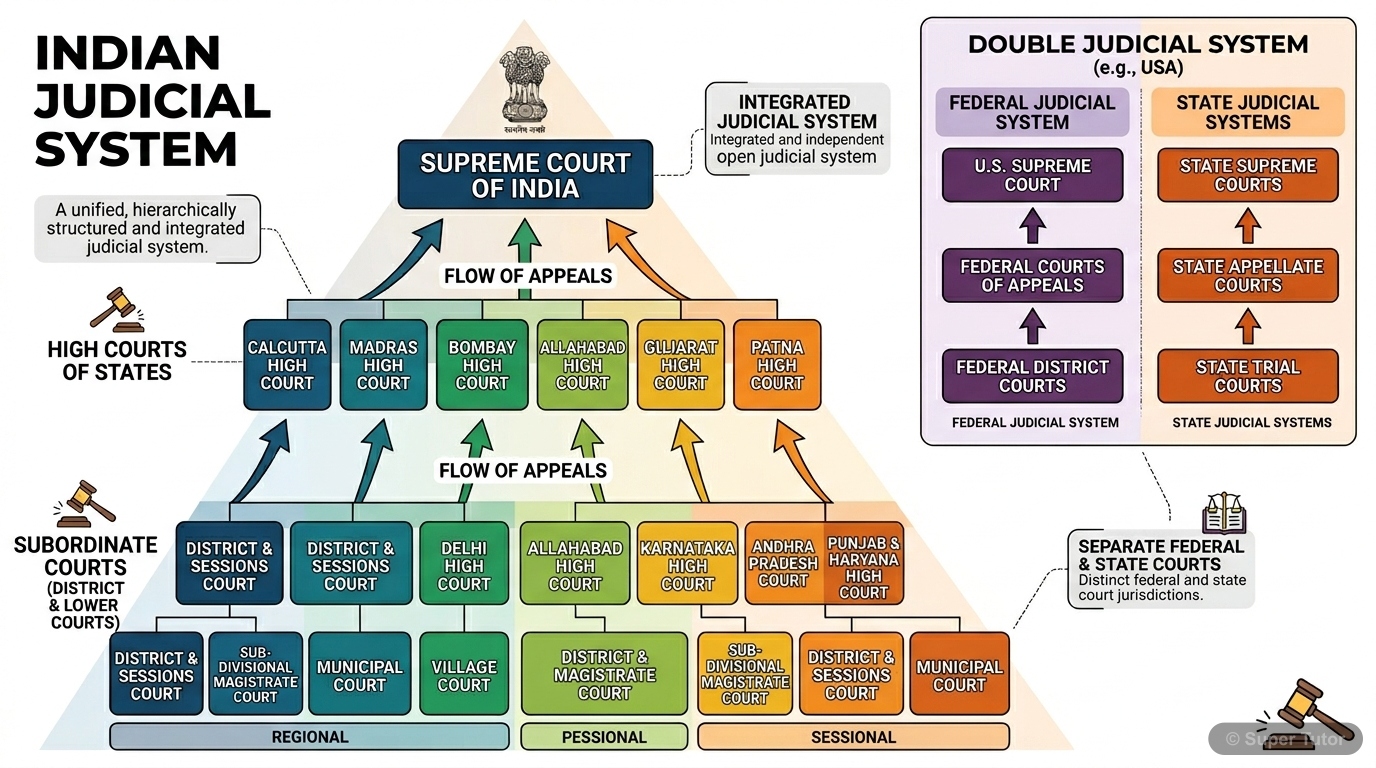
Learn better with visuals Super Tutor pairs illustrations like this with notes and quizzes for The Judiciary.
Overview
The judiciary is the part of the government that interprets laws, explains their meaning, and gives punishment to law breakers. India has an independent, uniform, and integrated judicial set-up. The court system is arranged like a pyramid, with the Supreme Court at the top, High Courts in the middle
Key Concepts
The judiciary interprets laws
The judiciary interprets laws, explains their meaning, and punishes law breakers. It helps maintain justice and protects rights.
India’s judicial system is arranged like
India’s judicial system is arranged like a pyramid. The Supreme Court is at the apex, High Courts are below it, and District Courts and other subordin
The Supreme Court is the top
The Supreme Court is the top judicial set-up of India. It consists of the Chief Justice and 33 other judges. Judges are appointed by the President of
Original jurisdiction means the authority
Original jurisdiction means the authority to hear a case for the first time. Cases involving interpretation of the Constitution, disputes between the
The Supreme Court hears appeals after
The Supreme Court hears appeals after cases have gone through the District Court and High Court.
Learning Objectives
- Understand the role of the judiciary in the government
- Learn the structure of the Indian court system
- Identify the powers and functions of the Supreme Court
- Understand the role of High Courts and subordinate courts
- Learn the meaning and use of important writs
Frequently Asked Questions
What are the important topics in The Judiciary for ICSE Class 8 History & Civics?
How should I revise The Judiciary for Class 8 exams?
Sources & Official References
Content is aligned to the official syllabus. Refer to the board website for the latest curriculum.
More resources for The Judiciary
For serious students
Get the full The Judiciary chapter — start free.
Quizzes, flashcards, an AI doubt solver and a study plan for ICSE Class 8 History & Civics. Free to start, no card needed.