Matter — Important Questions
ICSE · Class 8 · Physics
45 important questions from Matter for ICSE Class 8 Physics, with answers. Includes multiple choice questions. Part of the ICSE Class 8 Physics syllabus.
Interactive on Super Tutor
Studying Matter? Get the full interactive chapter.
Quizzes, flashcards, AI doubt-solver and a step-by-step study plan — built for important questions and more.
Free trial, no card needed.
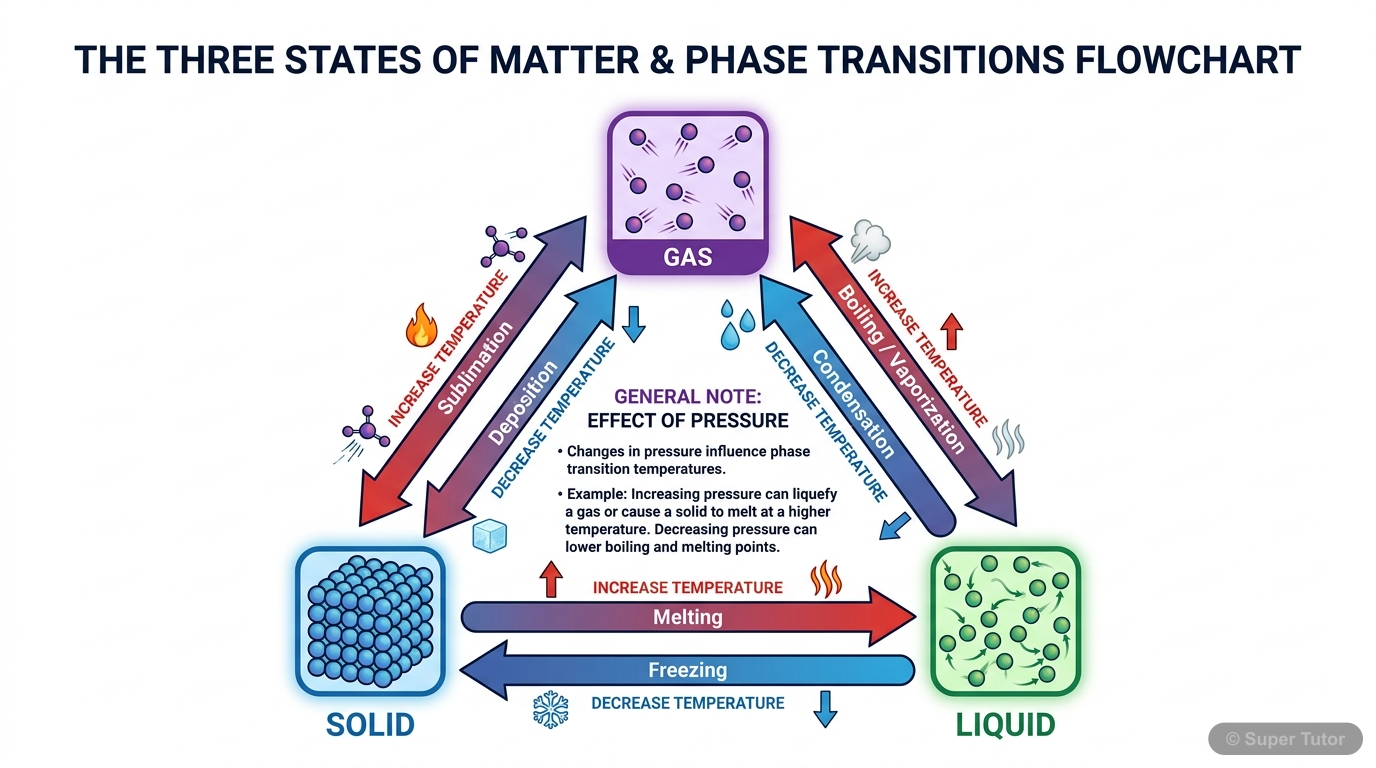
Learn better with visuals Super Tutor pairs illustrations like this with notes and quizzes for Matter.
Important Questions from Matter
During the process of condensation of steam at 100°C, what happens to the temperature of the steam and the heat energy?
Show answer
Temperature remains constant at 100°C as steam releases latent heat to become water
Step 1: Condensation is the reverse process of vaporization/boiling — steam changes into water. Step 2: Just like melting/freezing, condensation occurs at a fixed, constant temperature (100°C for steam-to-water). Step 3: During condensation, the steam RELEASES (gives out) heat to the surroundings, not absorbs. Step 4: This released heat is latent heat — the temperature does not change during the process even though heat is being given out. Step 5: Option A is wrong as temperature does not rise. Option C is wrong because steam releases heat (does not absorb) and temperature stays at 100°C. Opti
A student sprays perfume in one corner of a classroom. Within a short time, the smell is detected throughout the room. Which property of molecules does this activity primarily demonstrate?
Show answer
Molecules are in constant random motion
Step 1: When perfume is sprayed, the perfume molecules are released into the air as a gas. Step 2: Gas molecules possess high kinetic energy and move in random directions at high speeds. Step 3: As the perfume molecules move randomly, they mix with air molecules and spread throughout the room — this is called diffusion. Step 4: If molecules were not in constant motion, the smell would only be detected near the corner where it was sprayed. Step 5: Option A (intermolecular spaces) explains salt dissolving in water without volume change. Option B (small size) explains why molecules can't be seen.
Ice has a melting point of 0°C and its latent heat of fusion is 336 × 10³ J/kg. How much heat energy is required to melt 2 kg of ice at 0°C into water at 0°C?
Show answer
672 × 10³ J
Step 1: Identify the given values. Mass of ice (m) = 2 kg. Specific latent heat of fusion of ice (L) = 336 × 10³ J/kg. Step 2: The formula for heat absorbed during melting is: Q = m × L. Step 3: Substitute values: Q = 2 kg × 336 × 10³ J/kg. Step 4: Calculate: Q = 672 × 10³ J. Step 5: This heat is used only to break intermolecular bonds and change the state — the temperature remains at 0°C throughout. Option A (168 × 10³ J) would be the answer if mass were 0.5 kg. Option B is the latent heat for 1 kg only. Option D would be for 3 kg of ice.
Which of the following correctly distinguishes evaporation from boiling?
Show answer
Evaporation occurs at all temperatures from the surface; boiling occurs at a fixed temperature throughout the liquid
Step 1: Evaporation is the process of liquid changing to vapour from its surface at ANY temperature. Step 2: Boiling (vaporization) is a rapid process where the entire liquid converts to vapour at a specific fixed temperature called the boiling point. Step 3: For water, boiling occurs at 100°C, but evaporation occurs even at 25°C or 40°C etc. Step 4: Option A is exactly the opposite of the correct answer — evaporation is at the surface and boiling is throughout. Step 5: Option C is wrong because evaporation is slow and boiling is rapid. Option D is wrong because evaporation produces COOLING of
+41 more questions on Matter (ICSE Class 8 Physics)
Practise AllFrequently Asked Questions
What are the important topics in Matter for ICSE Class 8 Physics?
How many important questions are there in Matter?
Sources & Official References
Content is aligned to the official syllabus. Refer to the board website for the latest curriculum.
More resources for Matter
Practice Quiz
Test yourself with a quick quiz
Revision Notes
Key points for last-minute revision
Formula Sheet
The chapter's formulas in one place
Chapter Summary
Understand the chapter at a glance
Concept Maps
See how topics connect
Study Plan
Step-by-step plan for this chapter
Flashcards
Quick-fire cards for active recall
Syllabus
What topics to cover
For serious students
Get the full Matter chapter — start free.
Quizzes, flashcards, an AI doubt solver and a study plan for ICSE Class 8 Physics. Free to start, no card needed.