The Language of Chemistry — Important Questions
ICSE · Class 9 · Chemistry
44 important questions from The Language of Chemistry for ICSE Class 9 Chemistry, with answers. Part of the ICSE Class 9 Chemistry syllabus.
Interactive on Super Tutor
Studying The Language of Chemistry? Get the full interactive chapter.
Quizzes, flashcards, AI doubt-solver and a step-by-step study plan — built for important questions and more.
Free trial, no card needed.
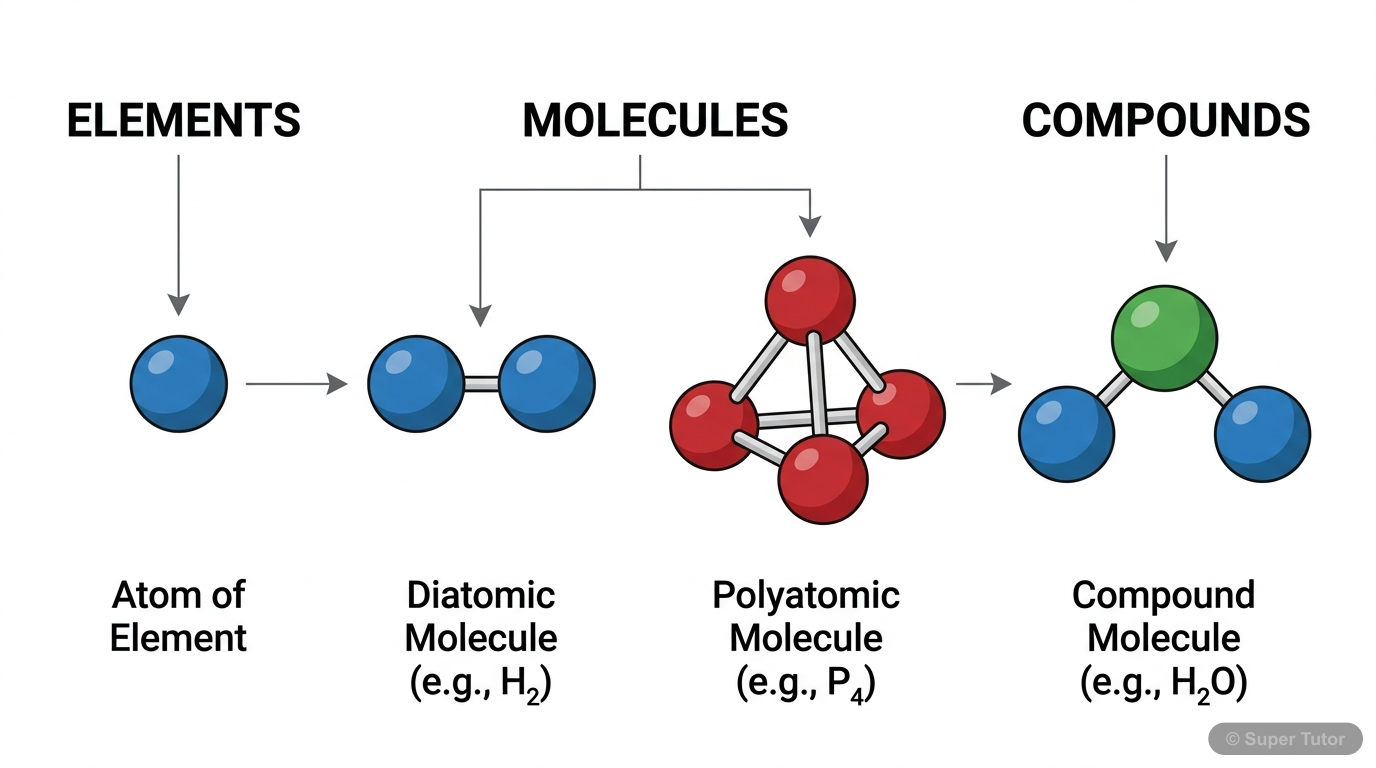
Learn better with visuals Super Tutor pairs illustrations like this with notes and quizzes for The Language of Chemistry.
Important Questions from The Language of Chemistry
Which of the following are correct chemical symbols? (Select all that apply)
Show answer
Fe for Iron, Au for Gold, Ag for Silver, Ca for Calcium
Fe (from Latin Ferrum), Au (from Latin Aurum), Ag (from Latin Argentum), and Ca are all correct element symbols. Co represents the element Cobalt, not carbon monoxide (which is CO).
The valency of hydrogen is always 1.
Show answer
True
Hydrogen has a valency of 1 because it has one electron in its outer shell and can lose, gain, or share one electron during chemical bonding.
Which of the following represent radicals? (Select all that apply)
Show answer
NH₄⁺ (Ammonium), SO₄²⁻ (Sulfate), Na⁺ (Sodium), OH⁻ (Hydroxide)
Radicals are atoms or groups of atoms with positive or negative charges. NH₄⁺, SO₄²⁻, Na⁺, and OH⁻ are all charged radicals. H₂O is a neutral molecule, not a radical.
What does a chemical formula represent?
Show answer
The molecular composition of a substance
A chemical formula shows the types and numbers of atoms present in a molecule of a compound. It represents the molecular composition and ratios of elements.
+40 more questions on The Language of Chemistry (ICSE Class 9 Chemistry)
Practise AllFrequently Asked Questions
What are the important topics in The Language of Chemistry for ICSE Class 9 Chemistry?
How many important questions are there in The Language of Chemistry?
Sources & Official References
Content is aligned to the official syllabus. Refer to the board website for the latest curriculum.
More resources for The Language of Chemistry
Practice Quiz
Test yourself with a quick quiz
Revision Notes
Key points for last-minute revision
Formula Sheet
The chapter's formulas in one place
Chapter Summary
Understand the chapter at a glance
Concept Maps
See how topics connect
Study Plan
Step-by-step plan for this chapter
Flashcards
Quick-fire cards for active recall
Syllabus
What topics to cover
For serious students
Get the full The Language of Chemistry chapter — start free.
Quizzes, flashcards, an AI doubt solver and a study plan for ICSE Class 9 Chemistry. Free to start, no card needed.