The Language of Chemistry — Concept Maps
ICSE · Class 9 · Chemistry
4 concept maps of The Language of Chemistry for ICSE Class 9 Chemistry, each also written out as a text outline.
Interactive on Super Tutor
Studying The Language of Chemistry? Get the full interactive chapter.
Quizzes, flashcards, AI doubt-solver and a step-by-step study plan — built for concept maps and more.
Free trial, no card needed.
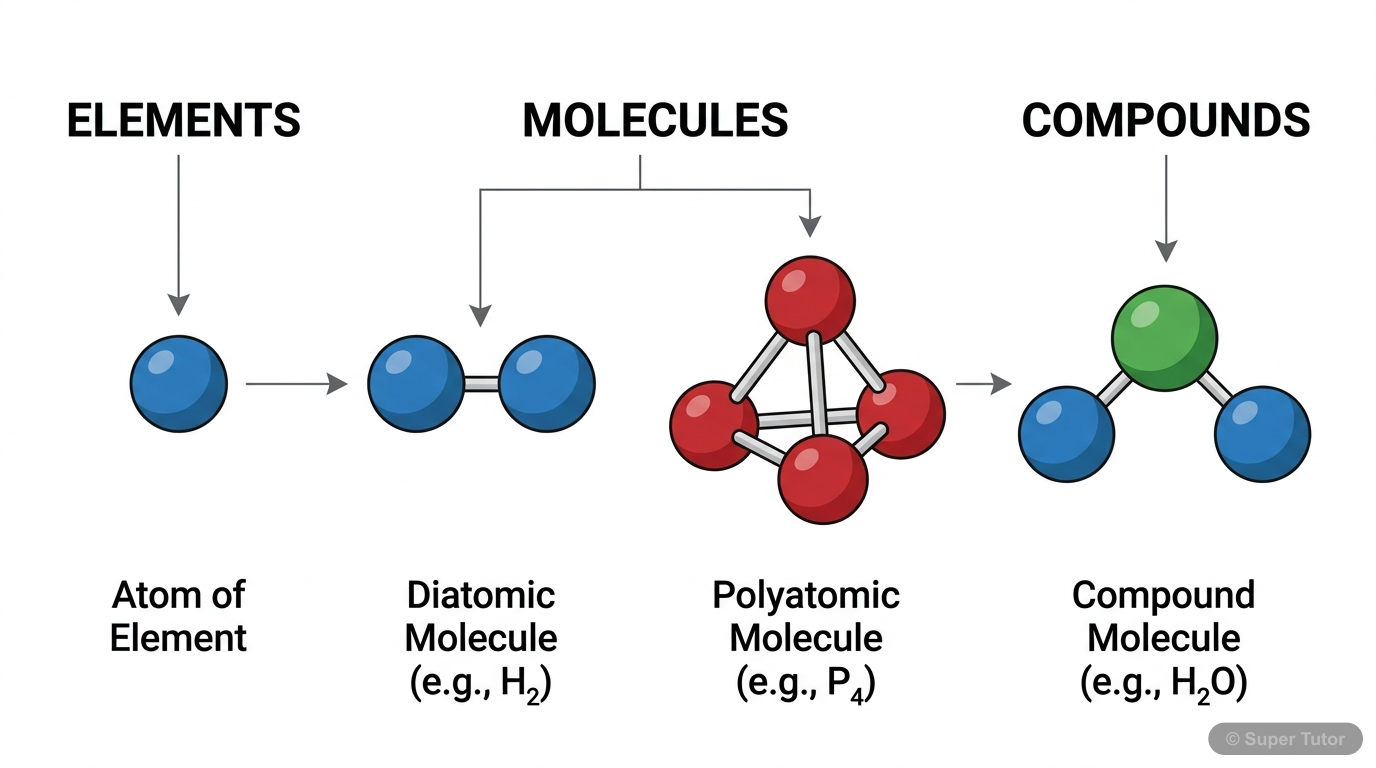
Learn better with visuals Super Tutor pairs illustrations like this with notes and quizzes for The Language of Chemistry.
How to Write a Chemical Formula Using the Criss-Cross Method (With Common Mistake Warnings)
The map in words
- Identify the Two Radicals
- Write Basic Radical First Then Acidic Radical
- Write Valency of Each Radical on Top
- Are Both Valencies Equal?
- Yes: Find HCF of Both Valencies
- Divide Both Subscripts by HCF
- Result is Simplest Formula eg CaO not Ca2O2
- Final Correct Formula
- Result is Simplest Formula eg CaO not Ca2O2
- Divide Both Subscripts by HCF
- No: Criss-Cross the Valencies as Subscripts
- Is Any Subscript Greater Than 1 for a Compound Radical?
- Yes: Enclose Compound Radical in Brackets
- No: Write Formula Directly
- Is Any Subscript Greater Than 1 for a Compound Radical?
- Yes: Find HCF of Both Valencies
- Are Both Valencies Equal?
- Write Valency of Each Radical on Top
- Write Basic Radical First Then Acidic Radical
The Language of Chemistry — Complete Concept Map
The map in words
- Language of Chemistry
- Symbols
- Definition
- Short form for element
- Represents one atom
- Rules
- First letter capital
- Second letter lowercase
- Latin Names
- Na Sodium
- Fe Iron
- Cu Copper
- Au Gold
- Pb Lead
- Definition
- Valency
- Definition
- Combining capacity
- Electrons lost gained shared
- Metals
- Lose electrons
- Form cations
- Monovalent Na K
- Divalent Ca Mg
- Trivalent Al
- Non metals
- Gain electrons
- Form anions
- Chlorine valency 1
- Oxygen valency 2
- Nitrogen valency 3
- Variable Valency
- ous suffix lower
- ic suffix higher
- Roman numerals IUPAC
- Definition
- Radicals
- Basic Positive
- Cations
- From base
- NH4 Na K Ca Fe
- Acid Negative
- Anions
- From acid
- Cl SO4 CO3 OH NO3
- Basic Positive
- Chemical Formula
- Criss Cross Method
- Write cation first
- Write valencies
- Divide by HCF
- Interchange subscripts
- Brackets for polyatomic
- Criss Cross Method
- Chemical Equation
- Definition
- Symbolic representation
- Of chemical reaction
- Balancing
- Law of Conservation
- Hit and Trial Method
- Never change subscripts
- Only add coefficients
- Types of Reactions
- One to Many Decomposition
- Many to One Combination
- Two to Two Displacement
- Definition
- Molecular Mass
- Relative Atomic Mass
- Standard C12 atom
- 1 amu = 1.6605 x 10 minus 24 g
- Relative Molecular Mass
- Sum of atomic masses
- All atoms in molecule
- Relative Atomic Mass
- Percentage Composition
- Formula
- Element mass divided by RMM
- Multiplied by 100
- Empirical Formula
- Simplest ratio
- Whole number atoms
- Formula
- Symbols
The Language of Chemistry — Key Concepts Overview
The map in words
- Language of Chemistry
- Symbols
- Short form of element
- First letter capital
- Second letter small
- Latin names for some
- Valency
- Combining capacity
- Valence electrons
- Monovalent elements
- Divalent elements
- Trivalent elements
- Variable valency
- Radicals
- Basic radical cation
- Acidic radical anion
- Simple radical
- Compound radical
- Formulae
- Criss cross method
- Molecular formula
- Empirical formula
- Chemical Equations
- Skeleton equation
- Balanced equation
- Hit and trial method
- Law of Conservation
- Atomic and Molecular Mass
- Carbon-12 standard
- amu definition
- RMM calculation
- Percentage composition
- Symbols
Chemical symbols, valency, radicals, formulae, chemical equations, balancing, and atomic and molecular masses
The map in words
- Chemical symbols, valency, radicals, formulae, chemical equations, balancing, and atomic and molecular masses
- Chemical symbols
- Molecular formula
- Valency
- Radicals
- Naming compounds
- Chemical equations
- Balancing chemical equations
- Relative atomic mass
Explore these maps interactively
Explore DiagramsFrequently Asked Questions
What are the important topics in The Language of Chemistry for ICSE Class 9 Chemistry?
What do the concept maps for The Language of Chemistry show?
How should I revise The Language of Chemistry for Class 9 exams?
Sources & Official References
Content is aligned to the official syllabus. Refer to the board website for the latest curriculum.
More resources for The Language of Chemistry
Practice Quiz
Test yourself with a quick quiz
Important Questions
Exam-style questions with answers
Revision Notes
Key points for last-minute revision
Formula Sheet
The chapter's formulas in one place
Chapter Summary
Understand the chapter at a glance
Study Plan
Step-by-step plan for this chapter
Flashcards
Quick-fire cards for active recall
Syllabus
What topics to cover
For serious students
Get the full The Language of Chemistry chapter — start free.
Quizzes, flashcards, an AI doubt solver and a study plan for ICSE Class 9 Chemistry. Free to start, no card needed.