The Language of Chemistry — Flashcards
ICSE · Class 9 · Chemistry
30 flashcards for The Language of Chemistry (ICSE Class 9 Chemistry) to test yourself on key terms and facts. Sample: "What is an element?"
Interactive on Super Tutor
Studying The Language of Chemistry? Get the full interactive chapter.
Quizzes, flashcards, AI doubt-solver and a step-by-step study plan — built for flashcards and more.
Free trial, no card needed.
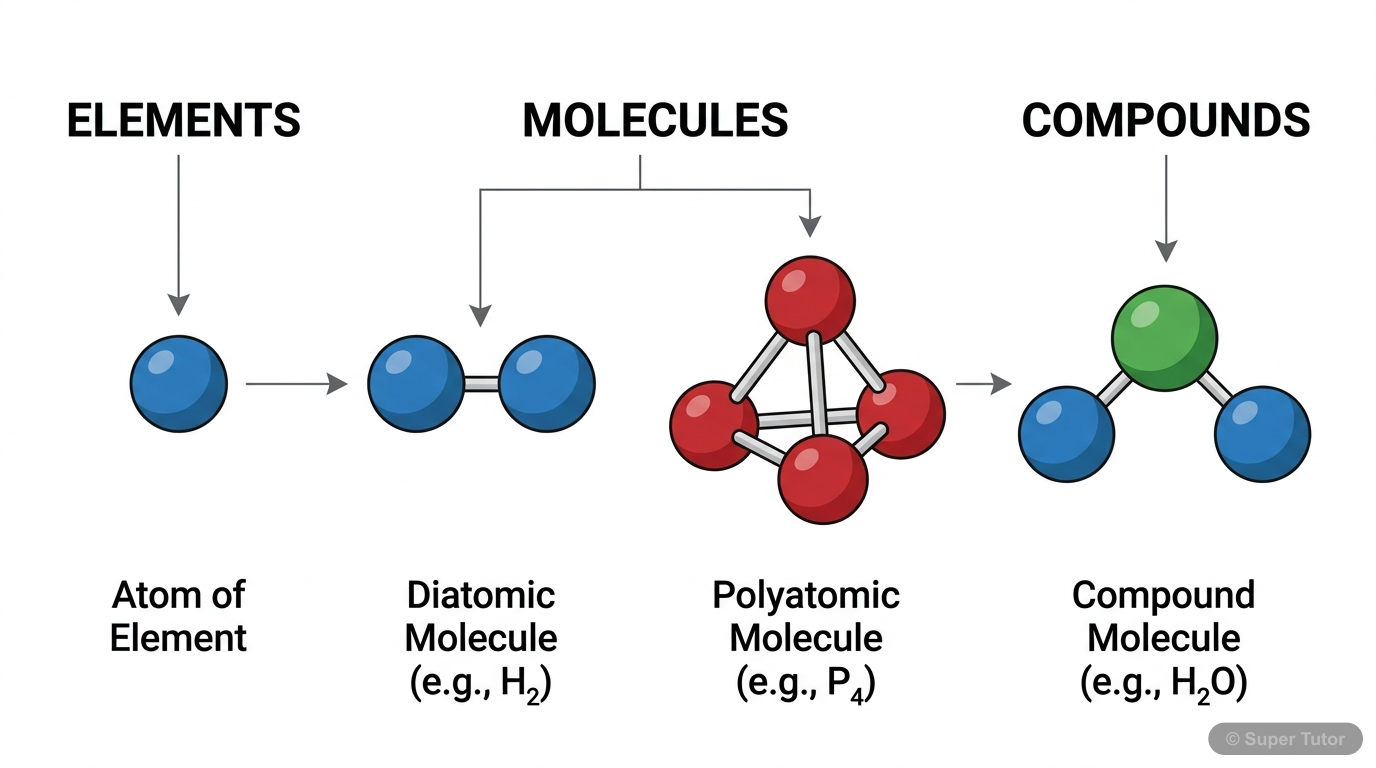
Learn better with visuals Super Tutor pairs illustrations like this with notes and quizzes for The Language of Chemistry.
What is an element?
Answer
An element is a simple and pure form of matter which cannot be decomposed into simpler substances. Example: carbon, hydrogen, oxygen.
Why are symbols used in chemistry?
Answer
Symbols are short forms for elements. They represent the name of the element, one atom of the element, and the quantity of the element equal in mass to its atomic mass or gram atomic mass. Example: N …
Why is Co different from CO?
Answer
Co means the element cobalt. CO means the compound carbon monoxide. Capital letters matter in chemistry because changing case changes meaning completely.
What did Johann Berzelius suggest about chemical symbols?
Answer
He suggested that the initial letter of an element written in capitals should represent that element, such as O for oxygen, H for hydrogen, and C for carbon. This method laid the basis of the IUPAC sy…
What is valency?
Answer
Valency is the combining capacity of an atom or of a radical. It is the number of hydrogen atoms, or double the number of oxygen atoms, that can combine with it. Example: oxygen has valency 2.
Why is the valency of hydrogen taken as 1?
Answer
Since no other element has combining capacity less than that of hydrogen, its valency is taken to be one (1) and is used as a standard.
What is variable valency?
Answer
Variable valency is the ability of an element to show more than one valency. Example: iron shows valency 2 and 3; copper shows valency 1 and 2; sulphur shows valencies 2, 4 and 6.
How are elements with two positive valencies named?
Answer
The lower valency takes the suffix ous and the higher valency takes the suffix ic. Example: Fe2+ is ferrous and Fe3+ is ferric; Sn2+ is stannous and Sn4+ is stannic.
+22 more flashcards
Practise AllFrequently Asked Questions
What are the important topics in The Language of Chemistry for ICSE Class 9 Chemistry?
How many flashcards are available for The Language of Chemistry?
How should I revise The Language of Chemistry for Class 9 exams?
Sources & Official References
Content is aligned to the official syllabus. Refer to the board website for the latest curriculum.
More resources for The Language of Chemistry
Practice Quiz
Test yourself with a quick quiz
Important Questions
Exam-style questions with answers
Revision Notes
Key points for last-minute revision
Formula Sheet
The chapter's formulas in one place
Chapter Summary
Understand the chapter at a glance
Concept Maps
See how topics connect
Study Plan
Step-by-step plan for this chapter
Syllabus
What topics to cover
For serious students
Get the full The Language of Chemistry chapter — start free.
Quizzes, flashcards, an AI doubt solver and a study plan for ICSE Class 9 Chemistry. Free to start, no card needed.