The Language of Chemistry — Chapter Summary
ICSE · Class 9 · Chemistry
Summary of The Language of Chemistry for ICSE Class 9 Chemistry. Part of the ICSE Class 9 Chemistry syllabus. Chemistry uses symbols, formulae, valency.
Interactive on Super Tutor
Studying The Language of Chemistry? Get the full interactive chapter.
Quizzes, flashcards, AI doubt-solver and a step-by-step study plan — built for chapter summary and more.
Free trial, no card needed.
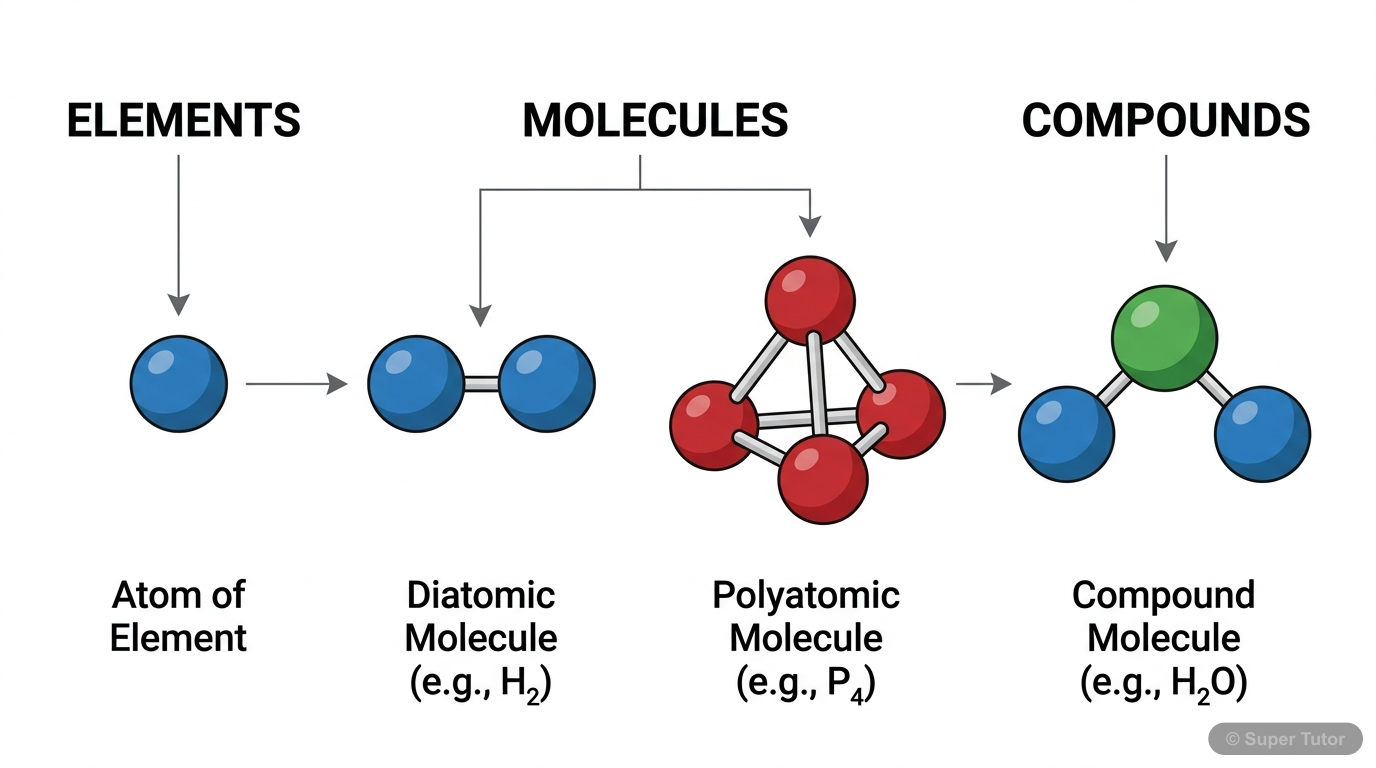
Learn better with visuals Super Tutor pairs illustrations like this with notes and quizzes for The Language of Chemistry.
Overview
Chemistry uses symbols, formulae, valency, radicals, and chemical equations to describe matter and its changes in a short and exact way. A symbol stands for one atom of an element, a formula shows the atoms present in a molecule, valency shows combining capacity, and a chemical equation gives the sy
Key Concepts
A symbol is the short form
A symbol is the short form that stands for the atom of a specific element. It usually uses the first letter of the element name in capital form, and s
A molecular formula shows the symbols
A molecular formula shows the symbols of the atoms in a molecule and the number of each atom present. For example, H2O shows two hydrogen atoms and on
Valency is the combining capacity
Valency is the combining capacity of an atom or a radical. It shows how many hydrogen atoms can combine with it, or how many electrons it can lose, ga
Some elements show more than one
Some elements show more than one valency. Iron shows valencies 2 and 3, copper shows 1 and 2, mercury shows 1 and 2, lead shows 2 and 4, and tin shows
A radical is an atom
A radical is an atom or group of atoms that behaves as a single unit with a positive or negative charge. Simple radicals are single atoms like Na+ and
Learning Objectives
- Understand the meaning and use of chemical symbols
- Identify monoatomic, diatomic, tetratomic, and octatomic molecules
- Learn the idea of valency and variable valency
- Recognize radicals and write chemical formulae correctly
- Write chemical equations and balance them by hit and trial method
Frequently Asked Questions
What are the important topics in The Language of Chemistry for ICSE Class 9 Chemistry?
How should I revise The Language of Chemistry for Class 9 exams?
Sources & Official References
Content is aligned to the official syllabus. Refer to the board website for the latest curriculum.
More resources for The Language of Chemistry
Practice Quiz
Test yourself with a quick quiz
Important Questions
Exam-style questions with answers
Revision Notes
Key points for last-minute revision
Formula Sheet
The chapter's formulas in one place
Concept Maps
See how topics connect
Study Plan
Step-by-step plan for this chapter
Flashcards
Quick-fire cards for active recall
Syllabus
What topics to cover
For serious students
Get the full The Language of Chemistry chapter — start free.
Quizzes, flashcards, an AI doubt solver and a study plan for ICSE Class 9 Chemistry. Free to start, no card needed.