The Language of Chemistry — Revision Notes
ICSE · Class 9 · Chemistry
The Language of Chemistry revision notes for ICSE Class 9 Chemistry: 4 topics in quick points. Part of the ICSE Class 9 Chemistry syllabus.
Interactive on Super Tutor
Studying The Language of Chemistry? Get the full interactive chapter.
Quizzes, flashcards, AI doubt-solver and a step-by-step study plan — built for revision notes and more.
Free trial, no card needed.
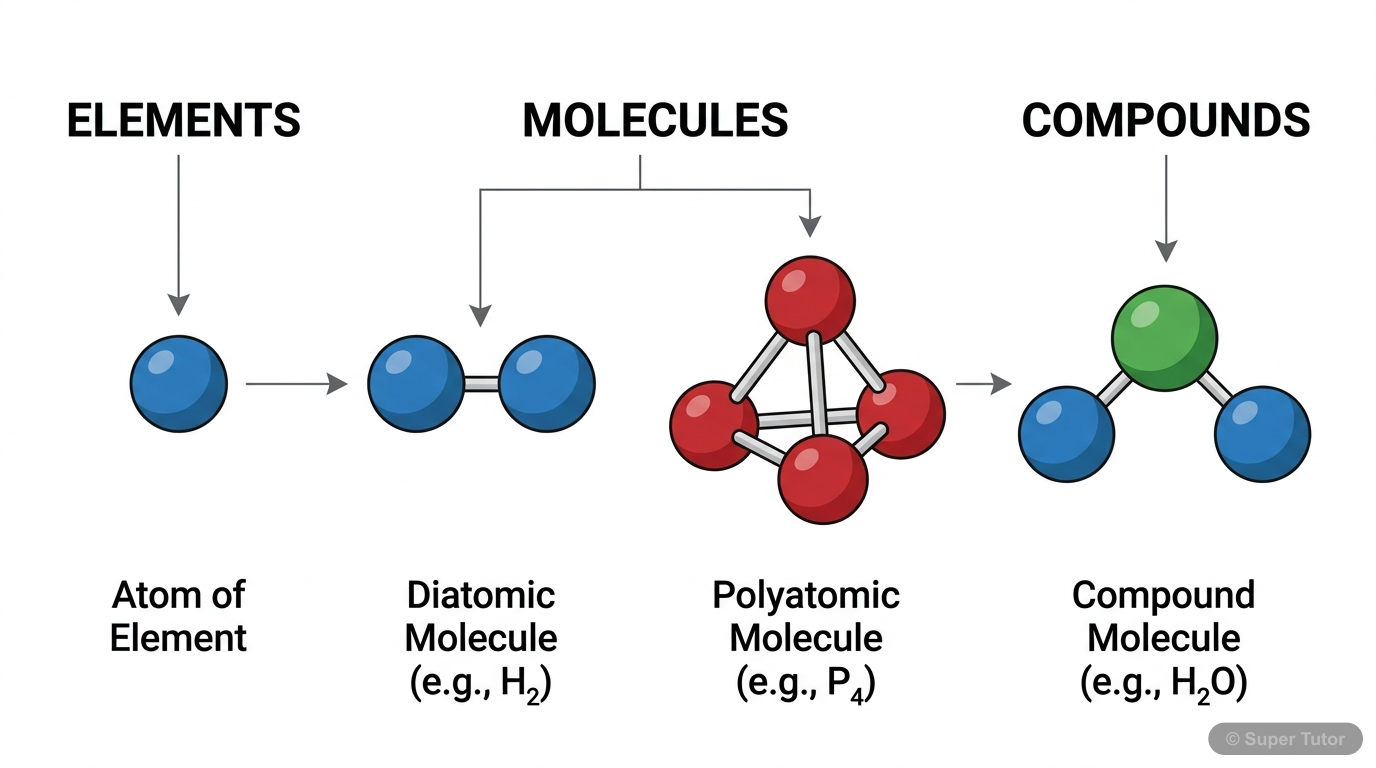
Learn better with visuals Super Tutor pairs illustrations like this with notes and quizzes for The Language of Chemistry.
Key Topics to Revise
1. Elements, Atoms, and Molecules
- An element is a simple and pure form of matter that cannot be decomposed into simpler substances.
- All elements are made of atoms, and atoms are the smallest particles of an element that show its properties.
- A molecule is the smallest particle that can exist independently.
2. Chemical Symbols and Formulae
- A symbol is the short form that stands for the atom of a specific element.
- Johann Berzelius suggested that the initial letter of an element written in capitals should represent that element.
- Some symbols come from Latin names, such as Cu for copper, Fe for iron, and Na for sodium.
3. Valency
- Valency is the combining capacity of an atom or of a radical.
- Valency is measured in terms of hydrogen atoms or oxygen atoms.
- Hydrogen is taken as valency 1 because no element has a lower combining capacity than hydrogen.
4. Radicals and Writing Chemical Formulae
- A radical is an atom or a group of atoms that behaves as a single unit with a positive or negative charge.
- A simple radical is an atom only, such as sodium ion or magnesium ion.
- A compound radical is made of two or more atoms, such as sulphate.
Get complete notes with diagrams and examples
Full NotesKey Concepts
Frequently Asked Questions
What are the important topics in The Language of Chemistry for ICSE Class 9 Chemistry?
How should I revise The Language of Chemistry for Class 9 exams?
Sources & Official References
Content is aligned to the official syllabus. Refer to the board website for the latest curriculum.
More resources for The Language of Chemistry
Practice Quiz
Test yourself with a quick quiz
Important Questions
Exam-style questions with answers
Formula Sheet
The chapter's formulas in one place
Chapter Summary
Understand the chapter at a glance
Concept Maps
See how topics connect
Study Plan
Step-by-step plan for this chapter
Flashcards
Quick-fire cards for active recall
Syllabus
What topics to cover
For serious students
Get the full The Language of Chemistry chapter — start free.
Quizzes, flashcards, an AI doubt solver and a study plan for ICSE Class 9 Chemistry. Free to start, no card needed.