Impact of Agricultural and Industrial Practices on the Ecosystem — Revision Notes
ICSE · Class 9 · Economic Applications
Impact of Agricultural and Industrial Practices on the Ecosystem revision notes for ICSE Class 9 Economic Applications: 4 topics in quick points.
Interactive on Super Tutor
Studying Impact of Agricultural and Industrial Practices on the Ecosystem? Get the full interactive chapter.
Quizzes, flashcards, AI doubt-solver and a step-by-step study plan — built for revision notes and more.
Free trial, no card needed.
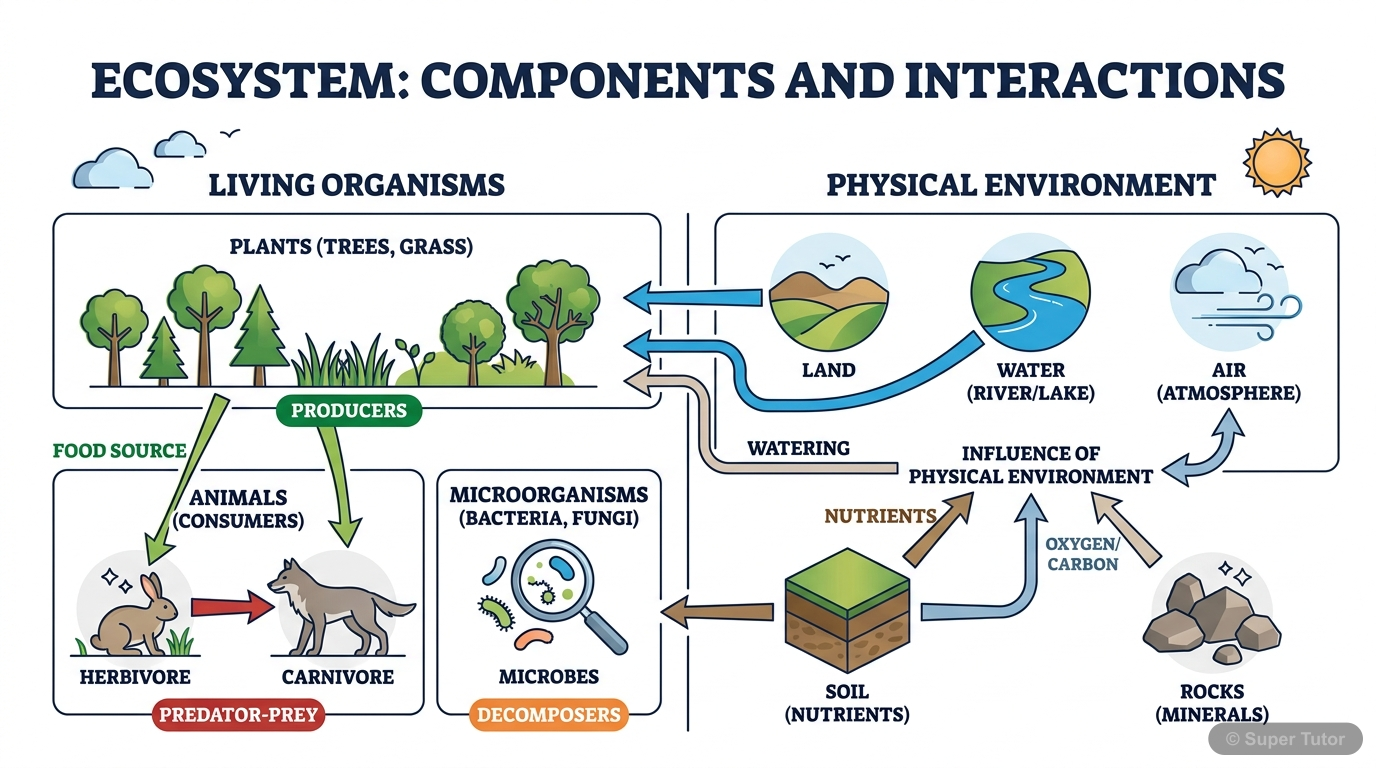
Learn better with visuals Super Tutor pairs illustrations like this with notes and quizzes for Impact of Agricultural and Industrial Practices on the Ecosystem.
Key Topics to Revise
1. Meaning and Features of Ecosystem
- An ecosystem consists of plants, animals and other living things which exist and survive together while adjusting to their physical environment.
- Living organisms interact with one another and with land, water, air, soil, and rocks.
- All living things in an ecosystem are grouped as a community.
2. Impact of Agricultural Practices on the Ecosystem
- Changing land use has led to deforestation and loss of topsoil.
- Deforestation for agricultural purposes cleared 1.5 lakh hectares of forest land per year in India between 1950-51 and 1979-80, dropping to about 16,500 hectares per year thereafter.
- Nearly 10.3 million hectares of land in India is affected by soil erosion annually.
3. Measures to Check Destruction of Ecosystem from Agriculture
- Small and fewer dams are better alternatives to large dams.
- Strong opposition to the construction of dam on Narmada river is a pointer to the ecological and displacement problems caused by large dams.
- Forest conservation is essential to reduce soil erosion, erratic rainfall, floods, and climate change.
4. Impact of Industrial Practices on the Ecosystem
- Industrial development has created three major problems: depletion of natural resources, generation of industrial waste, and environmental damage through pollution.
- Mineral resources are non-renewable and cannot be replenished once used.
- Fossil fuels are non-renewable sources of energy.
Get complete notes with diagrams and examples
Full NotesKey Concepts
Frequently Asked Questions
What are the important topics in Impact of Agricultural and Industrial Practices on the Ecosystem for ICSE Class 9 Economic Applications?
How should I revise Impact of Agricultural and Industrial Practices on the Ecosystem for Class 9 exams?
Sources & Official References
Content is aligned to the official syllabus. Refer to the board website for the latest curriculum.
More resources for Impact of Agricultural and Industrial Practices on the Ecosystem
For serious students
Get the full Impact of Agricultural and Industrial Practices on the Ecosystem chapter — start free.
Quizzes, flashcards, an AI doubt solver and a study plan for ICSE Class 9 Economic Applications. Free to start, no card needed.