Adjectives: Order and Degrees of Comparison — Chapter Summary
ICSE · Class 9 · English Language - Archer
Summary of Adjectives: Order and Degrees of Comparison for ICSE Class 9 English Language - Archer. Adjectives describe nouns and pronouns. When several.
Interactive on Super Tutor
Studying Adjectives: Order and Degrees of Comparison? Get the full interactive chapter.
Quizzes, flashcards, AI doubt-solver and a step-by-step study plan — built for chapter summary and more.
Free trial, no card needed.
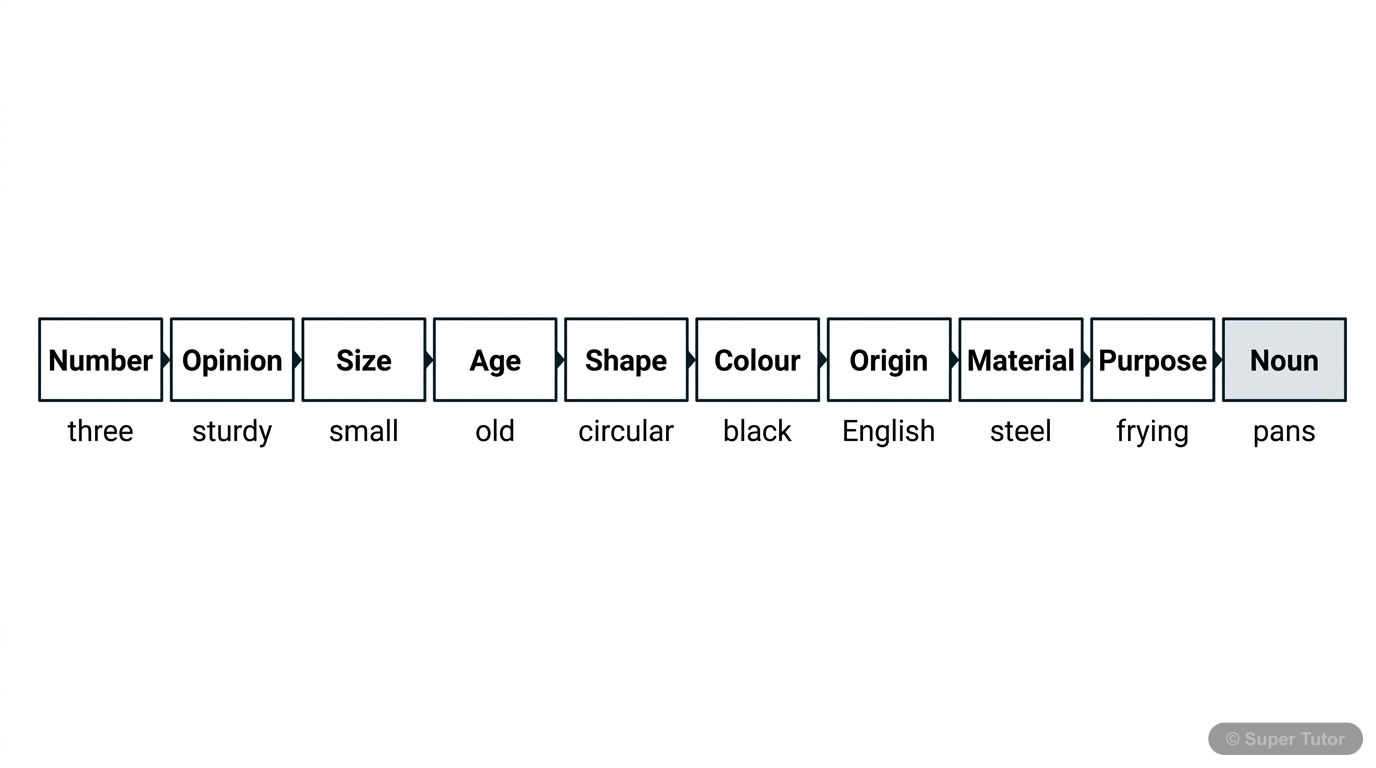
Learn better with visuals Super Tutor pairs illustrations like this with notes and quizzes for Adjectives: Order and Degrees of Comparison.
Overview
Adjectives describe nouns and pronouns. When several adjectives come before a noun, they follow a fixed order: number, opinion, size, age, shape, colour, origin, material, purpose, then noun. Adjectives also change form when comparisons are made. The positive degree is the simple form, the comparati
Key Concepts
Adjectives before a noun are arranged
Adjectives before a noun are arranged in a fixed sequence: number, opinion, size, age, shape, colour, origin, material, purpose, then noun. For exampl
The positive degree is the simple
The positive degree is the simple form of an adjective, without comparison. It is used for direct description and for equality forms such as as...as.
The comparative degree is used when
The comparative degree is used when two nouns or pronouns are compared. It usually takes than. Examples include tidier, more hardworking, taller, and
The superlative degree is used when
The superlative degree is used when more than two nouns or pronouns are compared, and it always uses the.
Adjectives ending
Adjectives ending in -or, such as senior, junior, superior, and inferior, use to in the comparative sense instead of than. Example: Riddhi is junior t
Learning Objectives
- Identify the correct order of adjectives before a noun.
- Use the positive, comparative, and superlative degrees correctly.
- Choose the correct comparison word with than or to.
- Avoid common errors with elder, older, later, latter, farther, further, nearest, and next.
- Rewrite sentences with the correct degree of comparison.
Frequently Asked Questions
What are the important topics in Adjectives: Order and Degrees of Comparison for ICSE Class 9 English Language - Archer?
How should I revise Adjectives: Order and Degrees of Comparison for Class 9 exams?
Sources & Official References
Content is aligned to the official syllabus. Refer to the board website for the latest curriculum.
More resources for Adjectives: Order and Degrees of Comparison
Practice Quiz
Test yourself with a quick quiz
Important Questions
Exam-style questions with answers
Revision Notes
Key points for last-minute revision
Formula Sheet
The chapter's formulas in one place
Concept Maps
See how topics connect
Study Plan
Step-by-step plan for this chapter
Flashcards
Quick-fire cards for active recall
Syllabus
What topics to cover
For serious students
Get the full Adjectives: Order and Degrees of Comparison chapter — start free.
Quizzes, flashcards, an AI doubt solver and a study plan for ICSE Class 9 English Language - Archer. Free to start, no card needed.