Substitution of One Part of Speech for Another — Chapter Summary
ICSE · Class 9 · English Language - Archer
Summary of Substitution of One Part of Speech for Another for ICSE Class 9 English Language - Archer. Parts of speech can be interchanged by adding.
Interactive on Super Tutor
Studying Substitution of One Part of Speech for Another? Get the full interactive chapter.
Quizzes, flashcards, AI doubt-solver and a step-by-step study plan — built for chapter summary and more.
Free trial, no card needed.
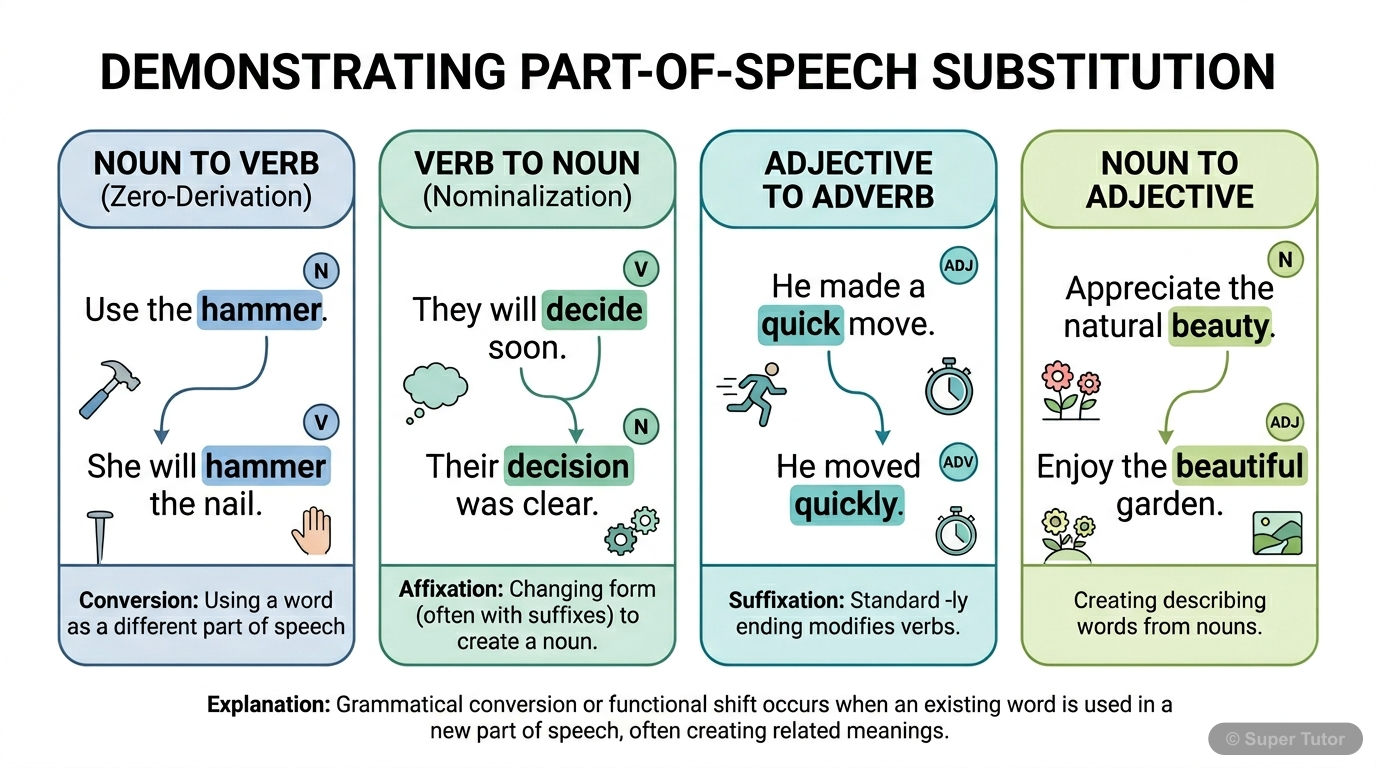
Learn better with visuals Super Tutor pairs illustrations like this with notes and quizzes for Substitution of One Part of Speech for Another.
Overview
Parts of speech can be interchanged by adding or removing suffixes. This chapter shows how a word may change from one part of speech to another and how meaning stays connected while form changes. The examples include noun, verb, adjective, adverb, gerund, and passive forms used in clear sentence pai
Key Concepts
Parts of speech can be interchanged
Parts of speech can be interchanged by adding or removing suffixes.
'Discover' is a verb
'Discover' is a verb, while 'discovery' is a noun.
'Proposal' is a noun
'Proposal' is a noun, while 'proposed' is a verb.
'Concluded' is a verb
'Concluded' is a verb, while 'conclusion' is a noun.
'Obligation' is a noun
'Obligation' is a noun, while 'obligated' is used as an adjective form in the sentence.
Learning Objectives
- Understand that parts of speech can change by adding or removing suffixes.
- Identify how a word changes its function in a sentence.
- Recognize noun, verb, adjective, adverb, gerund, and passive forms in examples.
- Compare original sentences with substituted sentences.
- Use sentence meaning to understand part-of-speech substitution.
Frequently Asked Questions
What are the important topics in Substitution of One Part of Speech for Another for ICSE Class 9 English Language - Archer?
How should I revise Substitution of One Part of Speech for Another for Class 9 exams?
Sources & Official References
Content is aligned to the official syllabus. Refer to the board website for the latest curriculum.
More resources for Substitution of One Part of Speech for Another
For serious students
Get the full Substitution of One Part of Speech for Another chapter — start free.
Quizzes, flashcards, an AI doubt solver and a study plan for ICSE Class 9 English Language - Archer. Free to start, no card needed.