Agreement of the Verb with Its Subject — Chapter Summary
ICSE · Class 9 · English Language - Archer
Summary of Agreement of the Verb with Its Subject for ICSE Class 9 English Language - Archer. Part of the ICSE Class 9 English Language - Archer syllabus.
Interactive on Super Tutor
Studying Agreement of the Verb with Its Subject? Get the full interactive chapter.
Quizzes, flashcards, AI doubt-solver and a step-by-step study plan — built for chapter summary and more.
Free trial, no card needed.
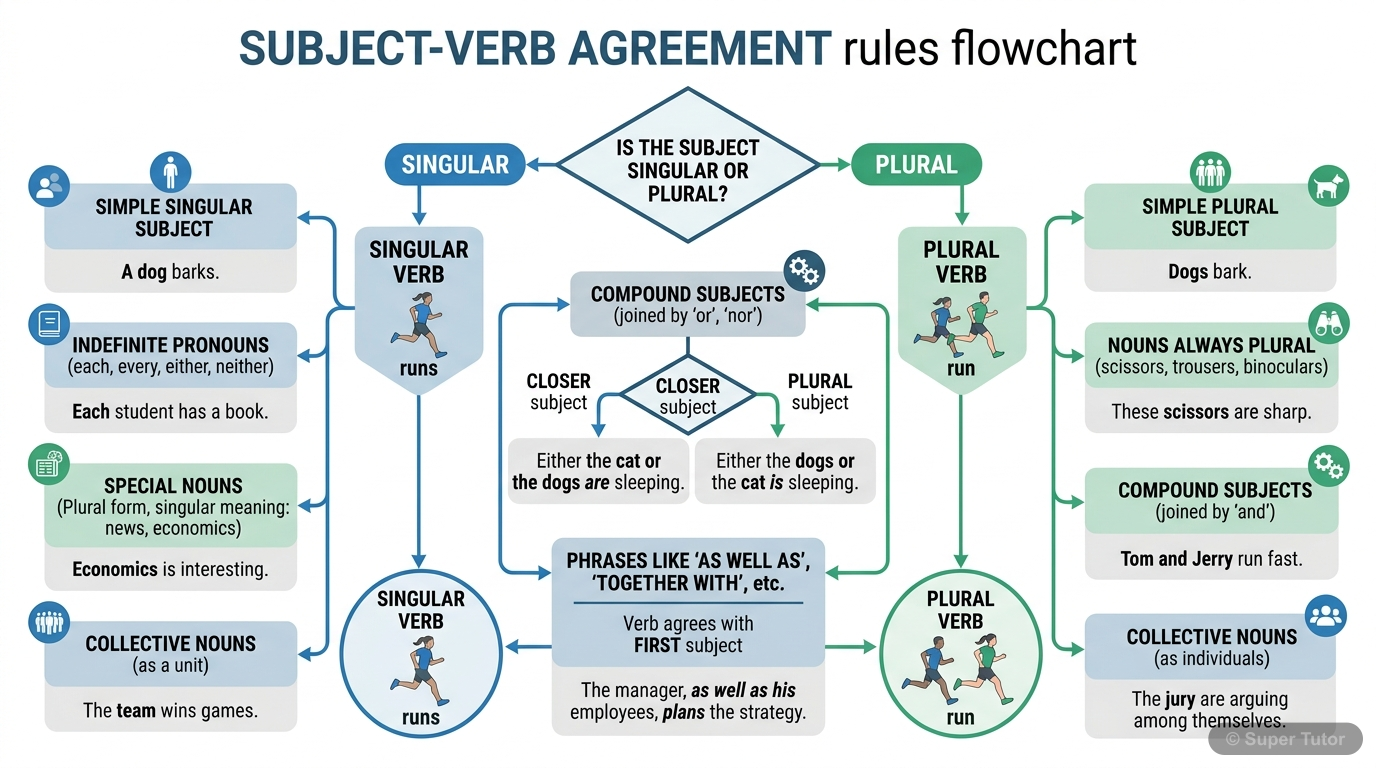
Learn better with visuals Super Tutor pairs illustrations like this with notes and quizzes for Agreement of the Verb with Its Subject.
Overview
Agreement of the verb with its subject means that the verb must match the subject in number and person. Singular subjects take singular verbs, and plural subjects take plural verbs. Correct agreement is essential for clear and standard English writing.
Key Concepts
A verb must always agree
A verb must always agree with its subject in number and person. A singular subject takes a singular verb, and a plural subject takes a plural verb.
When two or more singular nouns
When two or more singular nouns are joined by and, the subject becomes plural and takes a plural verb.
When two nouns refer to
When two nouns refer to the same person, thing, or idea, the verb remains singular.
A collective noun takes a singular
A collective noun takes a singular verb when it is treated as one unit. It takes a plural verb when the individual members are being considered separa
With as well as
With as well as, with, in addition to, together with, and along with, the verb agrees with the first subject.
Learning Objectives
- Understand that a verb must agree with its subject in number and person.
- Identify singular and plural subjects correctly.
- Apply special rules for collective nouns, paired subjects, and joined subjects.
- Use correct verb forms with phrases such as as well as, either...or, and neither...nor.
- Recognise special subject types such as plural-form singular nouns, always-plural nouns, and proper nouns that look plural.
Frequently Asked Questions
What are the important topics in Agreement of the Verb with Its Subject for ICSE Class 9 English Language - Archer?
How should I revise Agreement of the Verb with Its Subject for Class 9 exams?
Sources & Official References
Content is aligned to the official syllabus. Refer to the board website for the latest curriculum.
More resources for Agreement of the Verb with Its Subject
For serious students
Get the full Agreement of the Verb with Its Subject chapter — start free.
Quizzes, flashcards, an AI doubt solver and a study plan for ICSE Class 9 English Language - Archer. Free to start, no card needed.