Current Electricity — Chapter Summary
ICSE · Class 9 · Physics
Summary of Current Electricity for ICSE Class 9 Physics. Key concepts: Direct current has constant, Primary cells work by and Electric current is the rate.
Interactive on Super Tutor
Studying Current Electricity? Get the full interactive chapter.
Quizzes, flashcards, AI doubt-solver and a step-by-step study plan — built for chapter summary and more.
Free trial, no card needed.
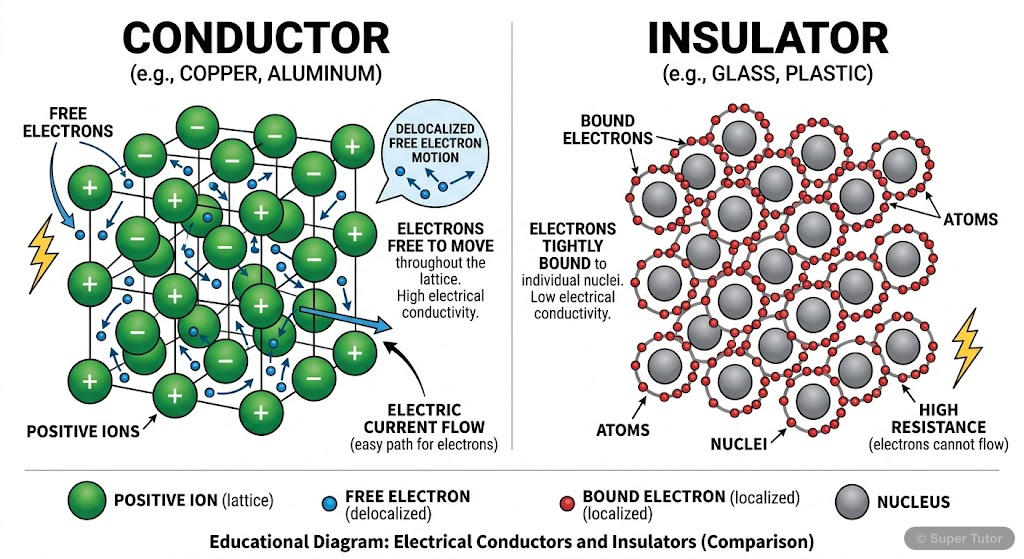
One of 11 illustrations for Current Electricity in Super Tutor — alongside flashcards, concept maps and practice questions.
Overview
Current electricity deals with the flow of electric charge in a circuit, the sources that provide current, the way current is measured, and the relation between current, potential difference, and resistance. It also includes the use of electric cells, meters, circuit symbols, conductors, insulators,
Key Concepts
Direct current has constant magnitude
Direct current has constant magnitude and flows in one direction. A cell or battery is a d.c. source, while mains and an a.c. generator are a.c. sourc
Primary cells work by an irreversible
Primary cells work by an irreversible chemical reaction, cannot be recharged, and are used once. Secondary cells have a reversible reaction, can be re
Electric current is the rate
Electric current is the rate of flow of charge across a cross-section normal to the direction of current. The formula is I = Q/t. In metals, current i
Current flows from the positive terminal
Current flows from the positive terminal to the negative terminal in the external circuit. Electron flow is in the opposite direction. Conventional cu
An ammeter measures current and
An ammeter measures current and is connected in series. A voltmeter measures potential difference and is connected in parallel. A galvanometer detects
Learning Objectives
- Understand direct current and the difference between primary and secondary cells
- Explain electric current as the rate of flow of charge
- Use circuit symbols for cells, switches, ammeters, voltmeters, galvanometers, rheostats, and loads
- Distinguish between open and closed circuits
- Identify conductors and insulators and relate them to free electrons
Frequently Asked Questions
What are the important topics in Current Electricity for ICSE Class 9 Physics?
How should I revise Current Electricity for Class 9 exams?
Sources & Official References
Content is aligned to the official syllabus. Refer to the board website for the latest curriculum.
More resources for Current Electricity
Practice Quiz
Test yourself with a quick quiz
Important Questions
Exam-style questions with answers
Revision Notes
Key points for last-minute revision
Formula Sheet
The chapter's formulas in one place
Concept Maps
See how topics connect
Study Plan
Step-by-step plan for this chapter
Flashcards
Quick-fire cards for active recall
Syllabus
What topics to cover
For serious students
Get the full Current Electricity chapter — start free.
Quizzes, flashcards, an AI doubt solver and a study plan for ICSE Class 9 Physics. Free to start, no card needed.