Laws of Motion — Chapter Summary
ICSE · Class 9 · Physics
Summary of Laws of Motion for ICSE Class 9 Physics. Part of the ICSE Class 9 Physics syllabus. Motion changes when a force acts on a body. Force can.
Interactive on Super Tutor
Studying Laws of Motion? Get the full interactive chapter.
Quizzes, flashcards, AI doubt-solver and a step-by-step study plan — built for chapter summary and more.
Free trial, no card needed.
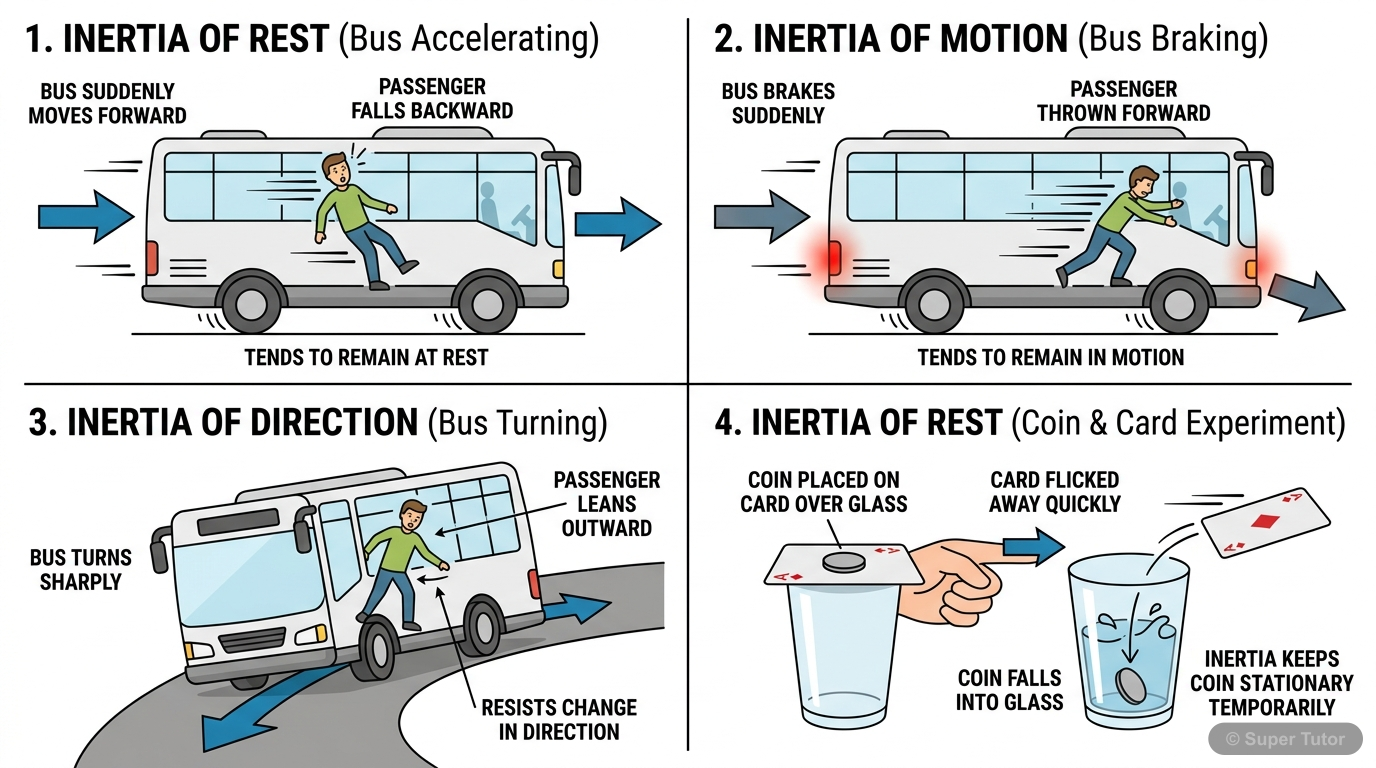
One of 25 illustrations for Laws of Motion in Super Tutor — alongside flashcards, concept maps and practice questions.
Overview
Motion changes when a force acts on a body. Force can change the state of rest or motion, and it can also change the size or shape of a body. The chapter connects this idea to inertia, momentum, Newton's three laws of motion, and gravitation. It also explains why mass and weight are different, why a
Key Concepts
A force is that physical cause
A force is that physical cause which changes or tends to change the size, shape, or state of rest or motion of a body. It may start motion, stop motio
Contact forces act only when bodies
Contact forces act only when bodies are in physical contact. Examples are frictional force, normal reaction force, tension force, and force during col
Inertia is the property of
Inertia is the property of a body by virtue of which it neither changes its state nor tends to change the state by itself. Mass is a measure of inerti
A body remains at rest
A body remains at rest or continues to move with the same speed in the same direction unless an external force acts on it. This law is also called the
Linear momentum of a body
Linear momentum of a body is the product of its mass and velocity. The formula is p = mv. It is a vector quantity and acts in the direction of motion.
Learning Objectives
- Understand the meaning of force and classify it as contact or non-contact force.
- Explain inertia and relate it to Newton's first law of motion.
- Use linear momentum to describe motion and relate force to rate of change of momentum.
- Apply Newton's second law to solve simple numerical problems.
- State and interpret Newton's third law of motion with examples of action-reaction pairs.
Frequently Asked Questions
What are the important topics in Laws of Motion for ICSE Class 9 Physics?
How should I revise Laws of Motion for Class 9 exams?
Sources & Official References
Content is aligned to the official syllabus. Refer to the board website for the latest curriculum.
More resources for Laws of Motion
Practice Quiz
Test yourself with a quick quiz
Important Questions
Exam-style questions with answers
Revision Notes
Key points for last-minute revision
Formula Sheet
The chapter's formulas in one place
Concept Maps
See how topics connect
Study Plan
Step-by-step plan for this chapter
Flashcards
Quick-fire cards for active recall
Syllabus
What topics to cover
For serious students
Get the full Laws of Motion chapter — start free.
Quizzes, flashcards, an AI doubt solver and a study plan for ICSE Class 9 Physics. Free to start, no card needed.