Heat and Energy — Chapter Summary
ICSE · Class 9 · Physics
Summary of Heat and Energy for ICSE Class 9 Physics. Key concepts: Heat is the internal energy, Temperature tells the thermal and Heat depends on mass.
Interactive on Super Tutor
Studying Heat and Energy? Get the full interactive chapter.
Quizzes, flashcards, AI doubt-solver and a step-by-step study plan — built for chapter summary and more.
Free trial, no card needed.
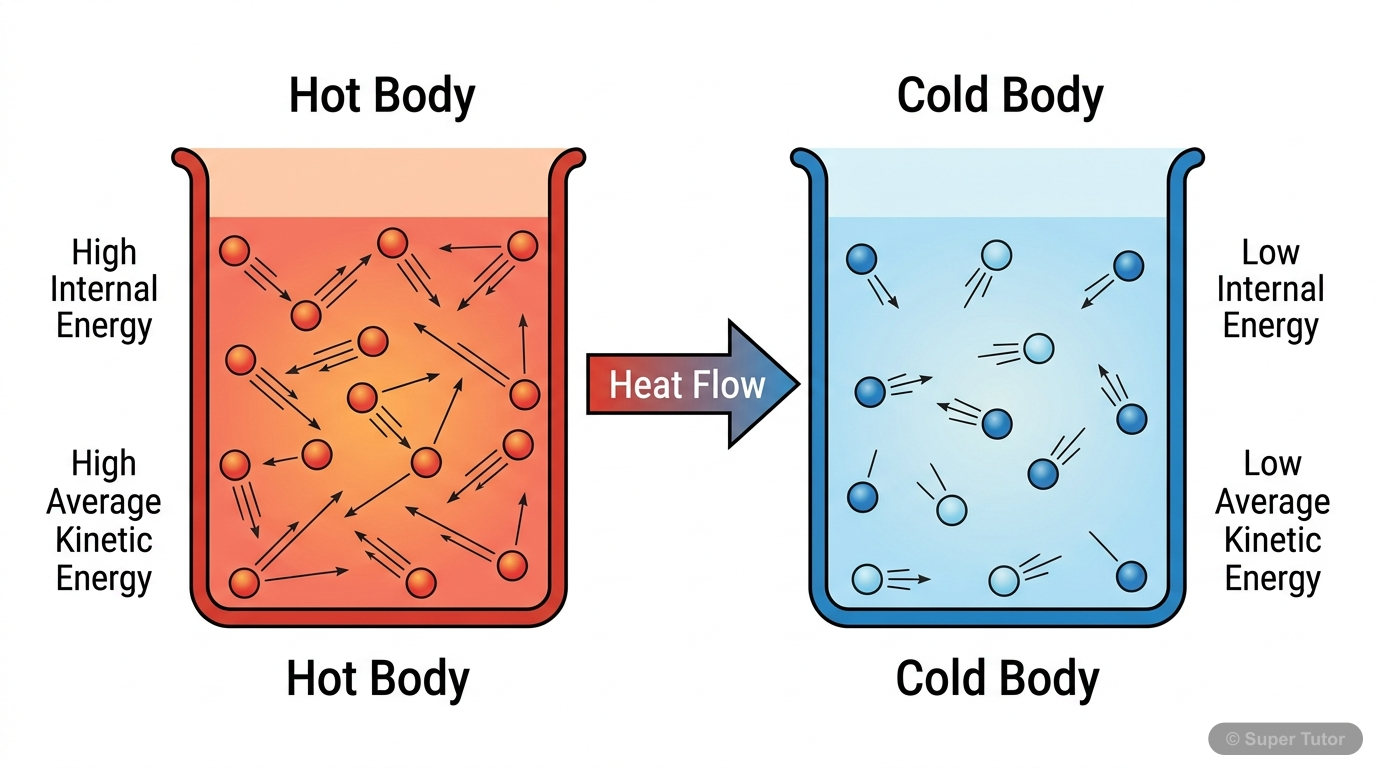
Learn better with visuals Super Tutor pairs illustrations like this with notes and quizzes for Heat and Energy.
Overview
Heat is a form of energy related to the internal energy of molecules in a body. It flows from a hot body to a cold body when the bodies are placed in contact. Temperature tells the thermal state of a body and decides the direction of heat flow. Water shows anomalous expansion between 0°C and 4°C, wh
Key Concepts
Heat is the internal energy
Heat is the internal energy of molecules constituting a body. It flows from a hot body to a cold body. Its SI unit is joule.
Temperature tells the thermal state
Temperature tells the thermal state of a body, that is, how hot or cold it is. It determines the direction of flow of heat when two bodies are placed
Heat depends on mass
Heat depends on mass, temperature, and material of a body, while temperature depends on the average motion of molecules. Two bodies may have the same
The Celsius and Kelvin scales
The Celsius and Kelvin scales are related by T K = 273 + t °C. More precisely, T K = 273.15 + t °C. Ice point is 0°C or 273 K and steam point is 100°C
Most substances expand on heating
Most substances expand on heating and contract on cooling. Solids show linear, superficial, and cubical expansion, while liquids and gases mainly show
Learning Objectives
- Understand heat as a form of energy and distinguish it from temperature.
- Use the correct units of heat and temperature, including joule, calorie, and kelvin.
- Explain thermal expansion and the special anomalous expansion of water.
- Describe Hope's apparatus and the reason water has maximum density at 4°C.
- Understand the linear flow of energy in ecosystems and the role of the sun.
Frequently Asked Questions
What are the important topics in Heat and Energy for ICSE Class 9 Physics?
How should I revise Heat and Energy for Class 9 exams?
Sources & Official References
Content is aligned to the official syllabus. Refer to the board website for the latest curriculum.
More resources for Heat and Energy
Practice Quiz
Test yourself with a quick quiz
Important Questions
Exam-style questions with answers
Revision Notes
Key points for last-minute revision
Formula Sheet
The chapter's formulas in one place
Concept Maps
See how topics connect
Study Plan
Step-by-step plan for this chapter
Flashcards
Quick-fire cards for active recall
Syllabus
What topics to cover
For serious students
Get the full Heat and Energy chapter — start free.
Quizzes, flashcards, an AI doubt solver and a study plan for ICSE Class 9 Physics. Free to start, no card needed.