Pressure in Fluids and Atmospheric Pressure — Chapter Summary
ICSE · Class 9 · Physics
Summary of Pressure in Fluids and Atmospheric Pressure for ICSE Class 9 Physics. Part of the ICSE Class 9 Physics syllabus.
Interactive on Super Tutor
Studying Pressure in Fluids and Atmospheric Pressure? Get the full interactive chapter.
Quizzes, flashcards, AI doubt-solver and a step-by-step study plan — built for chapter summary and more.
Free trial, no card needed.
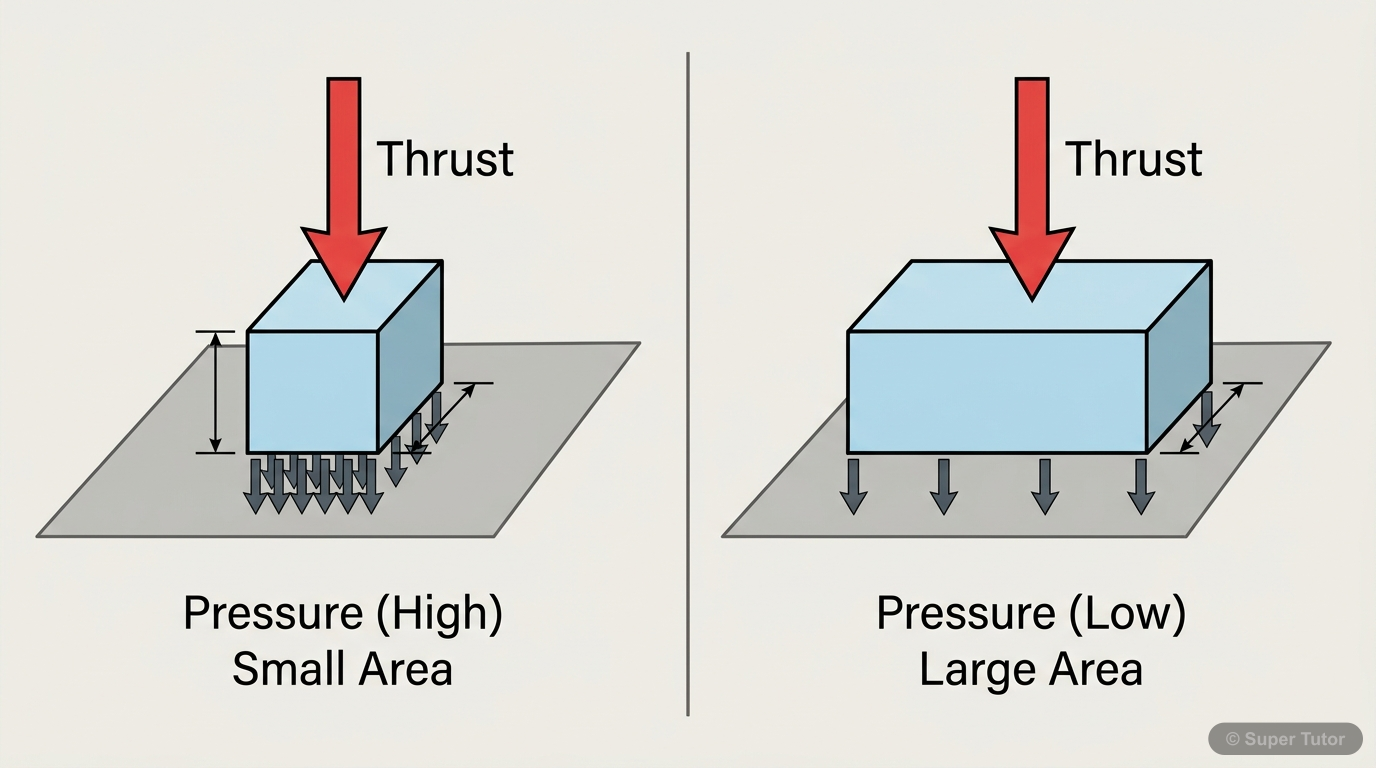
Learn better with visuals Super Tutor pairs illustrations like this with notes and quizzes for Pressure in Fluids and Atmospheric Pressure.
Overview
Pressure is the thrust per unit area of a surface. In fluids, pressure is produced by the weight of the liquid or gas and acts in all directions. Liquid pressure increases with depth, depends on density, and follows the relation P = hρg. Atmospheric pressure is the pressure exerted by the air around
Key Concepts
Thrust is the force acting normally
Thrust is the force acting normally on a surface. It is a vector quantity and is measured in newton in SI units. The thrust exerted by a body on a sur
Pressure is the thrust per unit
Pressure is the thrust per unit area of surface. It is a scalar quantity. The SI unit is pascal, and 1 pascal is the pressure exerted on an area of 1
Pressure is given by P =
Pressure is given by P = F/A, where F is thrust and A is area. Larger area means less pressure, while larger thrust means greater pressure.
A fluid is a substance
A fluid is a substance which can flow. All liquids and gases are fluids. A fluid contained in a vessel exerts pressure at all points and in all direct
Pressure at depth h in
Pressure at depth h in a liquid is given by P = hρg. It depends on depth, density of the liquid, and acceleration due to gravity.
Learning Objectives
- Define thrust and pressure with correct units and quantities
- Understand how pressure changes with area, thrust, depth, and density
- Use P = F/A, P = hρg, and total pressure = P0 + hρg in numerical problems
- Explain Pascal's law and the working of hydraulic machines
- Describe atmospheric pressure and its measurement with barometers
Frequently Asked Questions
What are the important topics in Pressure in Fluids and Atmospheric Pressure for ICSE Class 9 Physics?
How should I revise Pressure in Fluids and Atmospheric Pressure for Class 9 exams?
Sources & Official References
Content is aligned to the official syllabus. Refer to the board website for the latest curriculum.
More resources for Pressure in Fluids and Atmospheric Pressure
Practice Quiz
Test yourself with a quick quiz
Important Questions
Exam-style questions with answers
Revision Notes
Key points for last-minute revision
Formula Sheet
The chapter's formulas in one place
Concept Maps
See how topics connect
Study Plan
Step-by-step plan for this chapter
Flashcards
Quick-fire cards for active recall
Syllabus
What topics to cover
For serious students
Get the full Pressure in Fluids and Atmospheric Pressure chapter — start free.
Quizzes, flashcards, an AI doubt solver and a study plan for ICSE Class 9 Physics. Free to start, no card needed.