Chapter 6 of 13
NCERT Solutions

Control and Coordination

Madhya Pradesh Board · Class 10 · Science

NCERT Solutions for Control and Coordination — Madhya Pradesh Board Class 10 Science.

64 questions20 flashcards5 concepts

Interactive on Super Tutor

Studying Control and Coordination? Get the full interactive chapter.

Quizzes, flashcards, AI doubt-solver and a step-by-step study plan — built for ncert solutions and more.

1,000+ Class 10 students started this chapter today

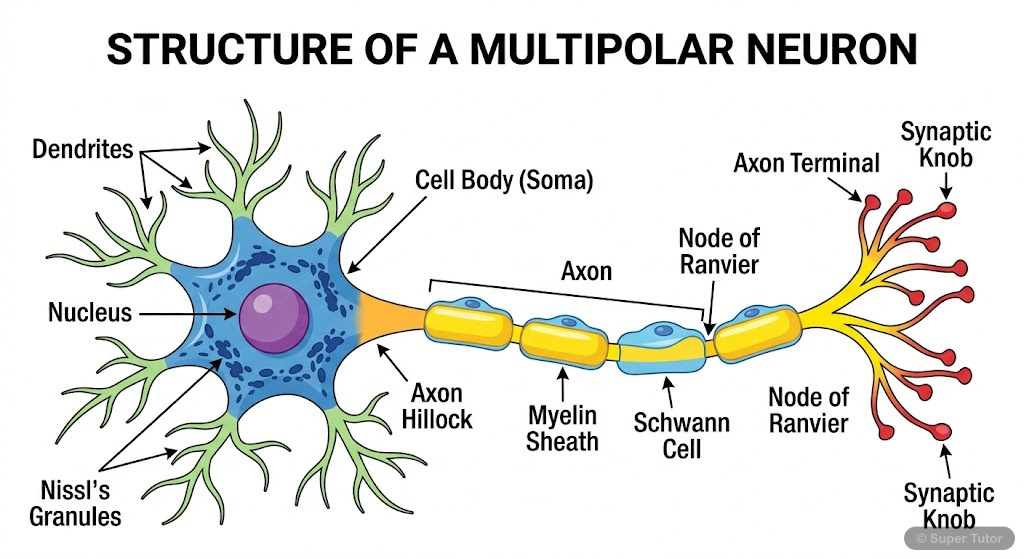
A detailed labeled diagram of a multipolar neuron, showing the cell body (soma), dendrites, axon, axon hillock, myelin sheath, Schwann cells, Nodes of Ranvier, and axon terminal with synaptic knobs.
Super Tutor

Super Tutor has 10+ illustrations like this for Control and Coordination alone — flashcards, concept maps, and step-by-step visuals.

See them all
17 Questions Solved · 3 Sections

Activity 6.4 — Complete the Table

Activity 6.4Hormones are secreted by endocrine glands and have specific functions. Complete Table 6.1 based on the hormone, the endocrine gland or the functions provided.Show solution
The completed Table 6.1 is as follows:

| S.No. | Hormone | Endocrine Gland | Functions |
|---|---|---|---|
| 1. | Growth hormone | Pituitary gland | Stimulates growth in all organs |
| 2. | Thyroxin | Thyroid gland | Regulates metabolism for body growth |
| 3. | Insulin | Pancreas | Regulates blood sugar level |
| 4. | Testosterone | Testes | Development of male sex organs and secondary sexual characters (e.g., beard, deep voice) |
| 5. | Oestrogen | Ovaries | Development of female sex organs, regulates menstrual cycle, etc. |
| 6. | Adrenaline | Adrenal gland | Prepares the body for emergency ('fight or flight') — increases heart rate, blood pressure, and redirects blood to muscles |
| 7. | Releasing hormones | Hypothalamus | Stimulates pituitary gland to release hormones |

Explanation of filled entries:
- Row 2: The thyroid gland secretes Thyroxin, which requires iodine for its synthesis and regulates carbohydrate, protein, and fat metabolism.
- Row 3: Pancreas (specifically the islets of Langerhans — beta cells) secretes insulin.
- Row 4: Testosterone is responsible for the development of male reproductive organs and secondary sexual characteristics such as growth of facial hair, deepening of voice, etc.
- Row 5: Oestrogen is the female sex hormone secreted by the ovaries.
- Row 6: Adrenaline (also called epinephrine) is the 'emergency hormone' that prepares the body for fight-or-flight responses.
- Row 7: The Hypothalamus secretes releasing hormones that control the pituitary gland.

Intext Questions (Page — before Exercises)

1How does chemical coordination take place in animals?Show solution
Given/Concept: Chemical coordination in animals is carried out by the endocrine system through chemical messengers called hormones.

Answer:

Chemical coordination in animals takes place through hormones — chemical substances secreted by endocrine (ductless) glands directly into the bloodstream.

Steps involved:
1. Endocrine glands (e.g., thyroid, pancreas, adrenal, pituitary) synthesise and secrete specific hormones.
2. These hormones are released directly into the blood, which transports them throughout the body.
3. Hormones reach specific target organs or cells that have complementary receptors.
4. The target organ responds to the hormone and brings about the required physiological change.
5. The amount of hormone secreted is regulated by a feedback mechanism — for example, when blood sugar rises, the pancreas secretes more insulin; as blood sugar falls, insulin secretion decreases.

Key features:
- Hormones act as chemical messengers.
- Their effect is slower but longer-lasting compared to nerve impulses.
- They coordinate growth, metabolism, reproduction, and responses to stress.
2Why is the use of iodised salt advisable?Show solution
Given/Concept: The thyroid gland requires iodine to synthesise the hormone thyroxin.

Answer:

The use of iodised salt is advisable because:

1. The thyroid gland secretes the hormone thyroxin, which regulates carbohydrate, protein, and fat metabolism and controls the rate of body growth.
2. Iodine is an essential raw material required for the synthesis of thyroxin.
3. If the diet is deficient in iodine, the thyroid gland cannot produce sufficient thyroxin.
4. This deficiency causes the thyroid gland to enlarge, resulting in a condition called goitre (swelling of the neck).
5. By using iodised salt (common salt fortified with potassium iodate), the daily requirement of iodine is easily met, preventing iodine deficiency and goitre.

Conclusion: Iodised salt ensures adequate iodine intake, which is necessary for the proper functioning of the thyroid gland and prevention of goitre.
3How does our body respond when adrenaline is secreted into the blood?Show solution
Given/Concept: Adrenaline is the 'emergency hormone' secreted by the adrenal glands in situations of fear, stress, or excitement.

Answer:

When adrenaline is secreted into the blood, the body shows the following responses:

1. Heart rate increases — the heart beats faster to supply more oxygen and glucose to the muscles.
2. Breathing rate increases — the rate of breathing speeds up to take in more oxygen.
3. Blood pressure rises — blood vessels dilate to increase blood flow to muscles.
4. Blood is diverted — blood supply to the digestive system and skin is reduced, and more blood is directed to skeletal muscles and the brain.
5. Liver releases glucose — stored glycogen is broken down to glucose, providing extra energy.
6. Pupils dilate — for better vision.
7. Muscles tense up — the body is ready for physical action.

All these changes together prepare the body for a 'fight or flight' response — enabling the organism to either confront the danger or escape from it.

Conclusion: Adrenaline is called the emergency hormone because it rapidly mobilises the body's resources to deal with stressful or dangerous situations.
4Why are some patients of diabetes treated by giving injections of insulin?Show solution
Given/Concept: Insulin is a hormone secreted by the beta cells of the islets of Langerhans in the pancreas. It regulates blood sugar (glucose) levels.

Answer:

1. Diabetes mellitus is a condition in which the blood sugar (glucose) level remains abnormally high.
2. This happens because the pancreas either does not produce enough insulin (Type 1 diabetes) or the body cells do not respond properly to insulin (Type 2 diabetes).
3. Insulin is responsible for:
- Stimulating body cells to absorb glucose from the blood.
- Converting excess glucose into glycogen (stored in the liver).
- Thereby lowering blood sugar levels.
4. In the absence of sufficient insulin, glucose is not absorbed by cells and accumulates in the blood, leading to high blood sugar, which can damage organs over time.
5. Since insulin is a protein hormone, it cannot be taken orally (it would be digested in the stomach). Therefore, it must be administered as injections directly into the bloodstream.

Conclusion: Diabetic patients who cannot produce adequate insulin are given insulin injections to regulate their blood glucose levels and maintain normal body functioning.

EXERCISES

1Which of the following is a plant hormone?
(a) Insulin
(b) Thyroxin
(c) Oestrogen
(d) Cytokinin
Show solution
Correct Answer: (d) Cytokinin

Justification: Cytokinin is a plant hormone that promotes cell division (cytokinesis) and is found in regions of rapid cell division such as fruits and seeds. Insulin is secreted by the pancreas, thyroxin by the thyroid gland, and oestrogen by the ovaries — all are animal hormones.
2The gap between two neurons is called a
(a) dendrite.
(b) synapse.
(c) axon.
(d) impulse.
Show solution
Correct Answer: (b) Synapse

Justification: A synapse is the tiny gap (junction) between the axon terminal of one neuron and the dendrite of the next neuron. Nerve impulses are transmitted across this gap through chemical neurotransmitters. Dendrite and axon are parts of a single neuron, while impulse is the electrical signal itself.
3The brain is responsible for
(a) thinking.
(b) regulating the heart beat.
(c) balancing the body.
(d) all of the above.
Show solution
Correct Answer: (d) All of the above

Justification: The brain performs all three functions:
- Thinking is carried out by the cerebrum (forebrain).
- Regulating heart beat and other involuntary actions are controlled by the medulla oblongata (hindbrain).
- Balancing the body and coordinating muscular movements are functions of the cerebellum (hindbrain).
Therefore, all of the above is correct.
4What is the function of receptors in our body? Think of situations where receptors do not work properly. What problems are likely to arise?Show solution
Function of Receptors:

Receptors are specialised cells or nerve endings present in the sense organs (eyes, ears, nose, tongue, skin) that detect stimuli from the environment (light, sound, smell, taste, touch, temperature, pain, etc.) and generate nerve impulses in response. These impulses are then transmitted to the brain or spinal cord via sensory (afferent) neurons for processing and appropriate response.

Examples of receptors:
- Photoreceptors (rods and cones) in the eyes — detect light.
- Phonoreceptors in the ears — detect sound.
- Thermoreceptors in the skin — detect temperature.
- Chemoreceptors in the nose and tongue — detect smell and taste.

Problems when receptors do not work properly:

| Receptor Affected | Problem Arising |
|---|---|
| Photoreceptors (eyes) | Blindness or inability to detect light/colour |
| Phonoreceptors (ears) | Deafness or inability to hear |
| Pain receptors (skin) | Inability to feel pain — dangerous as injuries may go unnoticed (e.g., in leprosy) |
| Thermoreceptors (skin) | Inability to sense hot or cold — risk of burns or frostbite |
| Chemoreceptors (nose/tongue) | Loss of smell (anosmia) or taste (ageusia) |

Conclusion: If receptors do not function properly, the body cannot detect changes in the environment, and appropriate responses cannot be initiated, which can be life-threatening.
5Draw the structure of a neuron and explain its function.Show solution
Structure of a Neuron:

A neuron (nerve cell) consists of the following parts:

1. Cell body (Cyton/Soma): The main body of the neuron containing the nucleus and cytoplasm. It is the metabolic centre of the cell.

2. Dendrites: Short, branched extensions arising from the cell body. They receive nerve impulses from other neurons or receptors and carry them towards the cell body.

3. Axon: A single, long cylindrical projection arising from the cell body. It carries nerve impulses away from the cell body towards the next neuron or effector organ (muscle/gland). The axon is covered by a myelin sheath (in myelinated neurons) which insulates it and speeds up impulse transmission.

4. Axon terminals (Synaptic knobs): The branched ends of the axon that form synapses with the dendrites of the next neuron. They release neurotransmitters to pass the impulse across the synapse.

DendritesCell BodyAxonAxon TerminalsNext Neuron\text{Dendrites} \rightarrow \text{Cell Body} \rightarrow \text{Axon} \rightarrow \text{Axon Terminals} \rightarrow \text{Next Neuron}

*[Note: Draw a neuron showing the cell body with nucleus, multiple dendrites, a long axon with myelin sheath, nodes of Ranvier, and branched axon terminals.]*

Function of a Neuron:

The neuron is the structural and functional unit of the nervous system. Its primary function is to receive, process, and transmit information in the form of electrical signals (nerve impulses).

- Sensory neurons carry impulses from receptors to the brain/spinal cord.
- Motor neurons carry impulses from the brain/spinal cord to effectors (muscles/glands).
- Relay (interneurons) connect sensory and motor neurons within the brain and spinal cord.

The transmission of impulse across a synapse occurs chemically via neurotransmitters (e.g., acetylcholine), which diffuse across the synaptic gap and generate a new impulse in the next neuron.
6How does phototropism occur in plants?Show solution
Given/Concept: Phototropism is the directional growth movement of a plant in response to light. It is controlled by the plant hormone auxin.

Explanation of Phototropism:

1. When light falls on a plant from one side (unidirectional light), the plant detects the direction of light.

2. The plant hormone auxin (produced at the shoot tip) plays a key role. Auxin promotes cell elongation.

3. When light falls from one side:
- Auxin migrates away from the light and accumulates on the shaded (darker) side of the shoot.
- The cells on the shaded side receive more auxin and elongate more than the cells on the illuminated side.

4. Due to unequal cell elongation:
- The shaded side grows longer.
- The illuminated side grows shorter.
- This causes the shoot to bend towards the light source.

LightAuxin moves to shaded sideMore elongation on shaded sideShoot bends towards light\text{Light} \rightarrow \text{Auxin moves to shaded side} \rightarrow \text{More elongation on shaded side} \rightarrow \text{Shoot bends towards light}

Result: The shoot shows positive phototropism (bends towards light), which helps the plant maximise light absorption for photosynthesis.

Note: Roots show negative phototropism (bend away from light) because roots are more sensitive to auxin — even small concentrations inhibit root cell elongation.
7Which signals will get disrupted in case of a spinal cord injury?Show solution
Given/Concept: The spinal cord serves as the pathway for nerve impulses between the brain and the rest of the body, and also coordinates reflex actions.

Answer:

In case of a spinal cord injury, the following signals will get disrupted:

1. Signals from the brain to muscles (motor signals): Voluntary motor commands sent from the brain through the spinal cord to the muscles below the injury site will be disrupted. This results in paralysis — the person loses voluntary control over muscles (e.g., legs, bladder, bowel).

2. Signals from the body to the brain (sensory signals): Sensory information (touch, pain, temperature, pressure) from body parts below the injury site cannot reach the brain. This results in loss of sensation in those regions.

3. Reflex actions: Reflex arcs that pass through the injured region of the spinal cord will also be disrupted, affecting involuntary protective responses.

Summary:
- All voluntary movements below the injury level are lost.
- All sensory perceptions (pain, touch, temperature) below the injury level are lost.
- Reflex actions coordinated by the injured spinal cord segment are disrupted.

Conclusion: A spinal cord injury can lead to partial or complete loss of motor and sensory functions below the level of injury, potentially causing paraplegia or quadriplegia depending on the location of the injury.
8How does chemical coordination occur in plants?Show solution
Given/Concept: Plants do not have a nervous system. Chemical coordination in plants is achieved through plant hormones (phytohormones).

Answer:

Chemical coordination in plants occurs through plant hormones, which are chemical substances produced in one part of the plant and transported to other parts where they regulate growth and other physiological processes.

Major Plant Hormones and their roles:

| Hormone | Site of Production | Function |
|---|---|---|
| Auxin | Shoot tips | Promotes cell elongation; controls phototropism and geotropism |
| Gibberellin | Young leaves, seeds | Promotes stem elongation, seed germination, flowering |
| Cytokinin | Regions of rapid cell division (fruits, seeds) | Promotes cell division, delays ageing of leaves |
| Abscisic Acid (ABA) | Leaves, stems, roots | Inhibits growth; promotes wilting of leaves, seed dormancy; acts as 'stress hormone' |
| Ethylene | Ripening fruits | Promotes fruit ripening, leaf fall (abscission) |

How it works:
1. A stimulus (e.g., light, gravity, touch) is perceived by the plant.
2. In response, specific hormones are synthesised and transported (through phloem or by diffusion) to the target cells.
3. The hormones cause changes in cell elongation, division, or differentiation, resulting in a coordinated response (e.g., bending towards light, root growth downward).

Conclusion: Unlike animals, plants use only chemical means (hormones) for coordination. These hormones act as messengers to regulate growth, development, and responses to environmental stimuli.
9What is the need for a system of control and coordination in an organism?Show solution
Answer:

All living organisms are made up of various organs and organ systems that must work together in a harmonious and integrated manner to maintain life. A system of control and coordination is essential for the following reasons:

1. Integration of body functions: Different organs (heart, lungs, kidneys, muscles, etc.) must work in a coordinated way. For example, when we run, the heart beats faster, breathing increases, and muscles receive more blood — all simultaneously.

2. Response to stimuli: Organisms need to detect and respond to changes in the environment (stimuli) such as light, temperature, danger, food, etc. Control systems enable quick and appropriate responses.

3. Maintenance of homeostasis: The internal environment of the body (temperature, blood sugar, water balance, pH) must be kept constant. Control mechanisms (e.g., hormonal feedback) ensure this balance.

4. Survival and protection: Quick reflex responses (e.g., withdrawing hand from a hot object) protect the organism from injury.

5. Growth and development: Hormones regulate growth, reproduction, and development at the right time and in the right proportion.

6. Coordination of voluntary actions: Complex activities like walking, writing, and speaking require precise coordination between the brain, nerves, and muscles.

Conclusion: Without a system of control and coordination, the various parts of an organism would function independently and chaotically, making survival impossible. The nervous system and endocrine system together fulfil this vital role in animals, while hormones serve this function in plants.
10How are involuntary actions and reflex actions different from each other?Show solution
Difference between Involuntary Actions and Reflex Actions:

| Feature | Involuntary Actions | Reflex Actions |
|---|---|---|
| Definition | Actions that occur automatically without conscious control but are not in response to a sudden stimulus | Sudden, automatic responses to a specific stimulus that bypass the brain |
| Control centre | Controlled by the hindbrain (medulla oblongata) | Controlled by the spinal cord (reflex arc) |
| Nature | Continuous and ongoing | Sudden and instantaneous |
| Stimulus | Not necessarily triggered by an external stimulus | Always triggered by a specific external or internal stimulus |
| Examples | Heartbeat, breathing, peristalsis, blinking | Withdrawing hand from a hot object, knee-jerk reflex, sneezing, coughing |
| Purpose | Maintain basic life functions continuously | Protect the body from sudden harm quickly |

Key distinction:
- Involuntary actions are continuous background processes (e.g., the heart never stops beating).
- Reflex actions are sudden, one-time responses to a specific stimulus (e.g., you touch something hot and immediately pull your hand away).

Conclusion: Both types of actions occur without conscious thought, but reflex actions are rapid responses to stimuli coordinated by the spinal cord, while involuntary actions are ongoing processes regulated by the brain (medulla oblongata).
11Compare and contrast nervous and hormonal mechanisms for control and coordination in animals.Show solution
Comparison of Nervous and Hormonal Mechanisms:

Similarities:
1. Both are systems of control and coordination in animals.
2. Both help the organism respond to internal and external stimuli.
3. Both work together to maintain homeostasis.
4. Both involve communication between different parts of the body.

Differences:

| Feature | Nervous Mechanism | Hormonal Mechanism |
|---|---|---|
| Nature of signal | Electrical impulses (electrochemical) | Chemical substances (hormones) |
| Medium of transmission | Nerve fibres (neurons) | Bloodstream |
| Speed of action | Very fast (milliseconds) | Slow (seconds to hours) |
| Duration of effect | Short-lived, immediate | Long-lasting |
| Target | Specific — acts on specific muscles or glands | General — acts on specific target organs via blood |
| Control centre | Brain and spinal cord | Endocrine glands |
| Type of response | Precise, localised responses | Diffuse, widespread responses |
| Examples | Reflex action, voluntary movement | Growth, metabolism, reproduction |
| Feedback | Immediate feedback via sensory neurons | Slower feedback via blood hormone levels |
| Reversibility | Effect stops immediately when impulse stops | Effect persists until hormone is broken down |

Conclusion:
The nervous system provides rapid, precise, and short-term control (e.g., moving a muscle), while the hormonal (endocrine) system provides slower, widespread, and long-term control (e.g., regulating growth and metabolism). Both systems complement each other to achieve complete control and coordination in the body.
12What is the difference between the manner in which movement takes place in a sensitive plant and the movement in our legs?Show solution
Difference between Movement in a Sensitive Plant and Movement in Human Legs:

| Feature | Movement in Sensitive Plant (*Mimosa pudica*) | Movement in Human Legs |
|---|---|---|
| Type of movement | Nastic movement (non-directional, in response to touch) | Voluntary movement (directional, controlled by will) |
| Mechanism | Due to change in water content (turgor pressure) in cells at the base of leaflets (pulvinus cells) — cells lose water and shrink, causing the leaf to droop | Due to contraction and relaxation of muscles attached to bones |
| Control system | No nervous system involved; controlled by electrical-chemical signals transmitted through the plant tissue | Controlled by the nervous system — brain sends signals via motor neurons to muscles |
| Involvement of muscles | No muscles are present in plants | Muscles (biceps, quadriceps, etc.) contract and relax to move the leg |
| Involvement of proteins | No specialised contractile proteins | Actin and myosin proteins in muscle fibres bring about contraction |
| Speed | Relatively slow (seconds) | Can be very fast (milliseconds to seconds) |
| Reversibility | Leaves reopen after some time when turgor is restored | Leg returns to position when opposing muscles contract |
| Energy use | Osmotic changes (water movement) | ATP energy used for muscle contraction |
| Stimulus | Touch (thigmonasty) | Nerve impulse from brain (voluntary) or spinal cord (reflex) |

Conclusion:
Movement in a sensitive plant is a non-muscular, turgor-based, non-nervous response to touch, while movement in human legs is a muscular, nerve-controlled voluntary action. The fundamental difference is that plant movement involves changes in cell water content, whereas animal movement involves muscle contraction driven by the nervous system.

Stuck on a step?

Ask Super Tutor AI to explain any solution on this page in a simpler way — free, 24x7.

Ask a Doubt Free

Frequently Asked Questions

What are the important topics in Control and Coordination for Madhya Pradesh Board Class 10 Science?
Key topics in Control and Coordination include Control and Coordination Overview, Control and Coordination Overview, Control and Coordination Overview. These are the concepts Madhya Pradesh Board Class 10 examiners draw on most — study them first, then practise related questions.
How to score full marks in Control and Coordination — Madhya Pradesh Board Class 10 Science?
Understand the core concepts first, then work through the 64 practice questions available for this chapter. Revise formulas and definitions regularly, and use flashcards for quick recall before the exam.
Where can I get free NCERT Solutions for Control and Coordination Class 10 Science?
This page has free step-by-step NCERT Solutions for every exercise question in Control and Coordination (Madhya Pradesh Board Class 10 Science) — written the way examiners award marks: given, formula, working, answer.

Sources & Official References

Content is aligned to the official syllabus. Refer to the board website for the latest curriculum.

For serious students

Get the full Control and Coordination chapter — for free.

Quizzes, flashcards, AI doubt-solver and a step-by-step study plan for Madhya Pradesh Board Class 10 Science.