Outcomes of Democracy — Syllabus
Madhya Pradesh Board · Class 10 · Social Science
What Outcomes of Democracy covers in Madhya Pradesh Board Class 10 Social Science: 4 topics, for the 2026-27 session.
Interactive on Super Tutor
Studying Outcomes of Democracy? Get the full interactive chapter.
Quizzes, flashcards, AI doubt-solver and a step-by-step study plan — built for syllabus and more.
Free trial, no card needed.
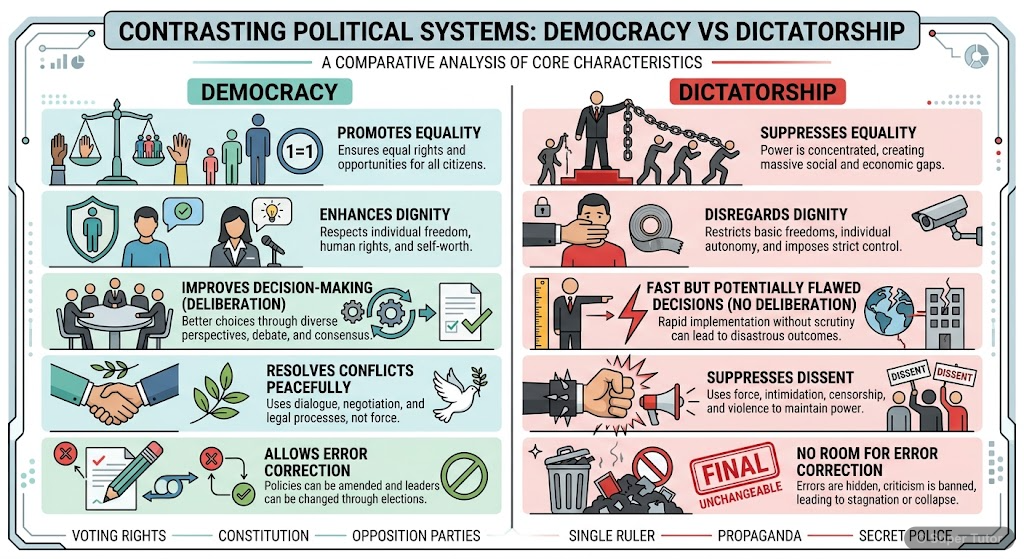
Learn better with visuals Super Tutor pairs illustrations like this with notes and quizzes for Outcomes of Democracy.
Topics in Outcomes of Democracy
1. How to assess democracy's outcomes
- Democracy is better than dictatorship or any other alternative because it promotes equality, dignity, better decision-making, conflict resolution and correction of mistakes.
- More than a hundred countries claim and practice democratic politics, but they differ in social situation, economy and culture.
- Democracy should not be expected to solve every problem automatically; it creates conditions, and citizens must use them.
2. Accountable, responsive and legitimate government
- The most basic outcome of democracy is government that is accountable to citizens and responsive to their needs.
- In democracy, people choose rulers and can control them.
- Democracy is based on deliberation and negotiation, so decisions may take more time.
3. Economic development
- It is reasonable to expect democracy to produce development, but democracy is not a guarantee of economic development.
- Over 1950 to 2000, dictatorships had a slightly higher average economic growth rate than democracies.
- The growth rate was 3.95 for all democratic regimes and 4.42 for all dictatorial regimes.
4. Reduction of inequality and poverty
- Democracy is based on political equality, but economic inequality can still remain very high.
- In South Africa, the top 20% take 64.8% of national income and the bottom 20% get 2.9%.
- In Brazil, the top 20% take 63.0% and the bottom 20% get 2.6%.
Key Concepts
Central concept: Outcomes of Democracy
Work through every topic in Outcomes of Democracy with notes and quizzes
Start This ChapterFrequently Asked Questions
What are the important topics in Outcomes of Democracy for Madhya Pradesh Board Class 10 Social Science?
How should I revise Outcomes of Democracy for the Madhya Pradesh Board Class 10 board exam?
Sources & Official References
Content is aligned to the official syllabus. Refer to the board website for the latest curriculum.
More resources for Outcomes of Democracy
Practice Quiz
Test yourself with a quick quiz
Important Questions
Exam-style questions with answers
Revision Notes
Key points for last-minute revision
Chapter Summary
Understand the chapter at a glance
Concept Maps
See how topics connect
Study Plan
Step-by-step plan for this chapter
Flashcards
Quick-fire cards for active recall
NCERT Solutions
Every textbook question solved step by step
For serious students
Get the full Outcomes of Democracy chapter — start free.
Quizzes, flashcards, an AI doubt solver and a study plan for Madhya Pradesh Board Class 10 Social Science. Free to start, no card needed.