Outcomes of Democracy — NCERT Solutions
Madhya Pradesh Board · Class 10 · Social Science
NCERT Solutions for Outcomes of Democracy, Madhya Pradesh Board Class 10 Social Science: 8 textbook questions solved step by step. Covers Exercises.
Interactive on Super Tutor
Studying Outcomes of Democracy? Get the full interactive chapter.
Quizzes, flashcards, AI doubt-solver and a step-by-step study plan — built for NCERT solutions and more.
Free trial, no card needed.
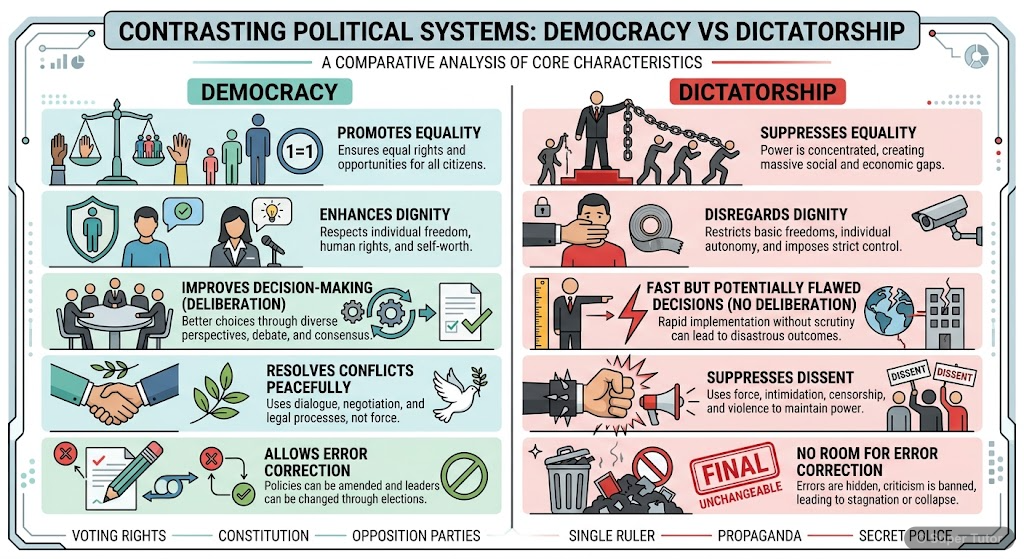
Learn better with visuals Super Tutor pairs illustrations like this with notes and quizzes for Outcomes of Democracy.
The first 4 solutions are open to read. The other 4 are free with a Super Tutor account.
Exercises
1How does democracy produce an accountable, responsive and legitimate government?Show solution
Given/Concept: We need to explain how democracy leads to accountable, responsive, and legitimate governance.
Answer:
1. Accountable Government:
- In a democracy, the government is elected by the people and must answer to them for its actions.
- Regular elections compel rulers to be answerable to citizens. If they fail, they can be voted out of power.
- Institutions such as the legislature, judiciary, and free press keep a check on the executive, ensuring transparency.
- Mechanisms like the Right to Information (RTI) Act allow citizens to demand information from the government, making it accountable.
2. Responsive Government:
- A democratic government has to respond to the needs and demands of its citizens because it depends on their votes.
- Citizens can express their grievances through elections, protests, petitions, and media, and the government is obliged to address them.
- Unlike a dictatorship, a democratic government cannot ignore public opinion for long without facing electoral consequences.
3. Legitimate Government:
- Democracy is based on the principle of free and fair elections, where every adult citizen has the right to vote.
- Because the government is chosen by the people themselves, it enjoys legitimacy — the people accept its authority willingly.
- Even when people disagree with a decision, they accept it as legitimate because the process of decision-making is transparent and participatory.
- People have the right to criticise and change their rulers through peaceful means, which further strengthens legitimacy.
Conclusion: Thus, through regular elections, constitutional checks, and citizen participation, democracy produces a government that is accountable to the people, responsive to their needs, and legitimate in its authority.
2What are the conditions under which democracies accommodate social diversities?Show solution
Given/Concept: We need to identify the conditions that enable democracies to manage and accommodate social diversities (differences of religion, language, caste, ethnicity, etc.).
Answer:
Democracy is the best system to handle social diversities, but only when certain conditions are met:
1. Understanding that Democracy is Not Simply Majority Rule:
- Majority rule must not become permanent majority rule based on religion, race, or language.
- The majority must work with the minority so that the government functions in the interest of all groups.
- Tyranny of the majority over minorities must be prevented.
2. Respect for Minority Rights:
- Every individual and group must have the right to maintain their cultural identity, language, and religion.
- The constitution and laws must protect minority rights so that no group feels excluded.
3. Equal Citizenship:
- All citizens, regardless of their social background, must enjoy equal political rights.
- No group should be treated as second-class citizens.
4. Constitutional Safeguards:
- A written constitution with fundamental rights, independent judiciary, and federal structure helps protect diverse groups.
- Mechanisms like reservations, special representation, and anti-discrimination laws help include marginalised groups.
5. Willingness to Share Power:
- Democracies must be willing to share political power among different social groups.
- Coalition governments and federal arrangements are examples of power-sharing that accommodate diversity.
6. Mutual Trust and Dialogue:
- Social harmony requires that different groups trust each other and resolve conflicts through dialogue rather than violence.
Conclusion: Democracy can successfully accommodate social diversities only when it combines majority rule with minority rights, constitutional protections, equal citizenship, and a spirit of power-sharing and mutual respect.
3Give arguments to support or oppose the following assertions:
(a) Industrialised countries can afford democracy but the poor need dictatorship to become rich.
(b) Democracy can't reduce inequality of incomes between different citizens.
(c) Government in poor countries should spend less on poverty reduction, health, education and spend more on industries and infrastructure.
(d) In democracy all citizens have one vote, which means that there is absence of any domination and conflict.Show solution
(a) Industrialised countries can afford democracy but the poor need dictatorship to become rich.
Opposition (This assertion is WRONG):
- There is no historical evidence that dictatorship leads to economic development. Many dictatorships (e.g., in Africa, Latin America) have kept their countries poor.
- Democratic countries like India, Botswana, and Costa Rica have made significant economic progress.
- Dictatorship concentrates wealth in the hands of a few rulers and their allies, increasing inequality.
- Democracy ensures that economic policies are debated and reflect the needs of the majority, including the poor.
- Poor countries need democracy even more because it ensures that resources are distributed fairly and the government is held accountable for poverty reduction.
- Therefore, the claim that poor countries need dictatorship is not supported by evidence and is fundamentally flawed.
(b) Democracy can't reduce inequality of incomes between different citizens.
Support (This assertion is PARTIALLY CORRECT):
- In practice, democracies have not been very successful in reducing economic inequality. The rich tend to have greater influence over political decisions.
- In many democracies, the top 20% of the population holds a disproportionately large share of national income.
- Economic inequality has actually increased in several democratic countries.
Opposition:
- However, democracy provides the tools — free press, elections, right to organise — through which the poor can demand redistribution.
- Democratic governments have implemented welfare schemes, minimum wage laws, and progressive taxation to reduce inequality.
- The failure to reduce inequality is not a failure of democracy itself but of its incomplete implementation.
Conclusion: The assertion has some truth, but democracy at least provides the mechanisms to address inequality, unlike dictatorship.
(c) Government in poor countries should spend less on poverty reduction, health, education and spend more on industries and infrastructure.
Opposition (This assertion is WRONG):
- Investment in health and education builds human capital, which is essential for industrial growth. A healthy, educated workforce is more productive.
- Neglecting poverty reduction, health, and education creates social unrest, which is harmful for industrial development.
- Infrastructure development is important, but without addressing basic human needs, growth will be unequal and unsustainable.
- Countries like South Korea and China that achieved rapid growth also invested heavily in education and health.
- In a democracy, the government is accountable to the poor majority; ignoring their needs is both morally wrong and politically unsustainable.
- Therefore, spending on social sectors and infrastructure should go hand in hand.
(d) In democracy all citizens have one vote, which means that there is absence of any domination and conflict.
Opposition (This assertion is WRONG):
- One person, one vote ensures political equality, but it does not automatically eliminate social and economic inequalities.
- Dominant groups (based on caste, religion, wealth) can still influence political outcomes through money, media, and social pressure.
- Conflicts based on religion, caste, language, and region continue to exist in democracies.
- Economic domination by the wealthy class continues even in democracies.
- Democracy reduces and manages conflicts through peaceful means, but it does not eliminate them entirely.
- Therefore, political equality (one vote) does not mean the absence of all forms of domination and conflict.
4Identify the challenges to democracy in the following descriptions. Also suggest policy/institutional mechanism to deepen democracy in the given situations:
(a) Following a High Court directive, a temple in Orissa that had separate entry doors for dalits and non-dalits allowed entry for all from the same door.
(b) A large number of farmers are committing suicide in different states of India.
(c) Following an allegation of killing of three civilians in Gandwara in a fake encounter by Jammu and Kashmir police, an enquiry has been ordered.Show solution
(a) Temple with separate entry doors for dalits and non-dalits:
Challenge to Democracy:
- This is a challenge of social inequality and caste-based discrimination.
- It reflects the persistence of untouchability and the denial of equal dignity to dalits, which violates the constitutional principle of equality.
- The fact that a High Court directive was needed shows that social attitudes have not changed despite legal provisions.
Policy/Institutional Mechanisms:
- Strict enforcement of the Protection of Civil Rights Act and the Scheduled Castes and Scheduled Tribes (Prevention of Atrocities) Act.
- Awareness campaigns and social education to change mindsets.
- Community-level sensitisation programmes involving religious leaders.
- Monitoring by local administration and human rights commissions.
(b) Large number of farmers committing suicide:
Challenge to Democracy:
- This is a challenge of economic inequality, government unresponsiveness, and failure of welfare policies.
- It shows that the democratic government has failed to respond to the distress of the farming community — a large and vulnerable section of society.
- It reflects the failure of the government to be responsive to the needs of the poor.
Policy/Institutional Mechanisms:
- Loan waiver schemes and crop insurance programmes for farmers.
- Minimum Support Price (MSP) guaranteed by law.
- Strengthening of rural credit institutions so farmers are not dependent on moneylenders.
- Setting up of a National Farmers' Commission with powers to monitor and address agrarian distress.
- Expansion of irrigation facilities and investment in rural infrastructure.
(c) Alleged fake encounter by Jammu and Kashmir police:
Challenge to Democracy:
- This is a challenge of accountability of security forces and protection of citizens' rights.
- It reflects the misuse of power by the police/security forces and the violation of the right to life.
- It shows that in conflict zones, democratic norms and human rights are often violated.
Policy/Institutional Mechanisms:
- A transparent and independent enquiry by a judicial commission (not an internal police enquiry).
- Repeal or amendment of laws like AFSPA (Armed Forces Special Powers Act) that give excessive powers to security forces without accountability.
- Strengthening of the National Human Rights Commission (NHRC) to investigate such cases.
- Ensuring that those found guilty are prosecuted and punished under ordinary criminal law.
- Setting up of independent oversight bodies to monitor the conduct of security forces.
A. conflicts among people
B. economic inequalities among people
C. differences of opinion about how marginalised sections are to be treated
D. the idea of political inequality
Free with a Super Tutor account
A. free and fair elections
B. dignity of the individual
C. majority rule
D. equal treatment before law
Free with a Super Tutor account
A. democracy and development go together.
B. inequalities exist in democracies.
C. inequalities do not exist under dictatorship.
D. dictatorship is better than democracy.
Free with a Super Tutor account
Free with a Super Tutor account
4 more solved questions in Outcomes of Democracy
They are free with a Super Tutor account, along with practice quizzes and flashcards for this chapter. Free to start, no card needed.
Frequently Asked Questions
What are the important topics in Outcomes of Democracy for Madhya Pradesh Board Class 10 Social Science?
Are these NCERT Solutions for Outcomes of Democracy free?
How should I revise Outcomes of Democracy for the Madhya Pradesh Board Class 10 board exam?
Sources & Official References
Content is aligned to the official syllabus. Refer to the board website for the latest curriculum.
More resources for Outcomes of Democracy
Practice Quiz
Test yourself with a quick quiz
Important Questions
Exam-style questions with answers
Revision Notes
Key points for last-minute revision
Chapter Summary
Understand the chapter at a glance
Concept Maps
See how topics connect
Study Plan
Step-by-step plan for this chapter
Flashcards
Quick-fire cards for active recall
Syllabus
What topics to cover
For serious students
Get the full Outcomes of Democracy chapter — start free.
Quizzes, flashcards, an AI doubt solver and a study plan for Madhya Pradesh Board Class 10 Social Science. Free to start, no card needed.