Outcomes of Democracy — Chapter Summary
Madhya Pradesh Board · Class 10 · Social Science
Summary of Outcomes of Democracy for Madhya Pradesh Board Class 10 Social Science. Part of the Madhya Pradesh Board Class 10 Social Science syllabus.
Interactive on Super Tutor
Studying Outcomes of Democracy? Get the full interactive chapter.
Quizzes, flashcards, AI doubt-solver and a step-by-step study plan — built for chapter summary and more.
Free trial, no card needed.
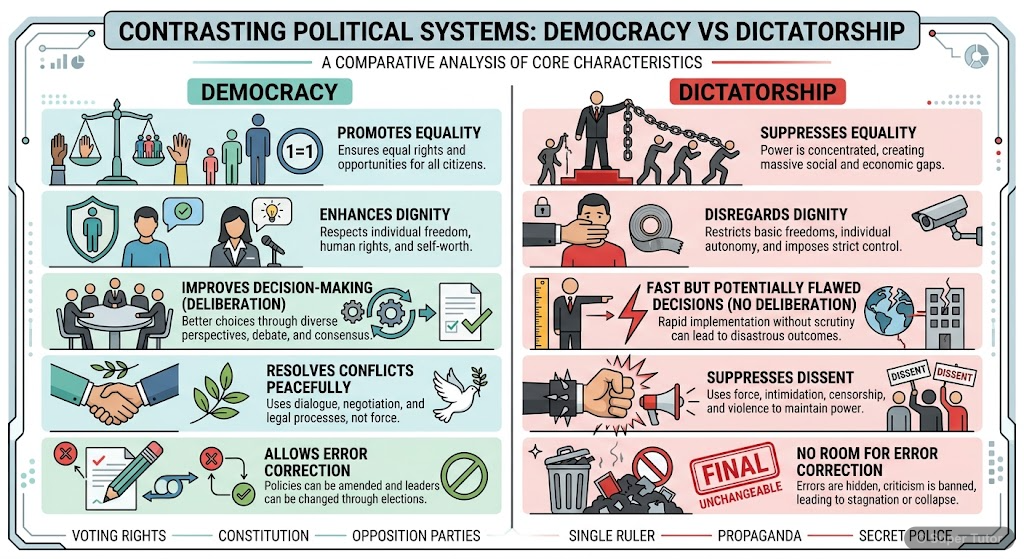
Learn better with visuals Super Tutor pairs illustrations like this with notes and quizzes for Outcomes of Democracy.
Overview
Democracy is a form of government that can only create conditions for achieving good outcomes; citizens must use those conditions well. Its value is judged by its results in government quality, economic development, equality, social harmony, dignity, and freedom. Democratic systems across the world
Key Concepts
Democracy is not a guarantee
Democracy is not a guarantee of every good result. It creates conditions for good government, but citizens and institutions must use those conditions
A democratic government should be accountable
A democratic government should be accountable to citizens, respond to their needs, and remain legitimate because it is chosen by the people.
Transparency means a citizen has
Transparency means a citizen has the right and means to examine whether a decision was taken through correct procedures.
Non
Non-democratic rulers can take quick decisions because they do not need public debate or assemblies. Democratic governments take more time because the
Democracy is not a guarantee
Democracy is not a guarantee of faster economic growth. Over 1950–2000, dictatorships had a slightly higher average growth rate than democracies, thou
Learning Objectives
- Understand how democracy is assessed through its outcomes.
- Explain why accountability, transparency, and legitimacy are important results of democracy.
- Compare democratic and non-democratic governments in decision-making and public accountability.
- Evaluate democracy’s record in economic growth, inequality, and poverty reduction.
- Understand how democracy helps manage social diversity and conflict.
Frequently Asked Questions
What are the important topics in Outcomes of Democracy for Madhya Pradesh Board Class 10 Social Science?
How should I revise Outcomes of Democracy for the Madhya Pradesh Board Class 10 board exam?
Sources & Official References
Content is aligned to the official syllabus. Refer to the board website for the latest curriculum.
More resources for Outcomes of Democracy
Practice Quiz
Test yourself with a quick quiz
Important Questions
Exam-style questions with answers
Revision Notes
Key points for last-minute revision
Concept Maps
See how topics connect
Study Plan
Step-by-step plan for this chapter
Flashcards
Quick-fire cards for active recall
Syllabus
What topics to cover
NCERT Solutions
Every textbook question solved step by step
For serious students
Get the full Outcomes of Democracy chapter — start free.
Quizzes, flashcards, an AI doubt solver and a study plan for Madhya Pradesh Board Class 10 Social Science. Free to start, no card needed.